
AI is forcing a collision between industries on radically different clocks: Hyperscale data centers can be planned and deployed in a matter of years, while new nuclear power plants often take a decade or more to license, finance and build.
Large AI systems require dense chip clusters, cooling equipment, backup systems and reliable transmission with little tolerance for interruption. Wind, solar, batteries and natural gas are all part of the power mix, but nuclear offers high-output, carbon-free generation around the clock.
The current U.S. fleet already demonstrates that profile, with 90+ reactors across 57 plants and capacity factors exceeding 90%. The dozens of startups developing small modular reactors (SMRs) and fusion systems argue AI’s growing electricity demand plays directly to nuclear’s strengths: reliable baseload generation and designs intended to be more repeatable than the bespoke megaprojects that historically defined the industry.
Google, Meta, Amazon and other hyperscalers are now backing that premise through investments and power purchase agreements (PPAs), from advanced fission systems nearing commercialization to fusion concepts that remain technically ambitious but are attracting major customers.
AI demand meets grid reality
Nuclear's technical appeal starts with its extraordinary density. "The pure technological advantage in the amount of energy per unit of fuel is amazing," said Keith Drudy, Studsvik Americas COO and a 24-year industry veteran who worked on the last major U.S. nuclear expansion project, helping add roughly 2.2 GW of capacity at Georgia's Plant Vogtle through two Westinghouse AP1000 reactors. "Data centers need rock solid reliability for their power source, and you just cannot get that practically and at the scale needed from other clean energy sources," Drudy said.
“There's a lot of momentum in the data center boom, and the promise of these centers enabling AI and other technology advances isn’t going to just vanish," Drudy added. "That said, they’re definitely wanting to move faster than anyone can accommodate.”
That pressure is forcing developers, suppliers and utilities to adapt together. As advanced nuclear companies navigate licensing and regulatory reviews, they must also secure fuel, manufacturing capacity, project sites and customers years before reactors enter service.
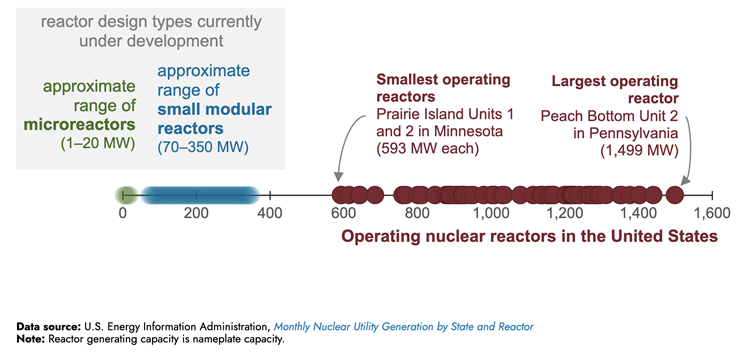 Generating capacity of U.S. nuclear reactors, as of March 2026. Source: EIA
Understanding the contenders: SMRs versus conventional reactors
Not every path to powering AI data centers involves a fundamentally new reactor concept. The most realistic near-term option may be building more large reactors based on existing designs.
Plant Vogtle's AP1000 expansion, completed in 2024, serves as both a cautionary tale and a potential blueprint for future projects. Although the two units entered service about seven years late and cost more than double the original $14 billion estimate, Drudy notes they were first-of-a-kind builds that began construction before the design was complete, and they still produced valuable lessons.
"I'm confident that any repeat build of that plant would be substantially less risky in both expense and timeline than the flagship units," Drudy said. While AP1000 plants may be harder to finance and build than SMRs, he added, "I honestly believe these will be the most likely to be built on budget and schedule."
Still, much of the industry's activity is centered on SMRs, which seek to lower construction costs and project risk through smaller, standardized designs. Most target a few hundred megawatts or less, compared with 550 MW to 1.5 GW for conventional reactors.
NuScale (with the NuScale Power Module), Holtec (SMR-300), GE Vernova Hitachi (BWRX-300) and Westinghouse (AP300) are standardized light-water reactor designs intended to simplify construction and operation relative to large conventional nuclear builds. Several are advancing through utility-led projects and licensing efforts in North America and Europe, targeting first deployments around 2030 or in the early 2030s.
Although light-water SMRs are behind AP1000 in design maturity, they could use similar supply chains and fewer resources per plant, potentially converging “on 'nth of a kind' faster because of the scale," Drudy said.
Other companies are exploring non-light-water reactors, using alternative fuels and coolants to improve efficiency, safety or add new capabilities not practical in light-water designs. Examples include TerraPower's sodium-cooled fast reactor Natrium (2.8-GW Meta deal, with initial delivery around 2032), Kairos Power's fluoride salt-cooled Hermes technology (500-MW Google deal, starting around 2030), and X-energy's high-temperature gas-cooled Xe-100 (drawing Amazon's support to bring over 5 GW online by 2039).
 A rendering of Oklo's Aurora Powerhouse facility. Source: Oklo
Among the larger proposed non-light-water deployments is Oklo's recent agreement with Meta, envisioning a 1.2-GW Ohio campus powered by its Aurora sodium-cooled fast reactor, with a first phase targeted for 2030 and full delivery by 2034. Oklo is also developing an Aurora Powerhouse pilot project at Idaho National Laboratory, positioned as a first test of the company’s fast-reactor model.
Sodium coolant enables low-pressure operation and high outlet temperatures, which can reduce pressure-related complexity and support higher thermal efficiency, according to Bonita Chester, Oklo’s head of media and communications.
"Aurora’s fast-neutron spectrum and metal fuel also provide fuel-cycle flexibility beyond conventional light-water systems, with the potential for longer operating cycles in some configurations," Chester added. The design incorporates passive safety, including inherent physics and passive heat removal.
The tradeoff is that sodium-cooled fast reactors are less familiar than light-water designs and require different suppliers and regulatory pathways. Chester said Oklo is addressing this by integrating reactor design, fuel fabrication, recycling, licensing and plant operations.
Oklo plans to build, own and operate plants while selling electricity directly to customers. Its Meta agreement also includes a prepayment mechanism intended to reduce deployment risk and support procurement of long-lead items.
Fusion's new pitch
Beyond advanced fission lies an even more ambitious proposition: fusion, which combines light atomic nuclei rather than splitting heavy atoms. If commercialized, it could provide carbon-free electricity without the same long-lived radioactive waste profile as fission.
"The promise is almost immeasurable, and we've been chasing the dream for decades," Drudy said. "Recent advances have brought the science to the verge of success: getting more power from fusion than it takes to make it happen."
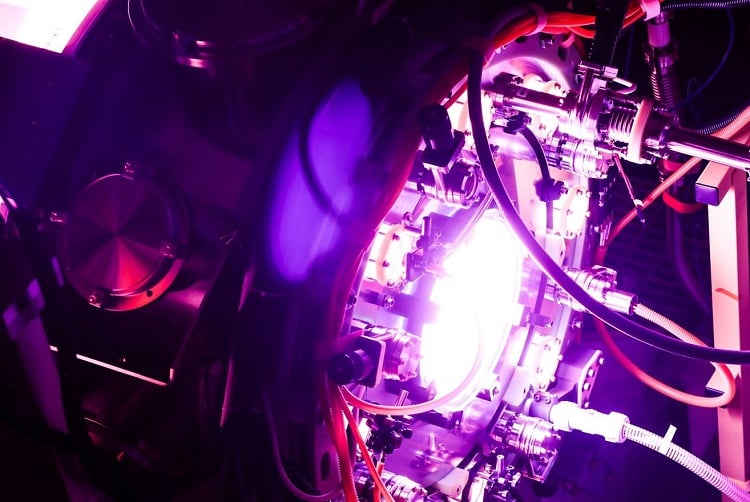 Fusion startup Helion Energy has landed deals with Microsoft and Nucor. Source: Helion
Fusion is already moving toward commercialization, with early projects targeted for the late-2020s and 2030s. Commonwealth Fusion Systems has signed PPAs over its tokamak-based ARC project, including a 200-MW offtake agreement with Google and a separate $1 billion-plus deal with Eni. Type One Energy inked deals with the Tennessee Valley Authority for its 350-MW Infinity Two stellarator plant and recently submitted an initial licensing application for the project, while TAE Technologies has reported advances in its field-reversed configuration approach.
Helion Energy aims to begin supplying power to Microsoft from its planned 50-MW Orion facility in Washington in 2028. A separate arrangement with steelmaker Nucor envisions a larger 500-MW deployment in the 2030s. Helion's pulsed fusion design directly captures electricity from the reaction itself, reducing the need for intermediate energy conversion, said Manav Singh, Helion’s director of electrical engineering.
"Because Helion’s machines don't have to achieve and sustain ignition, they can be smaller and require fewer exotic materials, which makes them more affordable to build and operate," Singh added. "They're also highly efficient in terms of how much electricity they produce relative to the amount of fusion they create."
Singh said a major priority is continuing to operate Helion's seventh-generation Polaris prototype while using subsystem testbeds to gather data on direct electricity recovery, circuit efficiency, thermal performance and component life, with the results informing Orion's development.
Different technologies, similar obstacles
Two concerns keep Drudy up at night: skilled labor and supply chains.
New nuclear construction still depends on skilled trades — steelworkers, pipefitters, welders and electricians — working to exacting safety standards and quality requirements.
At Vogtle, maintaining staffing required recruiting skilled workers nationwide. "It was hard to maintain the skill levels needed for that one large project," Drudy said. "Imagining doing that with several to dozens of build projects across the country will be a major challenge."
Reactors also require specialized metal forgings, pumps, electrical equipment, fuel and other nuclear-grade materials more difficult to source than conventional industrial hardware.
Drudy said Westinghouse spent years restarting supply chains for what he described as "specialty nuclear commodities" to support the AP1000 program. "Unfortunately, we only built two in the U.S., so some of those suppliers have already gone into hibernation or shut down altogether," he added.
Drudy said the industry is moving toward standardized reactor designs and supplier components to reduce supply chain complexity and support long-term operation for the next 60 to 100 years.
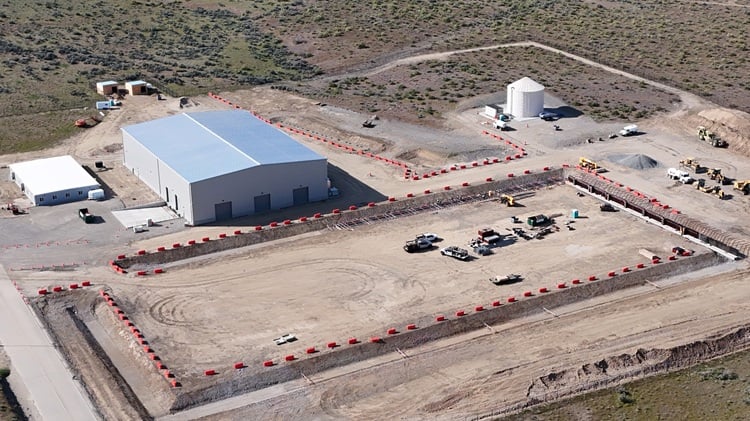 Orion construction in Washington. Source: Helion
Oklo is planning around similar constraints. Chester said that although repeatability is built into the design strategy, scaling up manufacturing still requires a qualified supplier base, nuclear-grade quality systems, trained craft labor and operators, and a fuel supply chain supporting serial deployment. The company is pursuing a multi-path fuel strategy while addressing those constraints in parallel.
Fusion adds another layer of complexity. Singh cited three engineering challenges, one being circuit efficiency — improving high-voltage switching and reducing losses across transmission lines and magnets. “Since we recover most of our input energy in each pulse, the amount of fusion energy we need is primarily determined by what it takes to overcome electrical losses,” Singh explained. Every increase in electrical efficiency reduces the machine's required scale.
Commercial fusion plants must also pulse continuously, heating cables, coils and other components. Hotter metals become less conductive, which increases losses and reduces efficiency as any heat-rejection systems also consume additional energy. Singh said Helion is designing its systems to maintain high efficiency even at elevated operating temperatures.
Helion also needs to scale the production of capacitor banks, electromagnets, power and control electronics, and other hardware while maintaining strict quality standards. Singh said the company is expanding its engineering and manufacturing teams, including new production lines and vertical integration.
Drudy expects advanced fission to arrive before fusion, as significant engineering challenges remain between scientific progress and commercial deployment. "These problems are solvable, but I personally think we might be a little too ambitious on the final timeline," he said.
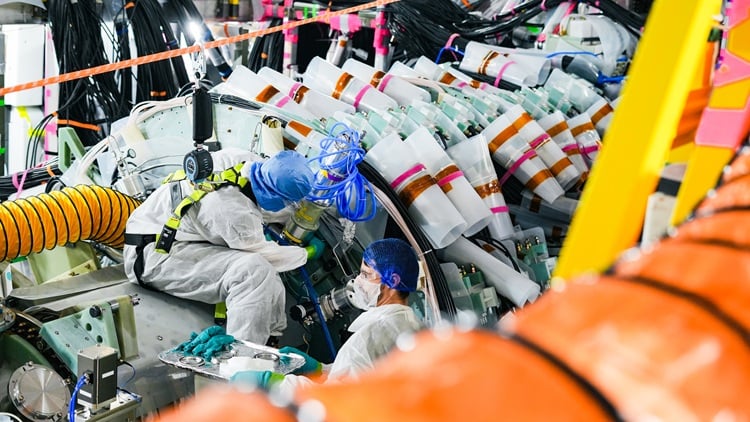 Helion engineers install a Polaris module. Source: Helion
Can advanced nuclear arrive fast enough?
Whether the fastest solution is advanced fission or fusion, the next test is moving from promising concepts to repeatable construction while rebuilding the workforce, manufacturing base and supply chains needed to support industry-wide growth.
"The interesting thing is, the challenges with individual plants and their technologies are lower tier in my mind," Drudy said. "Being ready to build and make things in a post-industrial nation is both our biggest challenge and possibly our biggest opportunity."
Editor’s note: Meta, Microsoft, Amazon and Google DeepMind did not make spokespeople available or provide additional comment for this article at the time of reporting.

