

Key takeaways:
- Companies are betting that moving AI computing into orbit can ease the strain on Earth’s power, water and land.
- SpaceX, Blue Origin, Google and Nvidia are all exploring it, alongside startups like Starcloud, Sophia Space, Lonestar and Cowboy Space.
- Orbit offers near-continuous sunlight, but there’s no air or water cooling. Heat has to be radiated into space, so thermal design has to start on day one.
Companies are betting that the fix for AI's power appetite is to go off-planet. Moving AI infrastructure into orbit could sidestep some of the strain AI is putting on Earth's power, water and land. Estimates suggest U.S. data centers could consume 12% of the country’s electricity by 2028 and around 20% by 2035. Orbital systems could instead draw on near-continuous sunlight in suitable orbits and process space-generated data before sending results to Earth.
But leaving Earth also means leaving behind grid power, air or water cooling, high-capacity networks and on-site technicians in server rooms. In orbit, hardware must shed heat through large radiators, survive launch and radiation, and keep running with few chances for repair. Thermal control, shielding and structure also compete with computing hardware for limited launch capacity.
Computers have flown in orbit for decades. What's new is making thousands of processors work as reliable, AI-ready infrastructure. That requires clearing four linked problems: managing heat, making distributed hardware behave like one computer, manufacturing and launching at scale, and delivering a reliable service.
Large companies are already exploring the idea. SpaceX has filed plans with the Federal Communications Commission (FCC) seeking permission to launch a megaconstellation of up to 1 million solar-powered satellites for AI data processing, while Blue Origin has proposed Project Sunrise, outlining a massive orbital data center constellation that could scale up to 51,600 sun-synchronous satellites. Google is moving toward hardware tests. Its Project Suncatcher plans to fly tensor processing unis (TPUs) in orbit, followed by a 2027 test of high-bandwidth optical links between satellites. Nvidia is also working with several startups to send its agentic-AI platform, Vera Rubin, to low Earth orbit (LEO).
Among startups, Starcloud launched a data-center-grade GPU in 2025 and later trained what it said was the first LLM in space. Orbital has filed with the FCC for a network of 100,000 orbital data centers. Cowboy Space has filed an FCC application to deploy up to 20,000 satellites for its Stampede constellation, targeting 2028. It plans to launch its first satellite later in 2026 to demonstrate space-to-Earth power beaming.
Space-based data centers could become practical at large scale within the next five to 10 years, but cost parity will be harder. Estimates for gigawatt-scale orbital systems range widely from $51 billion to $170 billion, compared with about $16 billion to $38 billion on Earth. They now cost roughly 2.5 to 3 times as much as comparable facilities on Earth, according to Boston Consulting Group (BCG). Falling launch costs, lighter satellites and design improvements could narrow that gap to about 1.5 times over the next decade.
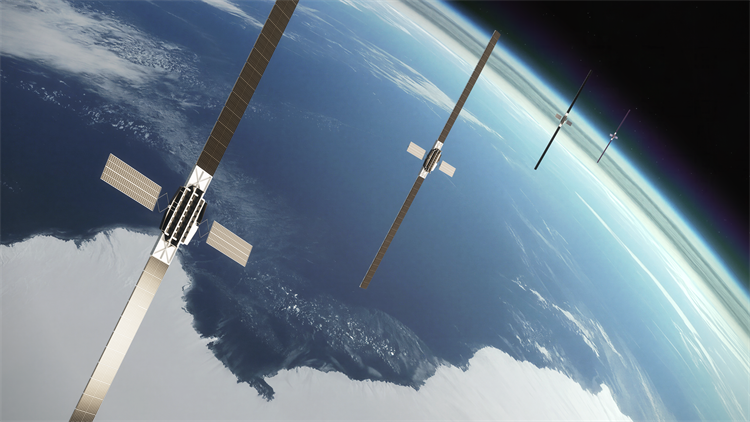 Sophia Space plans to deploy a 10-satellite computing constellation with launches beginning in 2028. Source: Sophia Space
How to cool computers in a space vacuum
The first constraint is basic physics. "There's no convective cooling in space, so managing heat has to be designed in from day one," said Joseph Yaffe, Cowboy Space's COO and CLO. Terrestrial facilities can carry waste heat away with air or liquid coolant. In vacuum, the system ultimately has to move that heat to radiator surfaces and emit it as thermal radiation.
Solar power, at least, works in orbit's favor. "The right orbital architecture can provide near-continuous exposure. This gives space-based infrastructure the potential to harness solar energy at the scale AI demands," Yaffe said. That advantage depends on orbit: Periods in Earth’s shadow require enough stored energy to keep high-power compute running.
Heat rejection, limited launch mass and eclipse periods all have to be designed in from the start. "One of the mistakes you can make in designing compute infrastructure for space is starting with a terrestrial data center and trying to adapt it for orbit," said Sophia Space CEO and co-founder Rob DeMillo.
The trade-off is lower power density than a typical terrestrial data center, in exchange for passive heat rejection, fewer moving parts, more predictable thermal behavior and scalability through modular design. "The objective isn't to maximize compute density at any cost," DeMillo said. "It is to deliver useful, reliable compute in an environment where there is no cooling water, no conventional HVAC system, and no technician who can walk down the aisle and replace a failed component."
Sophia's design uses modular Thermal Integrated LEO Edge (TILE) units that cool passively by radiation. Each TILE is a grid of compute blades, four in the current configuration, connected by thermal pathways to radiating surfaces that reject heat to space. Rather than concentrating heat and moving it to a central cooling plant, the design rejects heat near the components that produce it.
Thousands of computers in space acting as one
"The system has to behave as a distributed computer," said DeMillo. "Individual blades and TILEs need to discover one another, communicate, handle faults and continue operating without depending upon continuous intervention from the ground." Sophia pairs its hardware with Sophia Orbital Operating System (SOOS), its distributed software platform.
Lonestar Data Holdings, which has taken data storage and processing from LEO toward the moon, has run into a systems problem. Founder and executive chairman Christopher Stott said the hardest part isn't necessarily the storage device or processor but the system around it. The company began with experiments aboard the International Space Station in 2021 and 2022, then flew on lunar missions, including one carrying an 8-terabyte data center payload.
The most useful lesson so far, Stott said, is that "designing for graceful degradation and autonomy is more important than designing for theoretical peak performance."
Cowboy is also designing its launch vehicle, upper stage and orbital compute platform as one integrated system for AI infrastructure in LEO. Each rocket’s upper stage is designed to stay in orbit as a 1 MW data center. "Most systems treat the rocket as transport and the data center as payload, but we started with a blank sheet and designed them as a single vehicle," said Yaffe. The integrated approach reduces redundant mass and gives more control over launch economics, deployment cadence and compute delivered to orbit.
Building around the data: Storage first, compute second
Storage is a comparatively low-power entry point, and data can stay physically isolated until needed. "Compute becomes more interesting when you bring the computation to the data rather than continuously moving enormous datasets between Earth and space," Stott said. "That is one reason we see AI inference as a natural progression for us."
Lonestar's StarVault payloads combine high-density solid-state storage, onboard compute and secure communications. The modular design lets a StarVault fly as a hosted payload on another spacecraft or, eventually, on dedicated Lonestar satellites. This allows the company to scale without building a full constellation first, Stott said.
After four missions demonstrating storage and processing in space, Lonestar wants to grow capacity from terabytes toward petabytes and eventually exabytes, while also increasing communications bandwidth and compute. Stott said that will require "continued work on radiation tolerance, thermal management, power efficiency, optical and RF communications, autonomous operations, intersatellite networking, and increasingly sophisticated onboard inference."
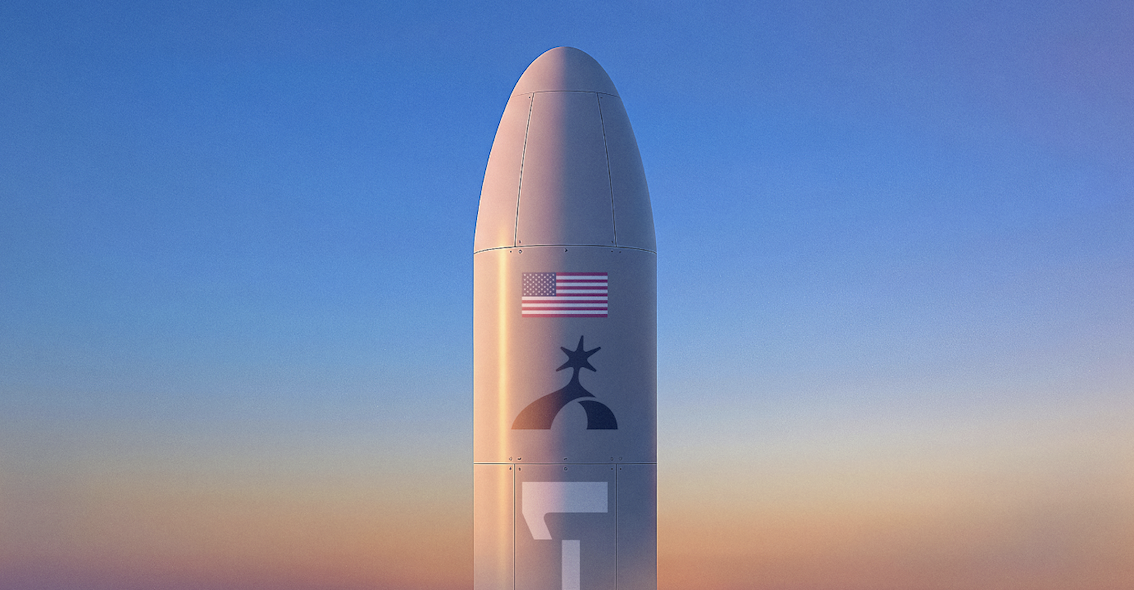 A rendering of Cowboy Space's rocket head. The startup is working to build engines for data centers in space. Source: Cowboy Space
Future tests in orbit
For Cowboy Space, the next challenge is "validating the integrated system — from power and thermal management to compute and optical communications — and then demonstrating that we can manufacture and launch at scale," Yaffe said. The company recently opened an industrial facility in Kent, Washington, where it will build its solar systems and rocket engines.
Lonestar expects commercial StarVault deployments in 2027. Its immediate goal is an end-to-end service: customer data travels through terrestrial networks and private communications infrastructure to an orbital StarVault, is stored and processed securely, and returns correctly on request.
Stott said technical success would start with launching, commissioning and powering the spacecraft and payload, while maintaining storage integrity. Next is communications, establishing a repeatable secure uplink and downlink through ground infrastructure and the ability to manage the system across normal orbital contact windows. Third is data integrity and security: "Encryption, identity, key management, and customer separation all have to work exactly as designed," he added. Finally, the system must show meaningful onboard processing and AI inference, not just storage.
Sophia Space aims to move TILE from ground validation to orbit in 2027, testing thermal and compute performance, power, communications, autonomous operation and hardware-software integration under real orbital conditions. Its larger 10-satellite constellation is planned for 2028.
"We're demonstrating the building blocks of an orbital computing infrastructure, including running the kinds of applications that customers ultimately intend to deploy," DeMillo said. "For us, that's the distinction between putting compute hardware in orbit and beginning to build an orbital data center."
