
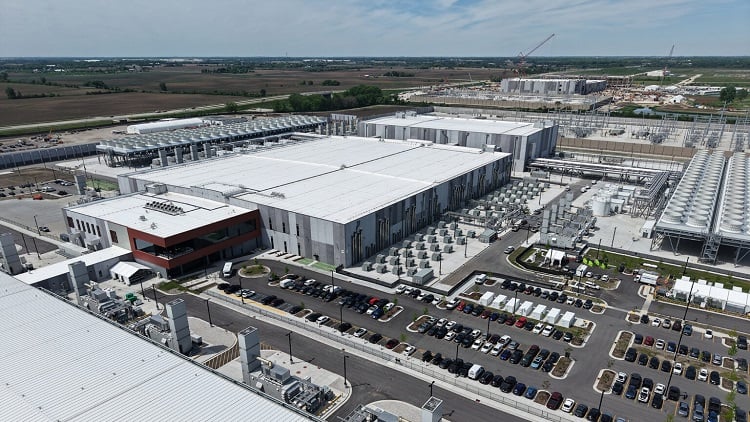
According to data from market research firm TrendForce, artificial intelligence (AI) servers are projected to surpass general-purpose servers in total electricity consumption in 2026 due to significantly higher power consumption per unit.
The theoretical shift in the electricity grid to hyperscale data centers occupying the largest electricity demand isn’t just on the horizon, it is happening now.
And the grid just isn’t ready for it.
TrendForce sees two bottlenecks in AI data center electricity demand: transmission and long lead times. Several regional transmission organizations are working with governments to accelerate grid interconnection processes for large-scale data center projects as some of these queues are now exceeding five years.
Meanwhile, the average lead time for large power transformers has extended to about 2.5 years and transformers in the 345 kV to 765 kV voltage class require about four to five years, TrendForce said. This is about double the lead times seen just six years ago in 2020.
Sustained AI demand is likely to continue to drive global data center growth with total installed power capacity expected to reach about 155 GW in 2026. Further jumps in electricity demand are expected in 2027-2028 as platforms like Nvidia’s GB300/Rubin and ASIC-based AI servers enter mass production, TrendForce told GlobalSpec.
How much power, exactly?
TrendForce’s data is backed up by research from Southeast Missouri State University, which forecasts global data center consumption to double or even triple by 2030, up from 200 TWh in 2020.
A single AI server demands between 2 kW and 20 kW of power. With even small data centers having hundreds or thousands of servers, this is a whopping amount of electricity needed for just one small data center, let alone large-scale hyperscale facilities which could take 100 MW of power.
This is the type of power that could be used by 80,000 people including all the residential, commercial and industrial usage, said Brad Deken, chair of engineering and technology at Southeast Missouri State University.
“On the smaller scale, a 2 MW data center would be on the same scale as a large hospital or manufacturing facility,” Deken said.
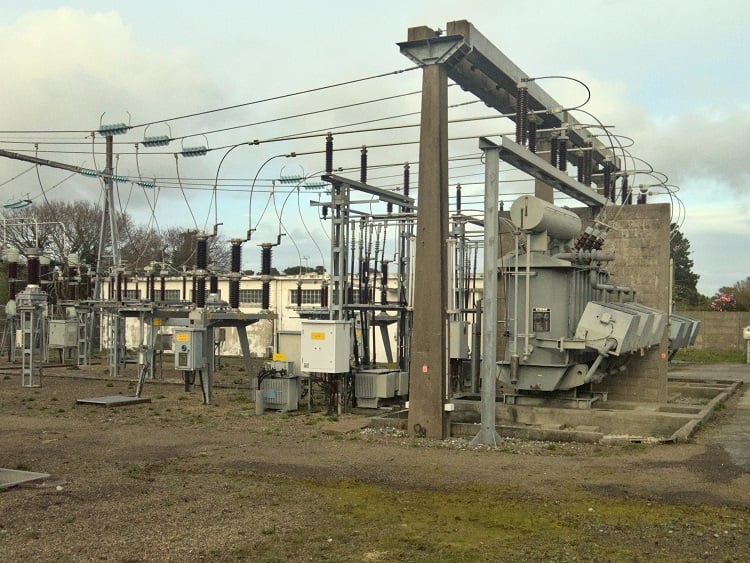 Many electrical transformer substations are 50 to 100 years old and are either incompatible with newer technology or cannot handle the sustained stress of the amount of electricity needed for AI data centers. Source: PtiBzh/Wikimedia CC0 1.0 Universal
The grid wasn’t built for this
Utilities plan power demand years in advance, and when a hyperscaler decides to put an AI data center in a town, it can create chaos as electricity generation can’t simply be added overnight. And with the bottlenecks in lead times and transmission hindering electricity expansion, the grid is severely strained.
Additionally, there is the issue of stability when there is such large usage of power. International regulatory organization North American Electric Reliability Council (NERC) has started ringing the alarm bells, issuing a level 3 alert regarding AI data centers, their highest urgency notification signifying immediate threats.
“When you turn off or on a 100 MW load, it isn’t as simple as a light bulb,” Deken said. “These changes can cause large voltage spikes or voltage reductions that can cause brownouts or blackouts.”
Deken said in the past 10 years, there have only been three NERC level 3 alerts all due to winter weather issues.
According to Dale Crawford, executive director of the Steel Tube Institute, AI data center construction is advancing at a pace that is outstripping the industry’s ability to build deep, shared expertise across design, installation and inspection in the electricity grid.
“Many systems being deployed in today’s data centers are fundamentally more complex, larger, and denser than what the industry may have routinely encountered, creating both an infrastructure gap and an expertise gap,” Crawford said. “That’s why continuous, structured education and clearer communication across the industry are so important.”
The bridge argument
But not everyone sees the grid as a one-way slide. Daren Shumate, founder and managing principal of Shumate Engineering, a Virginia-based firm that designs mechanical and electrical systems for data centers, argues the current pain the grid is facing is temporary and by design.
The bridge is power plants built at the data center to buy time for utilities to catch up to building enough power for the data centers and the communities.
"No data center developer actually wants to run permanently on their own power — they want to be on the grid,” Shumate told Globalspec. “So, they self-generate until the utility can build out generation and transmission, which might take five to seven years. Eventually, some of these developer-built power plants get handed over to the utility to run and use to back up the grid. The net effect of all these data centers isn't higher prices — it's a more resilient, more reliable grid. That's just a fact."
And there is a concrete example of this already underway. Chevron and Microsoft signed a 20 year deal in June of 2026 to build a 2.67-gigawatt natural gas plant in Reeves County, Texas. Called Project Kilby, the plant will power Microsoft’s Texas data center, and it won’t be connected to the grid when it first comes online.
According to Chevron, when the plant produces excess power, it will push it to the grid to help stabilize it.
Project Kilby falls into Texas’ regulatory guardrails around data centers. Texas Senate Bill 6, which was signed into law in June of 2025, requires large electricity users of 75 megawatts or more to disclose any on-site backup generation to their utility and to the state’s grid operator, ERCOT. Additionally, the bill requires equipment that lets ERCOT curtail or disconnect the large loads during grid emergencies. As a result, large battery storage is becoming the norm at data centers.
“What we're deploying in our data centers is a 34,500-volt battery system — a 300-megawatt building gets a 300-megawatt battery, about 100 boxes at three megawatts each,” Shumate said. “It's crazy expensive, but it's required in Texas and it's baked into the financial pro forma of the deal. If there's a real need to take that load off the grid, they can do it — for about an hour, an hour and ten, an hour and thirty minutes. That sounds small, but if it's 112 degrees at 2 p.m. and you take the load off for a couple of hours, by six o'clock it's down to 102 and you turn it back on, everything's fine, and the grid survives."
Shumate said the data center developers are eating the costs of these battery storage systems and are not raising rates. The utility is not paying for any of it either, so they aren’t passing it off to consumers, he said.
Until these new power bridges are put in place, the grid will continue to be strained where new data centers are emerging.
Utilities are already stretched
According to Deken, it is a minor miracle that the aging electrical gird is doing as well as it has so far in the hyperscale era. The grid was strained prior to the surge in AI data centers, and it is only getting worse, he said.
“A lot of the places where we are currently building data centers didn’t even have electricity 100 years ago,” Deken said.
Most utilities operate on tight margins already as it is not feasible economically to generate electricity that goes underutilized. Of course, there is some excess power available, but generally power carrying capabilities of the transmission lines are often near capacity, so often when extreme weather occurs — like air conditioners running full blast — the grid is pushed to the limit. And this is without data centers.
“The grid is not one thing,” Deken said. “It is millions of interconnected lines and devices. Some of those things are 50-100 years old and some are the newest technology. Just like you’d have a hard time running a modern operating system on a computer from the 80s, you are going to have things that just aren’t compatible.”
Who actually pays?
While the electrical infrastructure has long needed new investment, data centers have made a troubling situation worse. And it is likely that residential prices will continue to rise.
What is making matters worse is that in some regions, data centers are getting a much better deal than the average consumer on electricity. Small towns with residential wells are running dry because of data center construction, Deken said.
“I think, and hope, some of that is starting to change,” Deken said. “However, until we get policies that force that cost onto the data center it will likely continue to be an issue.”
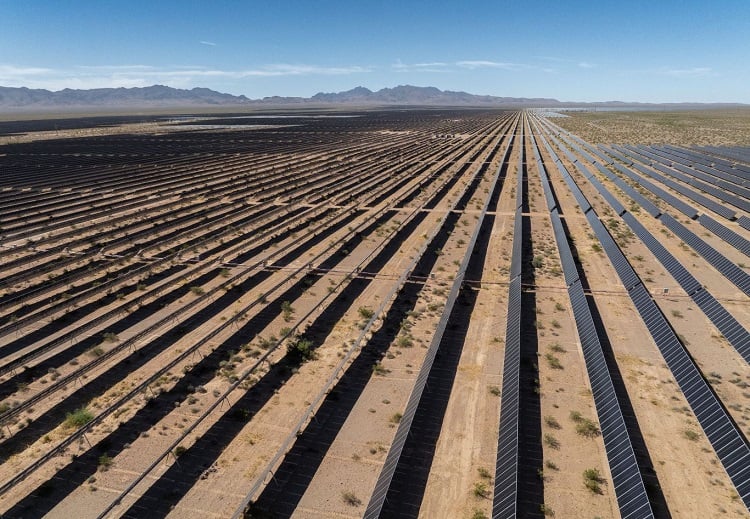 Gemini Solar project is the largest solar farm in the U.S. at 690 MW, located in Clark, Nevada. This facility could power only about seven AI data centers, indicating how much electrical demand these data centers will occupy in the coming years. Source: Primergy
Is "green" real?
Some of these policies could include investment in renewable energies like solar and wind as well as smarter approaches to cooling, heat recovery and optimization of the systems.
But even the most efficient systems require energy needs.
“I know a lot of companies talk about offsetting their usage with carbon credits or similar methods; however, the evidence of the actual effect of these offsets is shaky at best,” Deken said.
Deken added a 100 MW of power in a modern, industrial solar farm would be about 500 acres of land — about the size of an average U.S. farm — just to offset one AI data center facility.
“I’m certainly not saying that data centers shouldn’t use solar or other renewables to offset, but it is important to understand the true costs of what we are building,” he said. “It is nice to see communities gaining an understanding of just how important, and frankly fragile, many of our utilities are. It’s just too bad its because of people being so negatively affected.”
Crawford said there are real efforts underway around renewables and other energy sources, but the industry is also dealing with practical constraints around availability, timing and infrastructure.
“Whether people are talking about renewables, natural gas, nuclear, the core challenge remains the same: stakeholders need a strong, shared understanding to ensure they are implemented and evaluated as intended,” Crawford said. “Without that, the risk is not just delay, but inconsistency in how systems are installed and inspected.”
Conclusion
Luckily, the grid is capable of being upgraded with the right investment, but it will take a level of cooperation and investment on the scale of the rural electrification that occurred in the 30s and 40s to do it, Deken said.

