
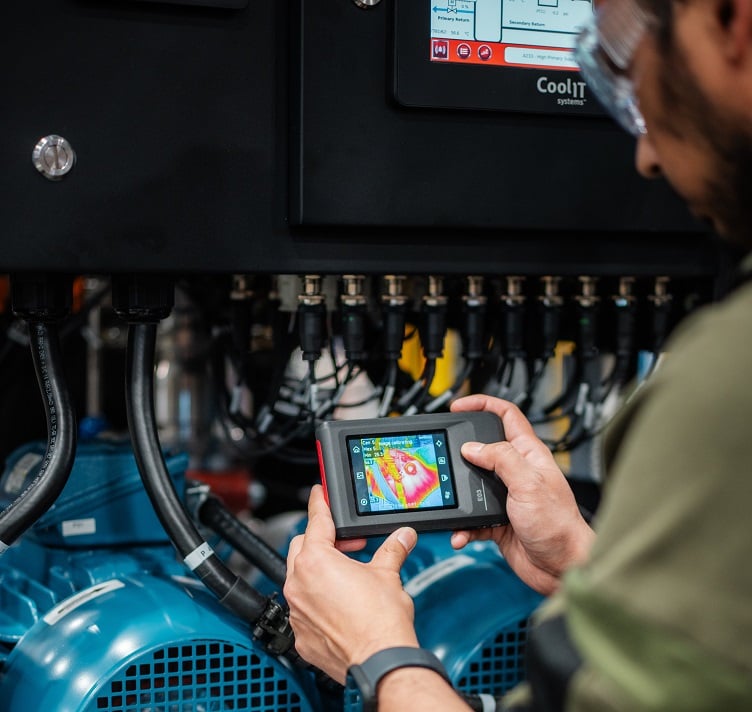
In July 2026, St. Paul, Minnesota-based Ecolab closed its acquisition of Canadian liquid-cooling vendor CoolIT Systems for $4.75 billion.
The combination of Ecolab’s coolant technology with CoolIT’s cooling hardware and infrastructure will allow the company to offer a complete solution for AI data center cooling.
And, according to Bob Walicki, senior research, development and engineering (RD&E) program leader at Ecolab, these solutions could prove important in the ongoing scrutiny that AI data centers are coming under from construction through resource use.
“There's a common misconception that data centers, like fabs, generate hazardous industrial wastewater,” Walicki said. “In reality, water circulated through a data center cooling system is similar in composition to water used in any commercial building, and it can typically be discharged into a standard municipal sewer for treatment.”
Walicki said this is part of a healthy conversation to have with the public and government if it is grounded in accurate information about how these systems actually operate.
Walicki sat down with Electronics360 to discuss challenges in direct-to-chip (D2C) cooling technology, including contamination and debris in the system; the race to develop standards in data center cooling; and the introduction of a cooling platform in November 2026 that will combine CoolIT and Ecolab technologies.
Electronics360: Do you have any real-world examples or data on cases where debris or leftover hydrotest water clogged a cold plate in the field? How small of debris can impact D2C in data centers?
Bob Walicki: In several recent deployments, we've seen cold-plate performance issues trace back to shortcuts taken during pre-commissioning — most often this comes down to incomplete flushing or fill procedures that leave particulate matter in the system. Cold-plate microchannels typically run around 100 microns, though sizes vary by design.
Even particles smaller than that can cause problems over time if they agglomerate and build up within the channels. Cases like these are exactly why deep pre-commissioning expertise, paired with ongoing monitoring after start-up, is so critical to protecting both uptime and the long-term performance of the [coolant distribution unit] (CDU).
Electronics360: Is this a widespread issue across the industry, or is it a case-by-case basis? Is there any independent data that backs it up?
Walicki: This is an industry-wide dynamic rather than an isolated issue. The sector is growing so quickly that commissioning best practices are still catching up with how fast cooling methods are evolving.
We're focused on partnering with leading data centers and hyperscalers globally to help close that gap, particularly through rigorous pre-commissioning and continuous monitoring. We don't have independent third-party data to point to on this specific question yet, though it's an area we're continuing to look into.
Electronics360: How can an operator avoid these issues in the future? Is there a checklist or process?
Walicki: We've worked with customers and industry partners to establish best practices for TCS (technology cooling system) flushing and filling, and we're extending that same rigor to rack-by-rack operations. The real challenge is execution — these protocols take planning, and in a fast-moving buildout, teams are often working against tight timelines.
Our guidance is to build pre-commissioning into the project plan from day one rather than treating it as an afterthought, and to pair it with ongoing monitoring once systems go live.
 EcoLab plans to launch a liquid cooling solution in November that will combine the company’s cooling fluids with CoolIT’s 3D TRASAR digital optimization for data center cooling. Source: EcoLab
Electronics360: Is there an emerging standard for direct-to-chip cooling? Is Ecolab helping to define one? Who else is involved?
Walicki: There isn't a single codified standard yet, but the industry is actively converging around shared best practices, and Ecolab is playing an active role in shaping them — working alongside customers, hyperscalers and cooling-technology partners as the field matures together.
One example is a white paper we recently co-authored with Salute, “The Importance of World-Class Chemistry Management for Direct-to-Chip (DTC) Liquid Cooling Environments in AI Factories.” It lays out best practices for monitoring and managing coolant chemistry and tech loop performance — from design and commissioning through day-to-day operations. These best practices help operators avoid the costly downtime that comes with contamination or degraded coolant. It's exactly the kind of technical rigor the industry needs as these standards continue to develop.
Electronics360: Does the acquisition of CoolIT help in any of these scenarios or technology-wise?
Walicki: Yes. Our coolant expertise — contaminant knowledge, early problem detection — combines directly with CoolIT's deep knowledge of cooling hardware and infrastructure, giving customers a more complete solution.
Electronics360: You mentioned that you plan to introduce in November a cooling platform that combines CoolIT tech with 3D TRASAR digital optimization and advanced cooling fluids. You said it can be used in Nvidia Vera Rubin, Grace Blackwell and more, but will it be future-proofed for other emerging technologies that may be developed in the next six months or so?
Walicki: Innovation is at the heart of what Ecolab delivers, and it's more critical now than ever as cooling methods evolve to handle significant computing volumes. This is one of the fastest-moving spaces in our R&D efforts, and we're designing with an eye toward what's next — higher temperatures, more complex fluids and future generations of AI hardware.
Electronics360: Are there other paths where Ecolab and CoolIT could merge for AI data centers, like in water solutions through circular water use or other innovations?
Walicki: Yes. Bringing CoolIT into the fold strengthens what Ecolab can offer across the full AI value chain — from ultra-pure water for chip manufacturing, to water solutions supporting the power behind AI, to direct-to-chip liquid cooling systems for high-density computing that improve performance while reducing environmental impact through circular water use. We're in the early days of our integration with CoolIT, but we see real opportunity to build on that combined expertise.
