
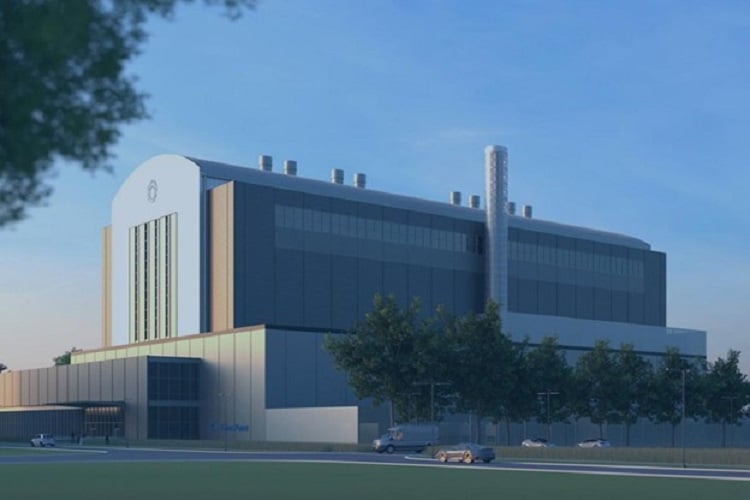
Google’s AI data centers and the Tennessee Valley regional power grid are converging at Hermes 2, an advanced nuclear project poised to become the first-generation IV reactor in the U.S. with a commercial power agreement. Kairos Power is developing the first 50-megawatt (MW) unit in Oak Ridge, Tennessee, with startup targeted for 2030 under a framework that could expand the fleet to 500 MW by 2035.
The deal marks a double milestone: The Tennessee Valley Authority (TVA) could become the nation's first major utility to procure electricity from a non-light-water reactor, and Google the first tech giant to contract a Gen IV fleet under a scheduled build program. TVA will act as offtaker and transmission host, purchasing from Kairos and providing clean energy attributes to Google's data centers in northern Tennessee and northeastern Alabama.
Google positions the arrangement as a "three-party solution" to de-risk advanced nuclear technology. The deal establishes a supply chain for AI data centers that require 24/7 baseload power unaffected by weather, while also giving TVA a hedge against rising demand and renewable variability. For Kairos, it guides the transition from test prototypes into commercial, grid-connected reactors.
Small modular reactors (SMRs) are compact nuclear plants designed to generate 300 MW or less per unit, far smaller than today's gigawatt-scale reactors. Unlike conventional light-water designs, which use high-pressure water for cooling and require complex containment systems, Hermes employs a low-pressure molten salt coolant and Tri-structural Isotropic (TRISO) fuel with built-in safety properties. The modular approach aims to cut capital costs, shorten construction timelines and improve site flexibility, while incorporating new passive safety features.
Google's next-gen nuclear strategy
Hermes 2 anchors Google’s structured nuclear procurement strategy. In a 2023 whitepaper, the company proposed a multi-reactor “orderbook” of numerous (five to 10) contracts for a single design. The goal is to sidestep the typical economic traps of one-off builds by front-loading the learning curve, instead of sinking capital into first-of-a-kind units. Certainty is essential for Google as it maps its AI expansion.
The International Energy Agency projects that continued AI demand will double global electricity consumption at data centers to 945 terawatt-hours (TWh) by 2030 or nearly 3% of worldwide electricity use, compared to 415 TWh or 1.5% today. In the U.S., data centers could account for nearly half of demand growth through this decade, outpacing steel, cement and aluminum. Typical facilities require 5 MW to 10 MW, but large "hyperscale" AI sites exceed 100 MW, comparable to the annual electricity consumption of hundreds of thousands of EVs.
For Google, which operates data centers in 29 locations worldwide, renewable power purchase agreements (PPAs) have been the backbone of its corporate sustainability plan. Data center emissions fell 12% in 2024 as Google signed record numbers of contracts totaling over 8 GW of clean energy. Since 2010, the company has inked 170 deals for 22 GW, primarily in North America (over 17 GW) and Europe (4.5 GW).
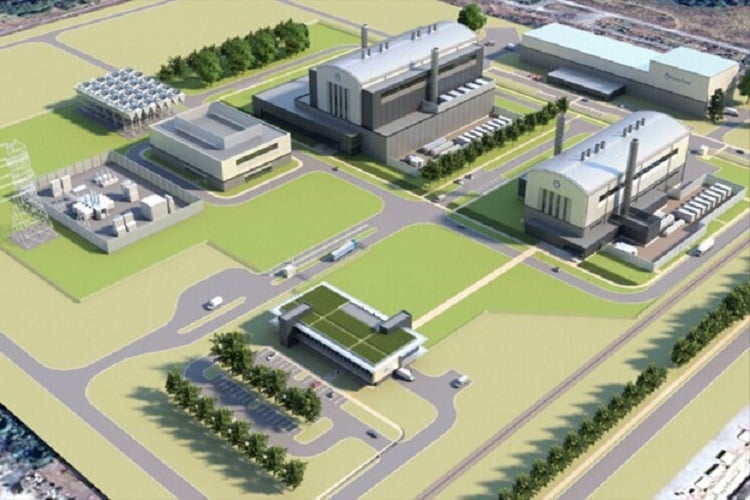 A rendering of the Hermes plant layout. Source: Kairos Power
Still, renewables alone cannot deliver continuous coverage for AI workloads. Electricity consumption at Google's data centers jumped 27% last year, continuing a four-year uptrend with 30.8 TWh consumed in 2024, up from 14 TWh in 2020.
Other hyperscale operators are also securing nuclear capacity, though by different routes. Amazon recently expanded a PPA with conventional nuclear plants in Pennsylvania by 1.9 GW through 2042, while Microsoft is helping restart a reactor at Three Mile Island by 2028. Meta signed a 20-year agreement to preserve and uprate a 1.1 GW plant in Illinois, and has shortlisted developers for another 1 GW to 4 GW of new nuclear capacity in the early-2030s. Together with Google, these four companies control over 40% of U.S. data center capacity.
Google's procurement whitepaper emphasized that its contracts aim to create new capacity, not divert generation from today's grid. However, since corporate PPAs can rescue legacy nuclear plants from retirement, Google may consider partnering with existing facilities for uprates or restarts in those cases. According to the DOE, equipment replacements and maintenance can extend many reactors' lifespans to 80 years, doubling the service life of aging light-water reactors built in the 1970s and 80s.
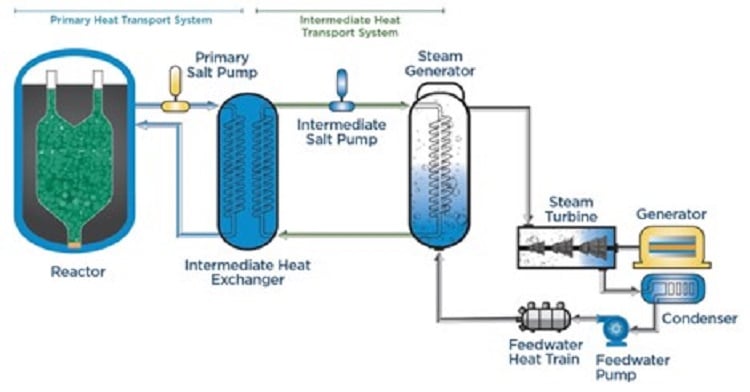 A diagram of KP-FHR's internal components and processes. Source: Kairos Power
Hermes 2 technology and key selling points
Hermes 2 is the second major build for Kairos Power’s fluoride salt-cooled high-temperature reactor (KP-FHR). Its predecessor, a low-power demonstrator called Hermes 1, secured a construction permit from the Nuclear Regulatory Commission (NRC) in late-2023 — the first such approval in five decades outside of traditional light-water reactors. Earlier this year, workers installed nuclear-grade safety concrete at the first drilled pier shaft for Hermes 1's foundation, marking the start of full construction at the Oak Ridge site.
While the low-power demonstrator is intended to validate material performance and passive safety behavior, Hermes 2 will focus on electricity generation. The NRC issued construction permits for Hermes 2 last November, authorizing Kairos to build its first grid-connected advanced reactor.
KP-FHR technology uses TRISO fuel particles in carbon matrix pebbles with ceramic coating that retains fission products at extreme heat, far above the limits of conventional metallic fuels. TRISO’s meltdown-resistant properties allow the fuel to maintain its integrity well beyond accident conditions that could otherwise lead to core failure.
The reactor is cooled by a molten fluoride salt mixture called FLiBe with strong heat transfer capabilities. Hermes targets an outlet temperature of 650° C and operates at a low pressure, allowing simpler and lower-pressure containment than light-water reactors. Its passive decay heat removal system is designed to act during both normal conditions and emergency conditions without requiring electricity to move heat from the core after shutdown.
Kairos completed over 2,000 hours of pumped-salt operations under a DOE-funded test program last year, generating more than 10 terabytes of performance data on simulated conditions involving possible failures, such as a broken pipe in the primary system.
Each Hermes 2 unit is rated at 50 MW, but future KP-FHR commercial plants will offer a dual-module 150 MW configuration at 75 MW each. If the Oak Ridge project follows schedule and leads to a series of identical plants as intended, Hermes 2 would be the first indication that advanced fission can be built, operated, and replicated to unlock new baseload power for compute-scale demands.
Takeaways
Google is supporting an advanced nuclear reactor project to meet the massive demands of AI data centers, which require continuous, weather-independent power. The partnership, with Tennessee utility TVA and California-based startup Kairos Power, could make Hermes 2 the first commercial Generation IV reactor in the U.S., while marking a broader shift as tech giants take a larger role in expanding grid power, due to their high electricity demands for quickly-expanding AI data centers.
About the author
Shannon Cuthrell is a North Carolina-based freelance journalist covering business and technology topics. Her byline appears in a variety of outlets, from local newspapers and magazines to technical trade publications.
