
On March 31, Richard Dinan, the CEO of British start-up Pulsar Fusion, took to the stage at the Mars Conference organized by Amazon founder Jeff Bezos in Ojai, California, to pitch his company’s tech to a crowd of space exploration enthusiasts.
Dinan, now 40, is a one-time contestant on a reality show about rich young Londoners, but has lately gained attention with his pet project — a venture developing nuclear fusion propulsion systems for spaceships bound for Mars and beyond. For a long time, he may not have been taken all that seriously. But in his 17-minute presentation, Dinan made a convincing case for the benefits of fusion in rocketry, and showed off what experts have called “a significant milestone worth celebrating.”
With exhaust speeds of 140 kilometers per second, nuclear fusion rockets would outstrip the fastest existing rocket technology (nuclear thermal propulsion powered by nuclear fission, the same process that powers nuclear power plants) by almost 17 times.
“In space, propulsion speed is literally fungible with money,” Dinnan told GlobalSpec following his talk. “If I can save you time and space, I can speed up return on your assets. And it's not just about building space stations. If you can be at a point in space faster than your competitor, then that's a strategic advantage.“
In practice, a one way trip to Mars could be cut from nine months to mere weeks. But Dinan also envisions a future where a fleet of fusion-powered spacecraft lingers in orbit around Earth, awaiting orders such as an urgent asteroid inspection or removal of a defunct satellite.
Decades to fruition
The idea of using nuclear fusion to propel rockets has been around for decades. But until recently, it has been considered mostly science fiction, Dinan admitted.
“15 years ago, the idea of launching a fusion reactor into space was insane,” he said.
Nuclear fusion is a process in which two atomic nuclei merge into a single larger, more complex nucleus. The process requires enormous amounts of heat to kick-start and usually begins with two hydrogen atoms merging into a helium atom.
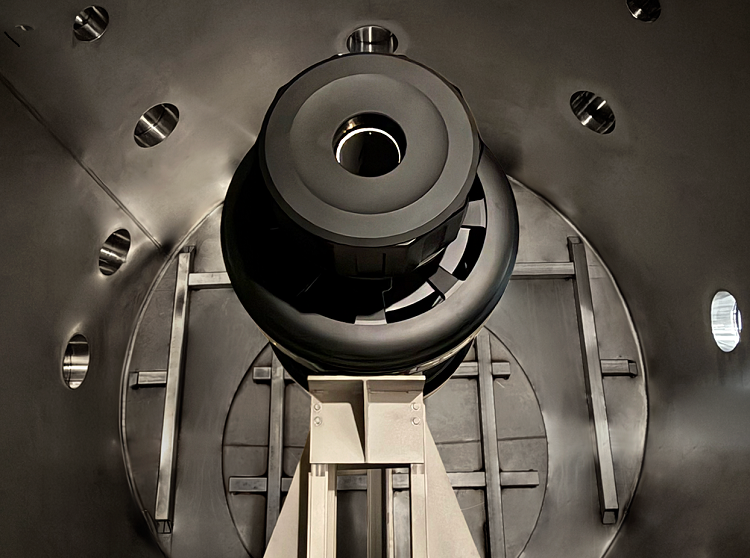 A front view of the Sunbird fusion rocket in a test chamber. The company is testing new methods of interplanetary propulsion. Source: Pulsar Fusion
Nuclear fusion is the process that keeps stars shining. It gets spontaneously triggered inside of fledgling stars when clouds of cosmic dust collapse into superdense balls of matter forced together by gravity. The nascent star spins, pulling in more matter, creating ever stronger gravitational forces at the star’s core.
Molecules at the star’s heart bump into each other under enormous pressure, creating more heat. When the heat reaches temperatures of around 15 million° C, nuclear fusion ignites, and a star is born. The energy released during the fusion counteracts the gravitational forces inside the stellar core, preventing the star from collapsing.
For billions of years after that, simpler atoms inside the star’s core will be fusing into more complicated atoms until the process would require more energy than it releases, at which moment the star collapses under the force of gravity and dies.
Humans have been trying to harness the same process in laboratories since the 1950s. In its crudest form, nuclear fusion is what gives rise to the destructive blast of a hydrogen bomb. Twenty times more destructive than a conventional nuke, a hydrogen bomb uses a fission-based nuclear explosion to generate heat, which then triggers a brief, but extremely powerful fusion reaction. Numerous test explosions have been carried out since the 1950s.
Churning away
To recreate the steady, ongoing, fusion reaction that churns away inside the sun and other stars is, however, much more complicated,
Generations of scientists have made steps toward producing limitless clean energy through nuclear fusion using large reactors called tokamaks and stellarators, powerful lasers and super magnets.
Although progress has been achieved over the years, nuclear fusion experiments can still only be sustained for a few minutes at best and produce only tiny amounts of energy compared to what is needed to trigger the reaction.
The record-breaking nuclear fusion experiment conducted at the Joint European Torus (JET) laboratory in the U.K. only produced 69 megajoules of energy — enough for five hot baths — during a five second spell.
However, Dinan believes that although commercial-scale nuclear fusion power generation might still be decades away, fusion rocket propulsion may be, if not within reach, then at least on the horizon.
“It's no small challenge from achieving fusion to achieving fusion power that is efficient,” Dinan said. “The infrastructure is incredibly complex. But if you want to use it for propulsion, you just need hot plasma.”
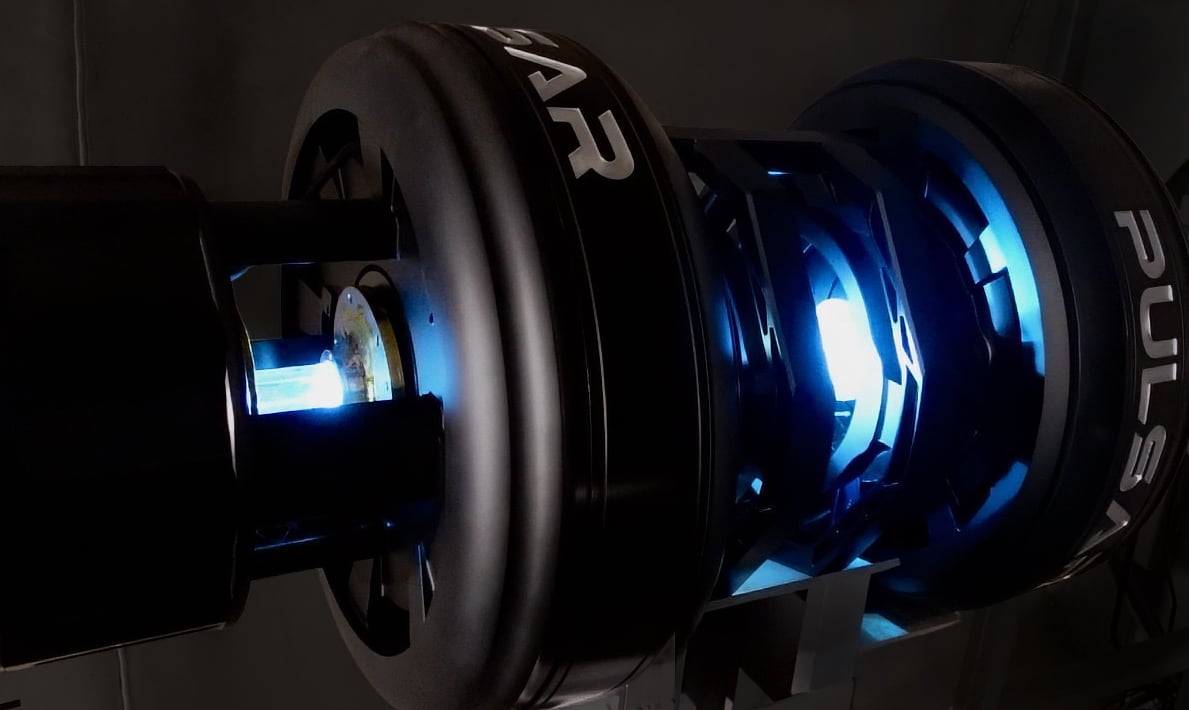 A view of the first plasma of the Sunbird rocket. The plasma is the first step toward fusion reaction. Source: Pulsar Fusion
First light
To prove his point, Dinan connected during the conference via a telelink to his company’s workshop in Bletchley, a small town northwest of London, which played a key role in breaking the German Enigma code during the Second World War and now hosts a burgeoning technology cluster.
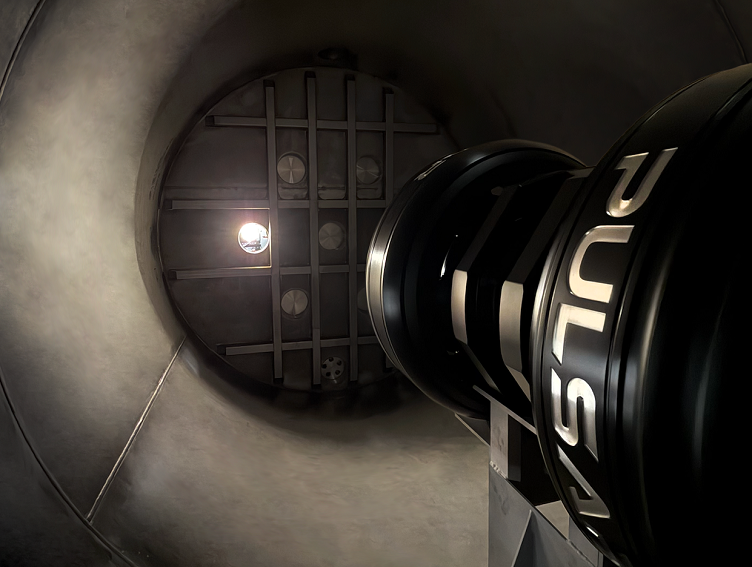
During the demonstration, Pulsar Fusion’s engineers turned on their Mark I Sunbird exhaust test system to produce a brief streak of plasma.
Dinan admitted that the company still has a long way to go to achieve a sustained fusion reaction. The first plasma generation is only the first step on that journey.
“The important part of the test we did was to show the first plasma in the structure of the test facility, in the testing system,” Dinan said. “The difficulty of that is really striking a plasma in the right place of the architecture. Because if you get that wrong, you just spark arcs all over the place, and that’s not helpful.”
Plasma is ionized gas that emerges when the heated hydrogen atoms eject electrons from their cores. Since plasma is charged, it can be controlled by magnetic fields. Containing the plasma is crucial to prevent the charged gas from cooling or dispersing before the fusion kicks in.
The Mark I Sunbird exhaust test system is a 2-meter-long reactor fitted with two rare-Earth superconductive magnets designed to focus and accelerate the beam of plasma between the ignition and exhaust chamber. Pulsar Fusion is using krypton as a fuel in its experiment, but once the system is fully developed, the reactor will fuse the hydrogen isotope deuterium into helium.
The system features the Dual Direct Fusion Drive (DDFD) based on the Direct Fusion Drive concept developed in 2002 by Princeton University professor of plasma science and technology Samuel A Cohen.
The Direct Fusion Drive generates thrusts directly from nuclear fusion rather than first generating electricity to heat the exhaust.
NASA concept
The technology is currently explored by NASA as part of a concept study for a future mission to Pluto.
Jason Cassibry, a professor of aerospace engineering at the University of Alabama Huntsville, called the demonstration “a significant milestone definitely worth celebrating.”
“A meaningful prototype that starts to resemble a fusion reactor is a big step for development,” Cassibry told GlobalSpec. “A fusion reaction for propulsion is very important for deep space exploration.”
According to the Fusion Industry Association, a non-profit organization of companies working in the fusion energy field, fusion rocket propulsion would be a game changer. It would not only shorten Mars-bound trips, but it would allow sending spacecraft much deeper into space than is currently possible.
Sophisticated telescopes could be placed so far away from Earth that planets orbiting other stars could be observed with a resolution of mere miles. Fusion-powered cargo vehicles would allow fast transportation of massive structures to and from the moon.
“There is a massive need for it,” Dinan said.
Cassibry added: “The propulsion technologies that we have now and the technologies of the near future using nuclear thermal propulsion or nuclear electric will enable faster human piloted trips to Mars and missions to the outer ice giant planets that are currently not possible. In the short term human missions to Mars in six months might be possible, whereas fusion could get us to Mars in three months. Science missions could extend beyond Saturn to rendezvous missions with Neptune and Uranus."
But how long will it take from that one second spark of plasma shown during the Amazon Mars Conference to an actual working rocket? On its website, Pulsar Fusion states that it wants to conduct an orbital demonstration in 2027. When asked, Dinan provided a much vaguer answer.
“There’s a long way to go,” Dinan said. “It’s not as simple as just turning up the current and turning up the voltage. We want to be able to focus that plasma for thrust. You may want to do a pulse and then shut it down and heat your fusion reactor again. This is the first plasma, the first step on the road.”
