
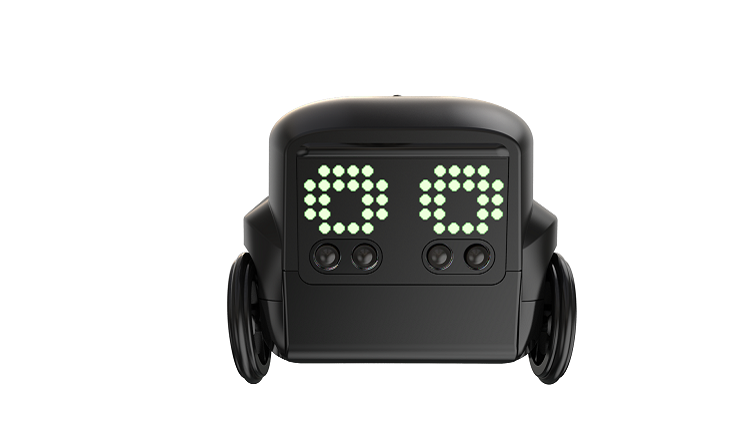
Boxer the Robot from Spin Master, Inc. is a fun little bot that simulates emotions and has the ability to follow commands, play games and provide lots of interaction. Electronics360 recently got the chance to give it a test drive.
The robot is around the size of a small coffee mug with the cube-like shape implied by its name. It has six wheels, three on each side, along with digital eyeballs that depict almost lifelike emotions. Boxer gets its charge from a USB-C port like those used on many smartphones. It uses coin cell batteries (included) and is controlled by a small remote.
When you turn Boxer on, it “wakes up”: Eyes appear on the small screen, and it begins to make little beeping sounds that mimic common expressions as it rolls back and forth. Boxer will react to various stimuli such as being picked up, which produces a “whee!” sound; if you shake it, it acts dizzy. Pushing its wheels back and forth is akin to tickling, as it elicits a reaction like laughter.
Boxer will also react to a hand placed in front of it, which it will follow. Although Boxer uses four IR sensors to detect nearby objects, it does not seem smart enough to avoid falling off a platform. On the bright side, however, the bot is sturdy enough to withstand a fall from a table.
Using the remote is relatively straightforward; once connected, you can drive the robot around. The remote appears to work via an optical signal, so it requires line of sight to operate. It also does not have a power switch; it simply shuts itself off after a period of inactivity and turns back on when a button is pressed. Despite these minor limitations, Boxer is much more responsive to remote control than one might expect for a bot of its size: it moves around very easily and quickly, with a speed corresponding to the movement of the joystick controls. Boxer is also quite nimble; it is able to flip over, balance on two wheels and right itself when it flips on its front or back. The bot can also spin in place.
More complex movements -- things like playing soccer, performing a "stunt show" or acting as a DJ or a "fortune teller" -- can be executed by getting Boxer to read one of several barcoded index cards that are shipped with the toy. This is accomplished by placing the bot's front wheels on the card and pressing a button on its back, which makes it drive over the card. To acknowledge its understanding of the card's instructions, Boxer plays a clever tone that sounds like “uh-huh, uh-huh.” Additional Boxer capabilities can be accessed by downloading the free Boxer app.
Although a grown-up member of our team did the in-depth reviewing, we also let someone more in line with Boxer’s targeted demographic (ages 6+) give it a go. Our 5-year-old assessor, a newly aspiring soccer aficionado, found Boxer's ability to play with its interactive ball (included) the most delightful of its tricks. Our tiny tester also enjoyed letting Boxer scan the index cards, and hearing the bot's quirky little laugh.
On a technical note, although Boxer is marketed as an interactive AI toy, it's a bit of a stretch to refer to its simulated emotions as "artificial intelligence"; this would imply an ability to learn behaviors through repeated interaction over time. Nevertheless, it can expand its repertoire through exposure to pre-coded instructions, and its ability to interact -- especially with the younger set -- does seem intuitive.
Overall, Boxer is an engaging toy, but it does require a bit of time and consultation with the directions to get it to do some of its more interesting tricks. Its abilities could be expanded through additional accessories available from its website, BoxertheBot.com; users will need to decide whether it's worth the time investment. To this adult, Boxer's many emotive sounds were quite loud. A volume control would be a welcome future addition.
At press time, Boxer is available from Spin Master for $79.99. Free shipping is available on orders of $35 or more.
