
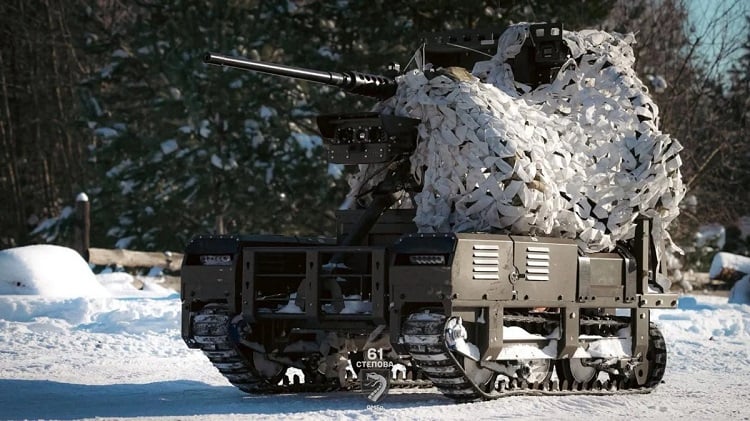
Science fiction has been turning into reality on the battlefields of Eastern Ukraine since Russia invaded its smaller neighbor in 2022.
In the early months of the war, Ukraine, lacking heavy artillery, turned to cheap aerial drones to gain control over the frontline. Then the country’s technologists began developing remotely controlled rovers to replace exhausted infantry men. First, the robots took over dangerous logistics and evacuation operations. As of 2026, such robots, fitted with machine guns and grenade launchers, commonly conduct attacks, kill invaders and recapture occupied territory. But the advent of military ground robots has brought new challenges, which Ukraine’s technologists are now trying to solve.
Yuri Vysoven, founder and CEO of Aerobavovna, is giving me a tour of the Kyiv offices of his company. I’ve just made myself a cup of cacao and settled comfortably in front of my computer in my London home office. We are talking via Zoom. Vysoven is walking through a small warehouse filled with all sorts of drones and military gear. Shoes and uniforms are piled up in boxes. Many of the hall’s large windows are boarded up with oriented strand board (OSB) and plywood. About a week ago, a missile hit a residential building across the street, killing eight people including a 12-year-old girl.
“We just got the shock wave,” Vysoven shrugged. He is calm. Hardened after more than four years of daily air raid alerts. But the morning after that attack, he let his quiet rage show. “We will make them pay,” he concluded his post on LinkedIn that day. But Ukrainian technologists cannot afford to slow down to grieve. The cat and mouse game between Ukraine and Russian innovators doesn’t stop.
Right now, Vysoven and his colleagues are trying to find better connectivity solutions for Ukraine’s growing army of ground robots.
Starlink shortcomings
“Right now, something like 90% of all unmanned ground vehicles (UGVs) in Ukraine are using Starlink satellite terminals,” Vysoven said. “It’s obviously the best solution, because you have your radio repeater in orbit. But there are issues with vegetation because the high-frequency waves that Starlink is using easily break when you have just a few leaves. You immediately lose the signal. So that’s a big problem. Especially in the summer.”
UGVs, roaming on the ground, have a disadvantage when it comes to conventional radio control. Even with specialized antennas, they can only crawl a few miles away from the operator before losing signal due to terrain obstacles and the curvature of the planet. Aerial drones, flying high above the terrain, have a longer range. For both technologies, Starlink offers an almost unlimited range extension. But when Starlink connectivity cuts out, the UGVs grind to a halt. Vysoven and his colleagues are using aerostats to build a network of radio repeaters 500 meters above the ground to provide UGVs a back-up communication channel to allow them to complete their missions when Starlink falters.
“From 500 meters above the ground, the transmitter can reach up to 80 kilometers if you have a direct line of sight,” Vysoven said. “You can safely place the aerostats 30 kilometers away from the frontline and still, the entire kill zone around the frontline will be more or less covered.”
The kill zone is the land along the frontline constantly criss-crossed by reconnaissance drones. Once the spy drone spots an enemy vehicle or soldier, a killer drone attack follows immediately. To reduce the presence of soldiers in that treacherous area, Ukrainians began experimenting with UGVs in the second year of the war.
“When both sides started using first person view drones, the kill zone started increasing from one kilometer to, right now, about 20 kilometers,” said Oleg Fedoryshyn, head of research and design at the leading Ukrainian UGV producer DevDroid. “It became logical to start using robots because a guy with a machine gun is always the first target.”
The size of the kill zone is limited by the reach of the radio links that control the drones. As better systems get developed, the kill zone’s width increases. Ukraine first began using UGVs to ferry supplies to the frontline and help evacuate the wounded and the dead, Fedoryshyn said. About 90% of the UGVs crawling across the kill zone are used for that purpose. The remaining 10% are the true killing machines, fitted with remotely controlled machine guns and grenade launchers.
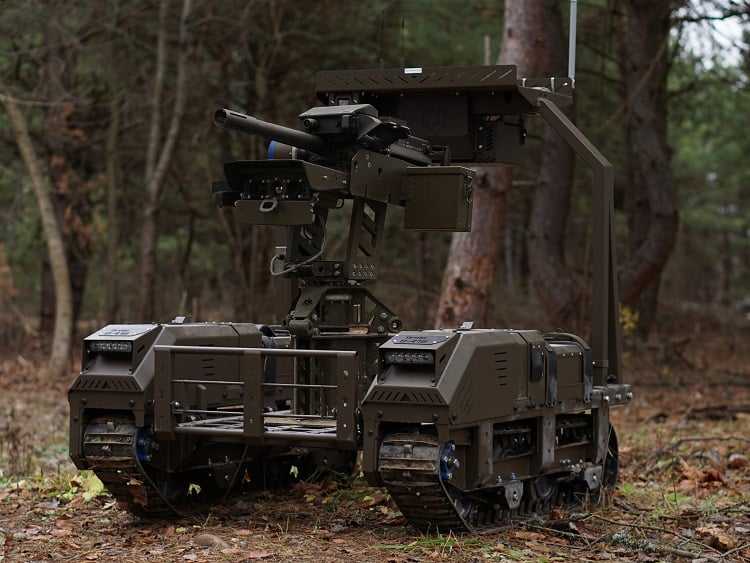 Autonomous driving of battlefield robots is challenging due to the rough terrain these vehicles need to traverse and Ukraine engineers are working on fixes that will help them better navigate. Source: DevDroid
The rise of killing machines
In mid-April, Ukraine’s President Volodymyr Zelensky announced that a team of remotely controlled drones and UGVs forced a group of Russian occupiers to surrender and give up their positions without the presence of Ukrainian infantry men. Those UGVs were made by DevDroid.
Similar victories are not rare along the frontline these days, Fedoryshyn said, although most don’t get publicized. In early 2025, DevDroid’s TW-7.62, equipped with infrared vision, successfully located Russian soldiers at night and “neutralized them at a distance of approximately 300 meters.”
For Ukraine, the progress in robotics is a major victory. With a pre-war population of around 40 million, Ukraine’s biggest disadvantage against the more numerous aggressor has been the lack of rested soldiers. The Ukrainian Ministry of Defence has therefore procured 25,000 UGVs from mostly Ukrainian innovators this year and plans to reach the 50,000 mark by the end of 2026.
Russia has made forays into UGV development, too, but has not rushed to deploy them en masse so far.
“Russia has almost unlimited supply of people, it’s cheap for them,” Fedoryshyn said. “They don’t think about losses. But for us, it’s not like that.”
According to Ivan Frankiv, CTO of electronic warfare producer Kara Dag, most men sent to the frontline get either killed or injured within nine months. The technologists steering the development of Ukrainian defense tech have all lost friends and family members.
Fedoryshyn hopes that UGVs will help reduce the number of infantry men needed along the frontline by 30% and take over the most dangerous tasks.
“You can control UGVs from 100 kilometers away,” he said. “You can even be in another country. You can put them in their positions and they can wait there for the enemies for days or up to a week. It’s perfectly safe. You don’t need to put humans at risk, and you don’t even need to recharge the battery.”
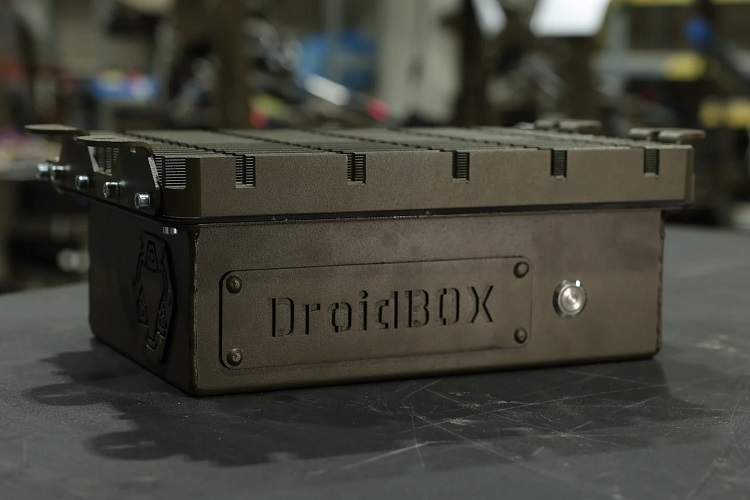 DevDroid is working on new connectivity solutions that can be placed on battlefield robots to allow them to continue to work when services like Starlink falter. Source: DevDroid
The comms problem
Fedoryshyn agreed that despite the availability of Starlink, Ukraine needs new communication solutions to keep their UGVs running smoothly. DevDroid’s ground robots are usually fitted with Starlink terminals, LTE modems for cellular connectivity and western military radio receivers capable of mesh networking.
LTE hardly works along the frontline as infrastructure gets quickly destroyed, said Aerobavovna’s Vysoven. The western military radios usually come at a price tag that, in the long-term, is too high for Ukraine. There is also the constant fear that access to Starlink could be lost if Ukraine falls out of America’s favor. Russia had been using Starlink illegally in Ukraine but was blocked from accessing the technology earlier this year by a registration scheme, which only allows whitelisted users to connect to the constellation from Ukraine’s soil. The loss has hit Russia hard, making it scramble for new solutions to connect their drones.
Frankiv said that Russia has made strides in developing a standardized, homegrown mesh radio network, installing Chinese radio modems on drones to extend the reach of the radio signal for dozens of kilometers.
“Somebody can sit in Belarus, 60 kilometers away from Kiev, and send signals to one [long-range] Shahed [drone], which will retranslate it to the other, which will re-translate it to the other,” Frankiv said. “They are building a standardized network, and that’s a very dangerous development.”
Vysoven said that one of Ukraine’s weaknesses is the lack of standardization in technology development, which results in a “zoo of systems” that don’t always cooperate with each other in a seamless manner.
“It’s a bit of a mess. Everyone is using what they have,” he said. “A good idea would be to build infrastructure with just a few systems.”
He added that Ukraine will have to look for cheaper, domestic options to replace the costly western military systems, but thinks the aerostats could help spread the signal along the frontline more effectively.
“You can use some cheaper radios that allow mesh networking and put a few aerostats along the frontline and cover a super big area,” Vysoven said. “This way, you can provide connectivity to everyone who needs it and actually control the bandwidth to prioritize some missions.”
Autonomy challenges
When connectivity is lost, so is the UGV. DevDroid is looking into the possibility of using autonomous navigation to help out in a crisis, Fedoryshyn said. Such a solution works quite well for Elon Musk’s Tesla cars, which drive on clean, orderly roads. But reliable autonomous driving is much more difficult to achieve in the rough and chaotic landscape of the kill zone.
“We have some partial autonomy for UGVs when they can ride from point A to point B,” he said. “It works quite well in good conditions.”
He added that the company hopes to develop some basic swarming algorithms that would enable a single operator to drive several UGVs across the kill zone to allow his colleagues to take a rest before reaching positions.
“We want to help operators spend less time on these missions,” he said. “Because they do it at the night and they need to sleep. So, maybe one operator can drive for 10 hours and then the others join him for one or two hours. We don’t have too many people in the army to start with. So we need to think about how to help them.”
Although Russia’s progress in Ukraine has almost ground to a halt in recent months, the war is not yet over, and neither is the technology race it has spurred.
