

On September 15, 2025, Portuguese Navy frigate NRP Dom Francisco de Almeida and the ocean surveillance vessel NRP Dom Carlos I sailed out of the ports of Troia and Sesimbra in southwestern Portugal and headed into the calm summer Atlantic Ocean waters. The warships were part of a special NATO exercise to test new unmanned military systems. Between them, they carried over 260 technological demonstrations, including a range of reconnaissance drones and autonomous mine-searching submarines.
During the exercise, dubbed REPMUS for Robotic Experimentation and Prototyping with Maritime Unmanned Systems, the ships also hosted two 16-kilogram metallic boxes — laser communication terminals developed by Lithuanian start-up Astrolight. The task of these gimbal-mounted reflectors was to maintain secure communication links between the ships during their two weeks in the sea, which could not be disrupted or intercepted by adversaries.
 Laurynas Maciulis is the co-founder and CEO of Astrolight.The experiment was among the first to test laser communications between two military vessels on the open sea, and is a major milestone toward next-generation, unjammable military communications that cannot be eavesdropped on.
Laser communications systems have been explored since the 1970s, mostly by the space industry, which sought to speed up transmissions and transfer larger amounts of data across vast distances of space. In fact, Astrolight itself, founded in 2019, started off with the vision of making affordable laser terminals that would form a foundation for a future interconnected satellite infrastructure, Laurynas Mačiulis, the company’s co-founder and CEO told GlobalSpec.
From space to defense
But then, Russia invaded Ukraine and the need for resilient communications on land, in air and on sea, quickly became apparent. To Lithuanians, who have for decades lived under a Russian-imposed totalitarian regime during the USSR era, that need became obvious faster and more palpably than to anybody else.
“When we started Astrolight, I never thought about defense, actually, in the beginning,” said Mačiulis, who previously co-founded the successful Lithuanian micro-satellite start-up NanoAvionics. “We were a communications company, and our main goal was to provide high-bandwidth secure communication to people going to space and to different worlds. But when the war in Ukraine happened, we felt a moral duty to support [European] defense with our technologies.”
Along the frontline in Eastern Ukraine, the jamming of satellite navigation signals and radio frequency links used to control drones and ground robots is a constant occurrence. But these disruptions have spilled out of the Ukrainian battle fields and are frequently affecting other nations bordering Russia, especially in the Baltic region. GPS jamming and spoofing – the more sophisticated disruption method that involves overriding the legitimate signal with a false one – has become a constant problem in that area, affecting ships and disrupting air traffic.
A report compiled by the Baltic states’ aviation agencies and submitted to the International Civil Aviation Organization in September last year stated that in the first four months of 2025, more than 123,000 flights in the region had been affected by GNSS jamming and spoofing. Many flights had to be diverted or even cancelled. On top of that, tens of thousands of vessels crossing the Baltic Sea have, too, experienced GNSS disruptions in 2025. Experts trace the origin of these electronic warfare attacks to the Russian exclave of Kalinigrad, a tiny territory sandwiched between Lithuania and Poland, and to the St. Petersburg region, Russia’s piece of the Baltic Sea coast.
In Lithuania, as well as in its fellow post-soviet Baltic neighbors Latvia and Estonia, many think that Russia’s territorial ambitions won’t stop with Ukraine. The region’s technologists have therefore been among the first to join the Ukrainian defense tech effort, building drones, drone interceptors and developing anti-jamming systems. Astrolight’s unjammable laser terminals represent another contribution to this endeavor.
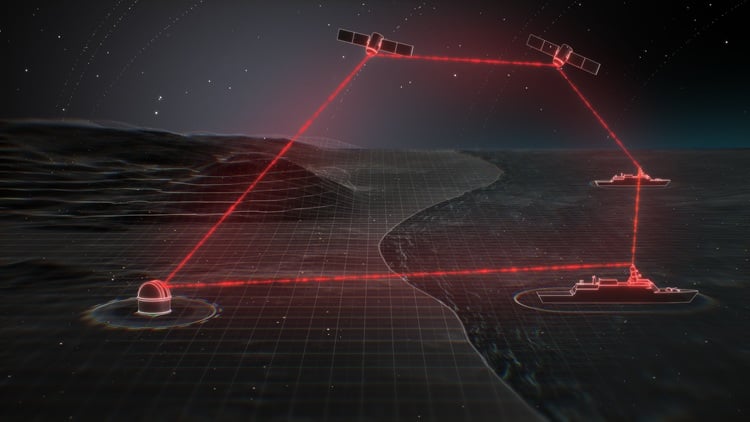 The testing of the unjammable laser links that was conducted by NATO using Astrolight’s optical terminals linked to ships from satellites. Source: Astrolight
Laser links unjammable
Mačiulis explains that laser communications possess many advantages over conventional radio waves, which have until recently been the default way of transmitting data across distances. The high-frequency and short wavelength of laser light mean the links can squeeze in much more data, making optical terminals a sought after-choice for satellite mega-constellation operators who want to improve their services. Astrolight says their terminals can beam data up to a hundred times faster than conventional radios.
SpaceX began fitting its Starlink satellites with laser terminals in 2021, and today, the constellation fully relies on optical links to transfer data in orbit. SpaceX’s CEO Elon Musk has already publicly teased future space-to-ground laser links, which would further increase the constellation’s bandwidth.
In the defense context, the nature of the laser light provides further advantages. The short wavelength means the light doesn’t scatter as much as radio waves do, forming sharp and accurately focused beams that are difficult to intercept, detect and interfere with.
“The way you decrease detectability is that you make the signal more directional, meaning that you reduce the emission of your signal outside of the direction in which you communicate with your allies,” Mačiulis said. “To do that with radio waves, you need very large antennas. In the case of lasers, you can do that with an optical antenna, which is the size of one inch. It’s much easier.”
Mačiulis described the solution like “two objects moving and pointing a laser point at each other,” being “essentially invisible” to anybody else apart from each other.
“Any adversary that would like to disrupt [the link] would need to be between these two parties,” he said. “He has to know where each of the parties are in order to be able to maintain the position to block the beam. It’s near the level of impossibility.”
Detection of radio sources is frequently used by adversaries to find and strike targets in war zones. With laser comms, forces can operate much more in stealth.
The terminals passed the REPMUS exercise with flying colors, according to Mačiulis, maintaining communication links through rain and fog, day and night, and transmitting gigabytes of data in real time, enough to simultaneously beam up to ten HD video streams.
None of the other vessels, drones and other vehicles participating in the exercise were able to detect the link with available sensors.
Two months later, in November, the company put the terminals through another NATO-backed test, this time to prove they can be used by ground-based troops to maintain communications amid pervasive jamming attacks.
“If you have a command post on the front lines and you need internet, satellite communications, like Starlink would be one of the primary solutions,” Mačiulis said. “But it has its drawbacks and so, the military need backups. In the test, we set up a high-speed, point-to-point link between two military installations and provided non-stop communication for over a week.”
The company also plans to test a smaller version of the terminal on a two experimental satellites to be launched to orbit in March. Astrolight is one of many companies riding the wave of interest in laser communications, motivated by the growing need for secure transmission of ever-growing amounts of data.
Laser boom
In addition to Starlink, companies including Mynaric, Tesat Spacecom and AAC Clyde Space have been developing laser terminals for satellite communications and other applications. Singapore-based Transcelestial has deployed its laser terminals in multiple hard-to-connect locations around the world including in Australia, India and Japan, providing terabit-level connectivity and effectively replacing costly optical fibers. The company is also currently testing a space-to-ground satellite laser terminal, hoping to provide fiber-grade connectivity from space to virtually anyone, anywhere in the world.
Transcelestial’s founder and CEO Rohit Jha told GlobalSpec that a constellation of space-born laser terminals could, in fact, replace undersea cables that stream data between continents, providing a more secure and cheaper solutions (undersea fiber optic cables are likely a target of adversary saboteurs wishing to throw enemies into internet darkness).
“You can pick a small town or a village, and you drop a high-speed laser link directly from orbit into a city and that will provide them as good internet connectivity as countries like Korea or Singapore have,” Jha said. “It dramatically simplifies the way we distribute internet and also substantially reduces, the cost of distributing high-bandwidth capability.”
He added that space-born lasers have potential to revolutionize internet delivery and leapfrog the current version of SpaceX’s Starlink mega-constellation. Instead of beaming internet to individual user terminals, which leads to quick bandwidth dilution as the number of users grows, Transcelestial envisions forming a super-high-speed link with a satellite and then redistributing the connectivity locally using ground-based laser terminals.
It took a long time from the early 1970s experiments to get laser communication technology work, but it seems to be finally arriving.
