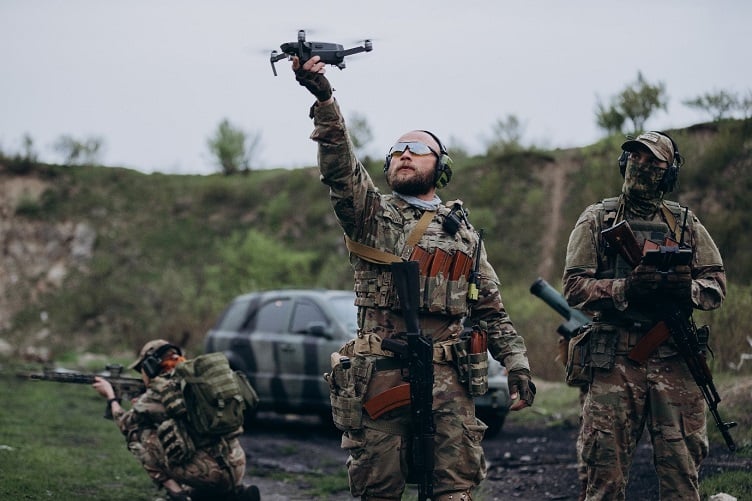
When Russian tanks rolled into Ukraine on February 24, 2022, Yehor Dudinov was a member of the Special Operations Forces of Ukraine at that time and became quickly involved in his nation’s race to develop innovative technologies to ward off the more numerous and better armed adversary.
Ukrainian tech whizzes soon began tweaking consumer quadcopters in hidden garages, strapping them with explosives to make up for artillery shortages. But Russia quickly caught up using decades-old Soviet-era jamming machines to stop the drones.
For Dudinov, those confused early days were a wake-up call.
“We couldn’t operate our reconnaissance drones because electronic warfare destroyed connections between operators and the drones,” Dudinov told GlobalSpec.
“We couldn’t see our radio stations,” Dudinov said. “So, I got an idea that I want to have a device that would allow me to understand what is happening in the radio frequency area, whether there is jamming going on and what devices — like drones, radios, jammers — we have around us.”
That year, Dudinov founded Falcons, a military tech start-up with a mission to develop a smart radio-frequency detection system that would show Ukrainian military units the precise locations of enemy radio sources in a single, user-friendly map interface.
War leads to innovation booms
Falcons are among some 300 companies developing electronic warfare technologies that have sprung up in Ukraine since the invasion. Over the past nearly four years, these companies have been engaged in an endless cat-and-mouse game with Russian drone innovators, trying to find solutions to outsmart every new invention designed to evade the latest generation of electronic warfare tools.
First-person-view (FPV) drones, such as those commercially sold DJI Mavics that dominated the early months of the war, use two frequency bands — 2.4 GHz and 5.8 GHz — to establish a link with the operator and transmit video feed. The drones are small so by the time they appear in sight of the target, the defenders have little time to shoot them down.
Electronic warfare — jamming and its more sophisticated counterpart spoofing — are the only reliable means of FPV drone defense. Once a jammer overrides the control signal, the confused drone either crashes down or remains hovering until it runs out of power.
Before the war, FPV drones were mostly used for entertainment, according to Yaroslav Filimonov, founder and CEO of Kyiv-based electronic warfare developer Kvertus. They were popular among filmmakers or hobbyists; some companies experimented with them to deliver packages to distant locations. They were also used by smugglers to transport contraband across borders.
It was the latest ‘application’ that inspired Filimonov’s interest when he started Kvertus in 2017. That same year, the company introduced its first product — a hand-held radio-frequency anti-drone gun capable of “shooting down” drones at up to 100 meters (300 feet).
The war with Russia, however, supercharged Kvertus’ business and R&D. While Russia’s Soviet-era jamming machines could send Ukraine’s drones to the ground, they also made it impossible for their own drones to fly. The Ukrainian side struggled with the same problem.
“At the beginning of the war, 99% of electronic warfare manufacturers were using 1970s white noise machines that would just jam every frequency,” Filimonov said. “These machines were huge, needing big power amplifiers and consuming enormous amounts of power.”
Kvertus began looking for less power-hungry, more portable solutions that could be easily used by troops on the move, quickly establishing themselves as a leading innovator.
Smarter jammers
But as electronic warfare developers began looking for new solutions, so did the drone makers. New frequencies were added to radio controls followed by smart frequency-hopping systems capable of constantly scanning the available spectrum for unjammed bands. So, jammers had to get smarter too and be able to work in sync with a new generation of frequency detectors capable of identifying not only the sources of radio waves in the environment, but also the direction of their travel.
Kvertus’s anti-drone gun has undergone two iterations since 2017, and the company’s portfolio expanded to involve completely new products: Jamming backpacks that create a protective dome around a group of soldiers on the move and various larger jammers for the use on mobile vehicles and for stationary deployments. The most powerful devices, designed to protect critical infrastructure, have a protective range of up to 10 kilometers (6.2 miles)
“If we will compare the electronic warfare development in 2021, before the war, then in 2023, and now — these are three totally different markets,” Filimonov said.
A drastic pace of design change
Instead of enormous, powerful jammers with a reach of hundreds of miles, the trend shifted toward interconnected networks of smart detectors and jammers that could perform “targeted killings” on those exact frequencies used by the approaching drones.
“From 2024 onwards, we have been focusing on flexible jamming,” Filimonov said. “We have new types of amplifiers that can generate a signal of any frequency and when we see a drone and detect its frequency, we generate a signal of that very same frequency to take the drone down.”
While pre-war consumer drones used two narrow frequency bands, today’s FPVs can be used on a wide range of frequencies from 200 MHz to 1,500 MHz, Filimonov said.
Kvertus is currently raising funds to build a vast “anti-drone wall” of interconnected detectors and jammers that would cover the entire frontline in eastern Ukraine and provide information to troops via one comprehensive interface.
The need for user-friendliness and practicality is what drives Falcons’ work too. The evolution of radio frequency detection systems over the course of the war has closely mirrored that of anti-drone jammers. Where in 2022 radio-frequency detection was dominated by large antennas with reaches of up to 100 kilometers (60 miles), the exponential rise in the number of sources along the frontline has called for more granularity and smart data integration.
“Previously there used to be big jammers and spoofers — only a few sources of radio-interference,” Dudinov said. “But now the tactic is to have networks of connected devices and that means that there are hundreds and thousands of signals coming from the front line and we need to be able to locate every single one of them and tell whether it’s coming from the enemy or from our forces.”
Falcons geolocates the sources of signals using triads of portable ETER antennas, which feed their data into a unified software that reveals the positions of sources in the area in the form of an easy-to-read map.
“We’ve shrunk the size of the zone [covered by a single antenna] to determine the precise location,” said Oleksandr Barabash, CTO and co-founder of Falcons. “That enables us to kind of zoom into the map.”
The Falcons’ ETER system has recently won funding from the U.S. Green Flag Ventures capital fund, which will help the company scale-up production and work toward NATO certification.
The deal, however, will by no means allow Falcons to ease off. The cat-and-mouse game with Russia will not stop with a new product. Barabash admits that on the Ukrainian frontline, the most cutting-edge technology becomes obsolete in less than six months.
“Everything is changing so drastically,” Barabash said. “You can’t keep producing the same device for more than six months.”
The jammers don’t target only the links between the drones and their operators but also the satellite navigation signal that helps FPV drones navigate across larger distances. On the battlefields of Ukraine, GPS is mostly unavailable due to the omnipresent jamming. Drone developers are therefore looking for alternative navigation systems including autonomous navigation using onboard maps and recognition of terrain features in images from onboard cameras.
The drive toward fully autonomous drones that would be able to navigate to the location chosen by their operators and automatically lock on targets is the most significant development trend of today. Barabash says that in a couple of years, those new developments will make all the current cutting-edge electronic warfare devices completely obsolete.
“Now we have a situation where we have all these radio-frequency signals and we need to make sense of that,” Barabash said. “But in two to five years, there will be no signals out there at all. Everything is going to be automated, and people will not be controlling anything, except perhaps confirming a target. So that’s a completely new challenge for us.”
About the author
Tereza Pultarova is a London-based science and technology journalist and video producer, formerly a senior writer at Space.com. Originally from Prague, the Czech Republic, Tereza began her career in 2005 after completing her journalism studies. She worked for six years as a reporter and scriptwriter for science programs at the Czech Public Service Television. She worked for the U.K.-based Engineering and Technology magazine and freelanced for a range of digital publications.
