
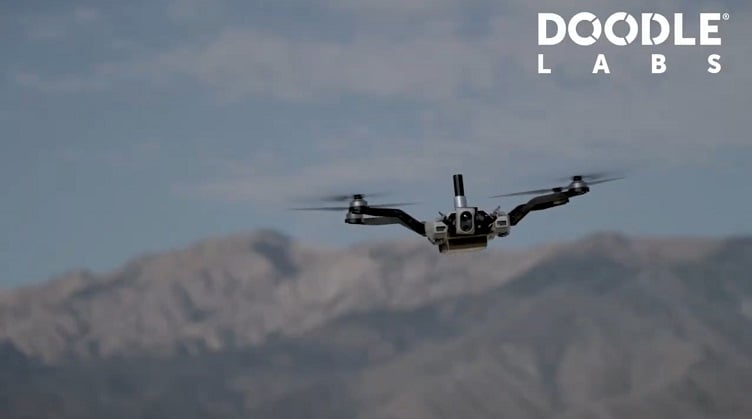
Armed conflict is spreading across swaths of the planet amid a warfighting paradigm shift that sees heavy artillery pushed aside in favor of fleets of cheaper, remotely controlled devices such as drones and robots.
Where physical destruction once provided the only defense, sophisticated electronic warfare systems — jammers and spoofers — can now disable attack weapons without touching them by disrupting operator control links and confusing GPS signals that guide them to their targets. Innovators are racing to find new solutions to keep those drones connected amid the ever more sophisticated electronic warfare onslaught.
While in the early days of the war, cheap, off-the-shelf drones bought from Amazon received instructions from operators via two radio frequency bands (2.4 GHz and 5.8 GHz), today’s drones must be able to switch between a vast range of frequencies from 200 MHz to 1,500 MHz, hopping from one to another as jammers target the links.
The never-ending innovation race between the drone makers and developers of electronic warfare systems has come to define the new era of warfare.
Dozens of companies in Ukraine and elsewhere are part of this race, building resilient communication systems designed to bypass the jammers overpowering the radio and satellite signals and the spoofers that attempt to override them with false ones.
While some companies bet on bespoke technology using complex and costly components such as field-programmable gate arrays — a type of integrated circuit that can be programmed after manufacturing — California-based Doodle Labs is leveraging latest advances in the 802.11 protocol used worldwide for Wi-Fi wireless networking in home and office settings.
Relying on tweaks of the widely used protocol allows Doodle Labs to move faster and more cheaply compared to competitors developing bespoke solutions using costly military technology, the company’s co-CEO Ashish Parikh, told GlobalSpec.
“We're one of the first people to take the Wi-Fi, 802.11 protocol and then adapt it to different scenarios,” Parikh said. “We are using things that are already on the market and then optimizing them, so that we are not reinventing the wheel in many types of situations.”
Modified Wi-Fi in harsh conditions
Doodle Labs, based in California and founded in 2008, originally set out to provide connectivity using modified Wi-Fi protocols in the most remote and challenging environments (the company once connected the Mount Everest base camp).
In the 2010s, the firm pivoted toward developing long-range connectivity solutions for the fast-growing field of robotics. The company, for example, connected the Boston Dynamics robot dog Spot, which can autonomously inspect and monitor dangerous or remote sites. Since the war in Ukraine started, however, the company’s focus has changed again.
“Four years ago, the U.S. Army approached us to design a radio system that could work specifically for their drones, flying at distances of 10 to 15 kilometers,” Parikh said. "They needed multiple different frequency bands for logistics reasons, to make it easy to ship their drones around the world because different continents have different frequency allocations. There was not a single discussion on electronic warfare or jamming. Now, this is obviously the most important thing.”
After the Ukraine war broke out, Parikh added, Doodle Labs' radio was among the first products on the market ready to respond to the sudden demand, its multi-band capability being conveniently tweaked to enable frequency hopping to maintain connection in jammed environments. Since then, the company has delivered thousands of radios to Ukraine’s defenders and recently set up a development team directly in Ukraine.
“Having a local team over there has completely changed our ability to support the work and the soldiers over there,” Parikh said. “There's a basic level of trust and openness to be able to share what's going on, because a lot of the data is not allowed to be released outside of Ukraine.”
Doodle Labs, Parikh added, has been able to benefit from the fast-paced iterative approach favored by the Ukrainians, whereby products are speedily tested in combat with operational experience further driving adjustments and improvements to address the needs.
 A soldier operates a drone in the field equipped with connectivity and anti-jamming technology from Doodle Labs. The company was one of the first to provide Ukraine with its technology when fighting broke out and has delivered thousands of radios to the country. Source: Doodle Labs
Adapting radios
The company’s solution, the Mesh Rider OS system, combines an innovative hardware product capable of supporting a wide range of frequency bands with a software layer, which drives the operations in the challenging conditions.
“We spend a lot of time going underneath, down to the level of packet sizing and packet timing to adapt when the radios communicate,” Parikh said.
In March, the company released a new set of radio technologies called Sense EW integrated into industrial radio transceivers, designed to provide assured communications for drones and ground robots in areas under electronic warfare attacks.
The system leverages the latest iteration of the 802.11be standard, also known as Wi-Fi 7, which was published in July 2025 and enables extremely high throughput connectivity with speeds of up to 30 GBPS, supporting 8K streaming and augmented and virtual reality low-latency applications.
“The key innovation behind Sense EW is the ability to monitor, protect and dynamically manage mission-critical communications links in real time, even under active interference,” Parikh said. “Our partners’ battlefield experience has shown that in contested environments, it’s about more than having multiple options. They need communications technology that continuously evaluates link quality, switches or combines paths, and prioritizes critical data without operator intervention.”
Drones fitted with the new solution will be able to avoid detection for longer, and maintain control even amid intense jamming.
“Instead of losing the link entirely, the system adapts to preserve command and control, enable continued autonomous operation, and protect both the operator and the drone,” Parikh said.
New jam-proof solutions
By combining the improvements enabled by the 802.11be standard with advanced chip technology, Doodle Labs hopes to unleash new jam-proof solutions enabling drones to simultaneously transmit and receive data using multiple frequency bands. Parikh described the innovation utilizing the 802.11be standard as the “number one thing happening” in the secure communications sector in years.
But no single solution is going to solve all Ukraine’s communication problems. To extend the range of both — drones and unmanned ground robots (UGVs) — Ukrainians rely on Starlink satellite connectivity. Standard radio-controlled drones can only reach distances of up to 20 kilometers, robots crawling on the ground even less. Starlink extends this range almost indefinitely, allowing the explosive-laden UAVs to penetrate hundreds of kilometers into the enemy-controlled territory. But Starlink, too, has its limitations. In addition to being effectively controlled by a single person — the world’s richest man Elon Musk — the mega-constellation cannot provide the bandwidth needed for such dense deployment of Starlink terminals as seen along the frontline in eastern Ukraine. In addition to that, the battlefield itself is not always favorable to even propagation of satellite signals.
“The main challenge in building communications for UGVs is the need to transmit video,” Misha Rudominski, CEO and co-founder of Ukrainian defense-tech start-up HIMERA, which has been developing low-cost solutions to keep Ukraine’s defenders connected. “The problem is that video transmission relies on high frequencies, which perform poorly in complex environments — particularly in forested areas. This is why solutions like Starlink can work in open areas but lose effectiveness in wooded or covered environments.”
HIMERA has recently rolled out an encrypted back-up radio for ground robots that connects to military internet networks and can also serve as a signal repeater to extend the range of radio links where Starlink is not available.
Whatever ingenious solutions the technologists introduce, the cat and mouse innovation race is set to continue for the foreseeable future and new ways of securing communications will continue to be needed.
