
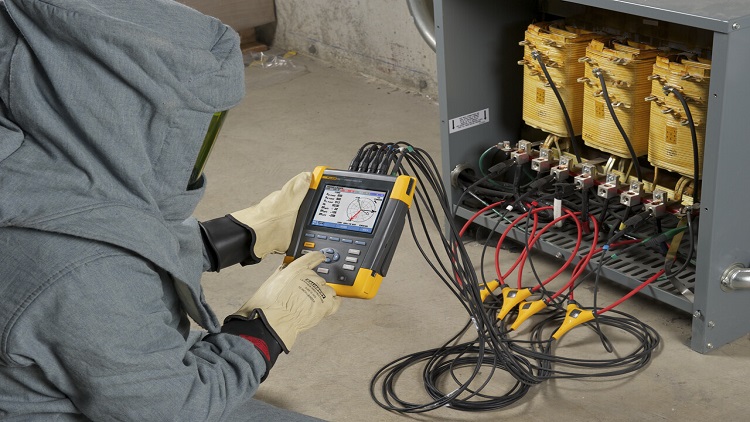
A power analyzer provides real-time data on voltage sags, swells and transients, allowing technicians to address power quality issues before any damage occurs. Without constant monitoring, unexpected power disturbances can lead to costly repairs and maintenance downtime. This device measures and analyzes the electrical waveforms to detect any inconsistencies or abnormalities that could damage machines. Regular monitoring ensures that the power supplied to the equipment remains stable and within acceptable limits.
What is a power analyzer?
A power analyzer, or power quality analyzer, is a piece of equipment that checks the voltage and current being supplied to electronic gadgets. To put it simply, power quality refers to how well an electrical supply and its connected load get along. There is a risk of load damage or malfunction due to poor power quality. Several factors contribute to subpar electrical supply, and power quality is evaluated based on the signal's voltage, frequency and waveform. Good power quality is defined as a supply voltage that is constant and within specified limits, an alternating current (AC) frequency that is constant and near to the rated value, and a voltage curve that is smooth.
[Learn more about power analyzers on GlobalSpec]
Disruptions in service, voltage fluctuations, transient currents and an increase in harmonic distortion in AC power are all potential factors affecting power quality. Using a power analyzer for troubleshooting allows for more accurate calibration and elimination of problems such voltage dips, voltage spikes, harmonic distortion and imbalance.
How does a power analyzer differ from a digital multimeter?
The voltage and phase needs of modern electrical systems are often flexible. Digital multimeters (DMMs) provide numerical readings for single-phase testing. In contrast, the power quality analyzers assess all three phases, providing for comprehensive system monitoring and it even provides a visual representation of the information.
Features of a typical power analyzer that help in troubleshooting
- Waveform display. A picture of the waveform is equal to a thousand voltage values. The user can observe how things really are functioning in the system. For example, flat-topping is a sure sign of an overloaded transformer; by keeping an eye out for it, the transformer can be prevented from overheating and breaking down. Waveforms captured by some power analyzers can be of value in research projects.
- History. Users may save waveforms from various times and places, then access them later to make comparisons, conduct analyses or transfer data. For example, the inrush current from a motor that unexpectedly trips might be recorded and analyzed to determine the source of the problem.
- Analysis. The analysis with power analyzer is easier. The root-mean-square voltage, peak-to-average voltage, peak-to-current ratio, crest factor, power (in watts, volt-ampere-seconds, and kilowatt-hours), power factor, displacement power factor, and frequency may all be trended. Instead of taking thousands of readings with a DMM, abnormalities may be revealed by looking at the patterns. For example, the user may examine the factors that contribute to the high peak load fees. Harmonics may be shown in either a spectral or tabular format, which is a nice bonus.
- Communication. The data collected by power analyzers can be sent to other computers through ethernet or USB for additional study.
- Employ system monitoring. Taking regular snapshots of system benchmarks and then automatically comparing them is a great way to ensure that the electrical system is performing at peak efficiency. Regular preventive maintenance employs an automated comparison to spot issues including arcing breaker contacts, rusting grounding connections, dripping power factor capacitors and early-stage winding breakdown in electric motors.
- Inputs from a number of different channels. Phases can be compared in real-time. Due to the ever-changing nature of current, it is essential to do simultaneous phase comparisons. When comparing Phase A and Phase B with DMMs, users need two DMMs and can only take one reading at a time. For example, real-time phase comparison reveals the extent of a motor's imbalance, allowing users to make adjustments before the motor overheats.
Applications of a power analyzer
Power quality evaluation is crucial because of the proliferation of electronic devices and the rising sensitivity of electrically powered loads. The following are some more uses for a power analyzer:
1. In order to maximize energy efficiency, it is necessary to collect data on a number of relevant electrical variables in real time.
2. To find out what the electrical problems are.
3. Analysis of variable-speed motor drives as it requires precise power measurements.
4. As a means of regulating and cutting back on wasteful energy consumption.
5. Calculating standby power consumption with software.
Conclusion
In order to guarantee the optimal performance of electrical systems, tools like power analyzers must be used for routine monitoring and troubleshooting. Simply hook up the device, check the condition (either numerically or visually), record the data and then share it with other systems for deeper study. Additionally, utilizing standby power management software can help identify areas of improvement and reduce energy waste. This can result in cost savings and a more efficient use of resources.
