
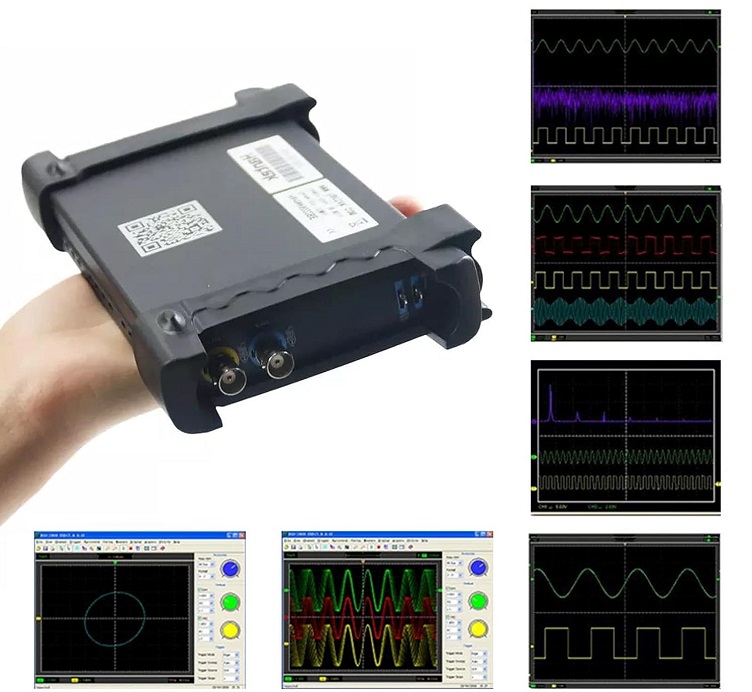
Engineers and researchers in the field of electronic systems, circuit boards and integrated circuits utilize oscilloscopes to display, graph and analyze electrical signals. These tools are essential for research, validation, quality assurance and troubleshooting processes. Digital electronics, optical communication, radio frequency, power electronics, automotive, aerospace and defense are just a few of the many fields that rely on oscilloscopes. The bulk and weight of conventional oscilloscopes are their primary drawbacks. Because of this, standard oscilloscopes are reserved for more formal environments like classrooms and laboratories and are not typically brought along on field trips.
For this reason, portable oscilloscopes are the way to go due to their portability and ease of use. While most are on the smaller side, there is a wide range in size; the tiniest portable oscilloscopes are roughly the size of a coin. Nevertheless, their stature is in no way a constraint on their features. Their tiny size doesn't diminish the amount of information and features they hold. One major benefit of portable oscilloscopes is that they can perform as well as larger oscilloscopes. Because of this, they find widespread application in routine testing and field operations. Everyone whose job requires them to utilize oscilloscopes often would benefit greatly from owning a portable oscilloscope.
Features of a portable oscilloscope
- Battery-powered — Can operate without AC power, ideal for outdoor/remote locations.
- Compact and lightweight — Easy to carry and use in tight spaces.
- Touchscreen and button controls — Some models offer both for ease of use.
- Built-in memory and USB connectivity — Saves waveforms for later analysis.
- Multiple input channels – Typically two or more, allowing differential signal comparison.
- Auto-triggering — Helps stabilize the waveform for clear viewing.
- FFT analysis — Converts time-domain signals into frequency-domain for advanced diagnostics.
- Rugged design — Often shockproof and dust-resistant for industrial use.
- Wi-Fi/Bluetooth connectivity — Some models can transmit data wirelessly for remote monitoring.
Example of field testing
Envision yourself in the middle of a textile factory troubleshooting a three-phase induction motor that is operated by a variable frequency drive (VFD). The motor is making too much noise and vibrates too much to be considered functional. The portable oscilloscope can be used for testing as follows:
1) Check the VFD output voltage waveform
- Connect oscilloscope probes to two phases of the motor output from the VFD.
- Set the oscilloscope to differential mode (if available) to observe phase-to-phase voltages.
- Look for distorted or unbalanced waveforms, which might indicate harmonics or faulty switching.
2) Measure frequency and PWM signal
- Switch to frequency measurement mode to confirm the VFD is providing the correct frequency.
- Inspect the pulse width modulation (PWM) waveform driving the motor.
- If pulses are irregular, the issue could be VFD misconfiguration, bad power transistors or interference.
3) Identify transient spikes
- Use the peak-detect mode to check for voltage spikes that can damage insulation.
- High-frequency noise or ringing may indicate improper grounding or poor filtering.
4) Monitor phase imbalance
- Compare all three phase waveforms to check for imbalance.
- If one phase has a lower amplitude, the motor might have an open winding or a bad VFD output.
Types of portable oscilloscopes
There are several types of portable oscilloscopes available in the market that may be used for field testing as per requirements of the project.
1) Handheld oscilloscope
For on-site diagnostics, troubleshooting industrial machinery and power electronics, this type is the best option.
Features:
- Small, battery-powered, rugged design.
- Built-in screen, buttons and sometimes a touchscreen.
- Often includes a multimeter function.
2) USB oscilloscope
Engineers that want portability yet prefer a laptop interface for extensive analysis are the ideal candidates for this product.
Features:
- Small probe-like device that connects to a laptop via USB.
- Uses the computer screen for display and analysis.
- Can record and analyze waveforms in-depth.
3) Tablet or wireless oscilloscope
This type is particularly useful for internet of things (IoT) applications and wireless remote monitoring.
Features:
- Connects to a smartphone or tablet via Wi-Fi/Bluetooth.
- Offers cloud storage for waveform data.
- Compact and lightweight for field use.
4) Automotive oscilloscope
The is ideal for diagnosing electronic systems in vehicles, including ignition, sensors and CAN bus.
Features:
- Optimized for low-frequency signals from vehicle sensors.
- Includes automotive diagnostic software.
- Often comes with special probes for engine testing.
5) Mixed signal oscilloscope (MSO)
Troubleshooting both analog and digital signals in embedded systems is the best application for this tool.
Features:
- Combines oscilloscope plus logic analyzer.
- Captures both voltage waveforms and digital data.
- Used for microcontrollers, FPGA and serial bus analysis (I2C, SPI, UART).
6) Pen-type oscilloscope
Pen-type oscilloscopes are ultra-portable oscilloscopes that are the size of pens and are designed for making waveform measurements in the field as quickly as possible.
Features:
- Compact and lightweight — Small enough to fit in a pocket or tool bag.
- Single-hand operation — Built-in probe makes it easy to use on-the-go.
- Basic measurement functions — Measures voltage, frequency and waveform shape.
- Limited bandwidth — Typically 5 MHz to 20 MHz, suitable for low-to-mid frequency signals.
Conclusion
The traditional oscilloscope is more often seen in academic settings, such as labs and classrooms, and is not usually brought in the field. Because of its mobility and user-friendliness, portable oscilloscopes are now ideal for testing in the field.
