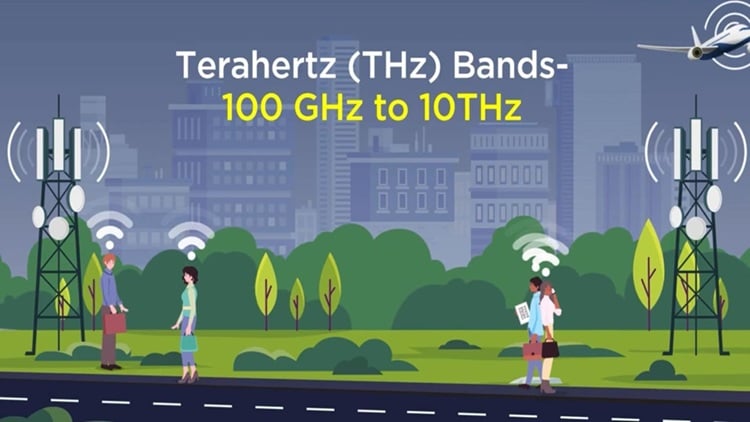
Rapid advancements in wireless cellular communication from 1G to 6G have improved connectivity for more than just people. Industrial machinery, vehicles, sensors and household appliances are becoming increasingly intelligent and can link with one another. This trend is expected to persist until 2030, eventually leading to the intelligent connection of everything, everywhere, at all times. We can open up a world of new possibilities can be had if terahertz (THz) can operate with 6G.
Among the numerous potential pillar technologies that fulfill the needs of 6G in 2030 and beyond, the THz band (0.1 THz to 10 THz) offers extremely high user data rates on the order of terabits per second (Tbit/s) and enables a vast array of linked devices. This is because transmission rates in the THz range are quite high and the available bandwidth is extremely big. Hence, if a way to achieve a Tbit/s communication rate without using air interface technology is needed, THz communication is a great choice. Its use is anticipated in holographic communication, small-scale communication, ultra-large-capacity data backhaul and short-distance ultra-high-speed transmission, among other scenarios.
Challenges in THz communication
Many important technologies must be investigated before THz communications may be used in the real world. These include channel modeling, multibeam antennas, front-end chip design, baseband signal processing and Tx and Rx resource management. The processing of baseband signals and the management of resources are preconditions for an accurate THz channel model.
Modeling of THz channels
In most cases, inside or with short-range transmission, the current THz channel measurements are performed at 300 GHz. The creation of THz channel models will require these higher-frequency band observations in the future. The situations should also be broadened to include outdoor or other specialized settings.
Regarding THz channel modeling, artificial intelligence (AI) shows great promise. A huge number of channel measurement/simulation databases allows examination of the intricate web of correlations between channel properties and various frequency bands, scenarios and system configurations. Machine learning regression techniques are employed to forecast future channel properties using channel measurement/simulation databases, under novel conditions and at unknown frequencies.
Terahertz multibeam antenna
There is a significant need for future applications of fully integrated multibeam THz antennas that can produce multipolarized beams, such as dual circularly and dual linearly polarized. Additional research into effective shared aperture technologies and structural designs is needed to significantly reduce the front-end module’s form factor. To further reduce loss and achieve accurate, low-cost implementation of THz antennas, it is vital to investigate novel materials and processing techniques. Design of THz front-end chips splitting, optimizing and assembling is the common knowledge when it comes to radio frequency (RF) front-end design. Electronics have benefited greatly from this traditional approach. This method does, however, reveal its limitations at THz frequencies.
Processing of THz baseband signals
Because of the distinctive band-splitting characteristic of THz communications, distance-adaptive modulations will be sought, particularly over long distances. For low-power applications like nanonetworks, this adds unnecessary complexity and is hence undesirable. In the THz band, where spectral efficiency is not a problem, low-order and noncoherent modulations could be used as a solution. Precoding and beam shaping rely on precise channel state information. When dealing with mobile settings, channel estimation and tracking in the THz range can be particularly problematic due to the tremendous impact that even small variations can have on the channel state. With THz systems anticipated to be double massive MIMO, obtaining the precoding and beam-forming matrices also requires solving high-dimensional optimization problems.
THz management of resources
Significant obstacles, including energy efficiency, resource management and big data, will be encountered by network and service administrators. Consequently, smarter and more efficient solutions to these problems require new technologies and approaches. One of the efficient ways for managing massive amounts of data is machine learning, a developing field of the AI-assisted network. By optimizing resource allocation using machine learning, the network can fulfill predicted demand based on criteria like location, time and unique service requirements of individual users. This is highly useful. By using machine learning into THz risk minimization and radio resource management, smarter, more efficient solutions can be realized along with improved power usage and spectrum utilization.
Establishment of THz signal transmission
There is a pressing demand for improved performance and operational methodologies for the fundamental components utilized in THz communications. In order to encourage development to other fields, THz system integration presents another enormous obstacle. Nonetheless, the significance of THz communication technology in both civilian and military contexts is only going to grow.
Conclusion
The future of THz communication will largely depend on continued advances in semiconductor technologies, antenna design, AI–driven network management and high-frequency testing tools. As research progresses toward practical 6G systems, THz links are expected to complement existing wireless bands by enabling ultra-high data rates, short-range terabit-per-second communication and massive device connectivity.
