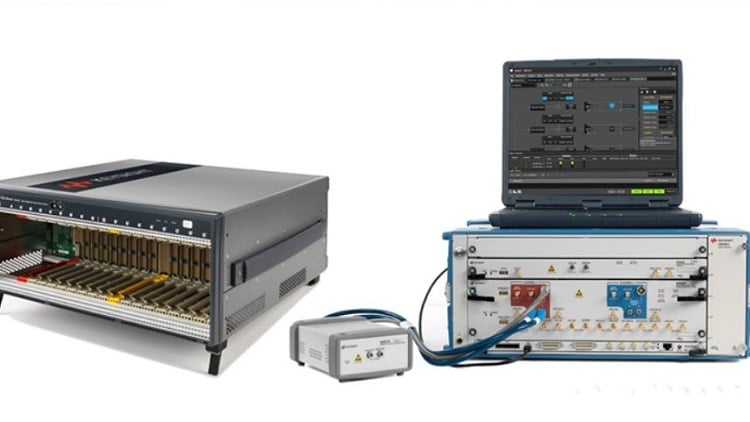
In the past 50 years, oscilloscopes, analyzers and meters have demonstrated significant utility in test and measurement, whether for rise time measurement, signal period assessment, peak-to-peak voltage identification, spectral analysis of high-frequency signals or electrical parameter measurement. These devices are the foundation of several applications, spanning from test benches to sophisticated automated testing systems. Modular hardware designs now provide engineers with the option to adopt software-driven platforms that are versatile. They are suitable for current uses like 5G/6G communications, electric vehicles, aerospace systems and semiconductor testing since this method allows for quick modification, scalability and integration.
Need for software defined modular instruments
As applications and devices become increasingly complicated and technologically convergent, these instruments have significantly advanced since their inception, integrating the latest commercial technologies to satisfy the rigorous demands of cost reduction and extended system longevity. Organizations are shifting from traditional rack-and-stack instruments and closed-architecture automated test equipment to advanced test systems that provide continuous connectivity and problem-solving capabilities, aiming to match or surpass the performance of the devices under evaluation.
These days, software-defined virtual instrumentation is the foundation for modular meters, analyzers and oscilloscopes. In order to save space, cut costs and provide a test instrument that can be customized, these modular instruments share common components including the chassis, display and power supply across different instrument modules.
Commercial software-defined instrumentation platforms
In a modular instrument, the host computer rather than the instrument itself stores user-defined software, which specifies the instrument's capabilities. It is impossible to exaggerate the importance of software in modular instrumentation. Engineers may easily adjust to evolving test requirements with a software-defined modular instrumentation system. Software allows them to integrate several modules of instrumentation into a single user-defined instrument with shared clocks and triggers. PXI is one of many software-defined instrumentation platforms used to create modular automated test systems. With over 1,500 software-defined PXI instruments and 70 vendors (including Agilent Technologies, National Instruments and Rohde & Schwarz), PXISA is a formidable force in the industry.
When compared to older generations of hardware-defined instrument systems, engineers that choose test systems built on modular, software-defined instrumentation can achieve better performance and more flexibility. For instance, for the Xbox 360 controllers, Microsoft required a reliable testing method. With the addition of new PXI modular instruments and quick adaptations to the current software-defined Xbox test system, Microsoft engineers were able to fulfill the increased test criteria. The new PXI tester increased test throughput per station by a factor of one hundred.
Advantages
- Flexibility and customization: Software defines functionality, allowing for the fast reallocation of hardware for various purposes.
- Modular architecture: Components utilize a shared chassis, power supply, and cooling system, thereby minimizing space and expenses while facilitating high-performance, specialized modules.
- FPGA-based performance: High-speed field programmable gate arrays (FPGAs) are employed for data collecting, signal processing and customizable functionality.
- Improved automation and test: Optimized for automated test equipment, minimizing test durations and accommodating intricate, evolving device specifications.
- Software ecosystem: Frequently employs graphical programming languages, like LabVIEW, and drivers such as NI-DAQmx or IVI for expedited application development.
Applications
1. Telecommunications (5G/6G and RF Systems)
In modern telecom systems, engineers can use modular radio frequency (RF) transceivers, digitizers and waveform generators to:
· Generate and analyze wideband signals used in 5G and upcoming 6G systems
· Perform beamforming and massive MIMO testing
· Validate signal integrity under real-world conditions
2. Semiconductor testing
In semiconductor manufacturing, software defined modular instruments play a key role in both design validation and production testing:
· Testing high-speed digital ICs (GHz-level signals)
· Performing parametric and functional tests on wafers
· Supporting automated test equipment systems
3. Automotive electronics (electric vehicles and autonomous systems)
In modern vehicles, modular instruments can help in:
· Testing battery management systems (BMS) and power electronics
· Validating radar, lidar and sensor fusion systems
· Simulating real driving conditions using programmable signals
4. Aerospace and defense systems
In aerospace and defense applications, engineers get help in:
· Testing radar and communication systems
· Simulating electronic warfare environments
· Validating avionics under harsh conditions
5. Industrial systems and condition monitoring
In industrial environments, they can be used for continuous monitoring and predictive maintenance:
· Collecting real-time data from sensors (temperature, vibration, voltage)
· Detecting anomalies using software algorithms
· Integrating with IoT platforms for remote diagnostics
6. Consumer electronics and product development
In fast-paced product development cycles, modular instruments help by allowing:
· Engineers to use modular instruments for rapid prototyping and debugging
· Testing wireless standards like Wi-Fi, Bluetooth and internet of things (IoT) protocols
· Performing EMI/EMC compliance testing
Conclusion
As devices continue to become more complex and include more disparate technologies, test systems must become more flexible. The best way to accomplish this is through software-defined instrumentation, which helps engineers develop scalable, high-performance test systems. As electronics continue to grow in complexity, modular instrumentation will play a critical role in ensuring accuracy, efficiency and innovation across all stages of product development and manufacturing.
