
Signal analyzers are widely used in the design, manufacturing and field service of electrical systems and devices; for a helpful overview, try this GlobalSpec explainer. But if, like me, you’re the sort of person who needs real-world examples to fully grasp these sorts of technical concepts, you might look to a couple recent news releases from Keysight Technologies. Both leverage signal analysis to solve challenges, such as shortening the time it takes to develop wireless communication devices or ensuring quality of service (QoS) for satellite communications.
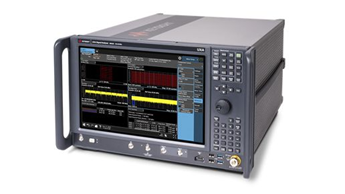 The introduction of a real-time spectrum analysis solution for the N9042B UXA Signal Analyzer, above, is one example of leveraging signal analysis to solve challenges. Source: Keysight Technologies One critical aspect of developing wireless communication devices is measuring and validating the signal quality of power amplifiers used to boost signals. During the research and development phase, this can be a time-consuming task involving hours or even days. Keysight’s answer is a new iterative learning control (ILC) test method designed to shorten digital pre-distortion (DPD) test times. According to the company, the ILC DPD test method optimizes Keysight measurement software to reduce power amplification characterization times to a matter of minutes, and it uses both a signal generator and the N9032B PXA Signal Analyzer to ensure test performance.
Keysight also reports that Hexawave, a fabless semiconductor manufacturer, was the first to deploy the ILC test method to characterize its new HWA1330 5G gallium arsenide (GaAs) power amplifier up to 4 watts in the 3.3 to 3.8 GHz frequency range. The method validated the PA’s ability to meet design targets — including more than 30% power added efficiency (PAE), 35.5 dB power gain, and below -50 dBc adjacent channel leakage ratio (ACLR) at 100 MHz bandwidth and 8.5 dB peak-to-average power ratio (PAPR) with DPD.
Meanwhile, a real-time spectrum analysis (RTSA) solution has been introduced for Keysight’s N9042B UXA Signal Analyzer, enabling up to 2 GHz of bandwidth to monitor satellite signals and interference. As Keysight explained, signal interference has increased as the satellite communication industry moves to high-throughput satellites and as traditional SATCOM frequency bands have been auctioned to terrestrial wireless operators. Interference monitoring in real time allows operators to identify anomalies and mitigate service degradation. According to the company, the new solution also speeds design and testing of satellite payloads, lowers prototyping costs, and accelerates time-to-market through the use of digital twin technology.
