
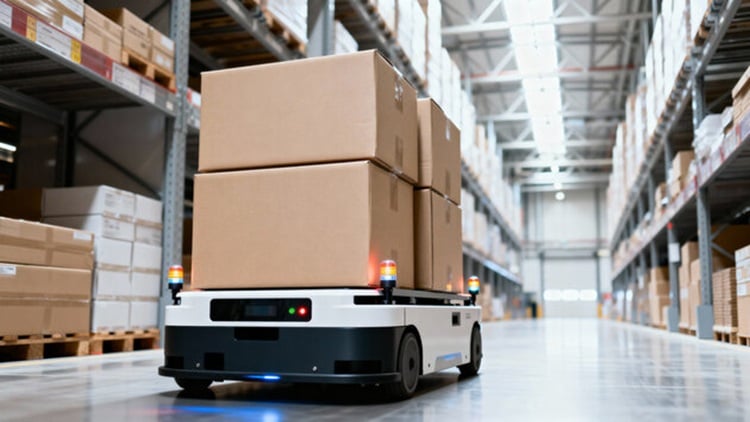
The emergence of Industry 4.0 and intelligent logistics made intralogistics automation a pivotal focus for manufacturing, warehousing, e-commerce and retail sectors. For decades, automated guided vehicles (AGVs) were the preferred method for material handling. In the past decade, autonomous mobile robots (AMRs) have swiftly emerged, providing flexibility, intelligence and scalability, thereby increasingly supplanting AGVs as the predominant technology. AGVs adhere to predetermined courses and necessitate explicit directives, but AMRs utilize sensors and sophisticated software to navigate dynamically and respond to their surroundings.
How AGV systems work
AGV systems autonomously move materials from one location to another by following pre-defined routes and have been a boon to warehouses all around the globe for many years. Magnet strips, quick response codes or laser navigation systems serve as physical indicators that direct their courses. The accuracy and dependability of AGVs are attributed to the paths they have already been programmed to follow. Because of their rigid design, they are best suited for mundane, repetitive jobs, such as moving parts along assembly lines in the car industry or sanitary products along predetermined routes in the food and drink sector. They are especially useful in logistics for warehouses, as they make regular trips between the incoming and outgoing sectors.
An AGV control system is in charge of issuing driving commands, keeping tabs on all the vehicles and making sure everything is running well. Who begins what time is precisely known by the warehouse control center — In what areas do you see obstacles? Which shipment is more important? — The algorithm "thinks" along, but it does so only according to predetermined parameters. Changes to workflows, such a different warehouse layout or a new route, necessitate technical interventions, such as reprogramming systems, redefining routes and adapting infrastructure, all of which can be rather costly and time-consuming. This inflexibility becomes a hindrance in situations that are constantly changing. Nevertheless, AGVs demonstrate exceptional dependability while operating in stable routines. Another attractive option is AMRs, which provide more mobility and autonomy.
How AMR systems differ from AGVs
AMRs are the next generation of self-driving transportation systems. They are more modern and flexible than AGVs. Like AGVs, they can move around warehouses on their own. AMRs use advanced sensors, cameras and artificial intelligence (AI) to change how they work in real time. Instead of following set routes, advanced motor routes use complex algorithms to figure out the best way to go. An AMR doesn't just stop; it quickly finds a new way to go if a pallet unexpectedly blocks its way. It's very important to be able to quickly adapt to new situations.
Because of the constant change in warehouse structure and requirements, AMRs work wonderfully in dynamic contexts such as e-commerce. Their ability to provide materials to production lines at the precise moment is a key component of their manufacturing success.
Key differences
|
Dimension |
AGV |
AMR |
| Flexibility | Fixed routes that are difficult to alter | Software-based dynamic optimization |
| Navigation | QR codes, Magnetic tape, reflectors | Incorporating SLAM and AI sensing |
| Safety | Discontinues when obstacle is encountered | Actively evading obstacles (ISO 3691-4) |
| Cost | Reduced starting costs, increased retrofitting | Greater return on investment (ROI) at the outset |
| Deployment | Extensive (construction required) | Quick (mapping in days) |
| Efficiency in scaling | It is necessary to reinstall new routes | Fleet easily expanded |
How to choose between AGV and AMR systems
AGVs perform best in places where the layout is fixed, the workflows are predictable, and the transport tasks are the same every time. They follow set courses utilizing physical or marker-based guidance, including wires, magnetic strips or QR codes. AGVs are very dependable because of their deterministic navigation. They also need less onboard computer power and are easier to control with centralized fleet management but usually require greater investment to build the infrastructure and take longer to set up. They are often utilized in production lines, pallet transfer and other stable manufacturing settings where the investment is expected to pay off over a longer period of time (around two years or more).
AMRs, on the other hand, are made for situations that are always changing, such as when layouts, processes or task priorities change. They can move around freely without set paths because they have advanced sensing and intelligence like lidar, cameras and SLAM-based navigation. AMRs can work with people, change routes in real time and usually don't need much work done to the facility, which means they can be deployed faster and get a return on investment (ROI) faster (often within a year). AMRs cost more per unit and require more complicated software, but they are more flexible, scalable, and adaptable. This makes them good for smart factories, mixed logistics operations and Industry 4.0/5.0 settings.
In real life, a lot of modern facilities are using hybrid fleets where AGVs handle heavy, repetitive fixed-route transport and AMRs handle dynamic material movement and activities that require human interaction. The main choice is frequently between stability and predictability (which favors AGVs) and flexibility and adaptability (which favors AMRs).
Conclusion
Autonomous systems with sophisticated sensors and AI are becoming the norm in the robotics industry. Automaton is evolving into more than just a command-and-control system; it can now make decisions and work with humans in real time. Choose AGVs for a highly structured environment with consistent, repetitive or long-term workflows, such as fixed assembly lines or pallet-to-rack, long-haul movements. For activities that require high-frequency, short-range and flexible picking, or that deal with dynamic, ever-changing layouts or workflows, or that demand rapid automation deployment (as in flexible manufacturing or e-commerce), AMRs are the way to go.
