
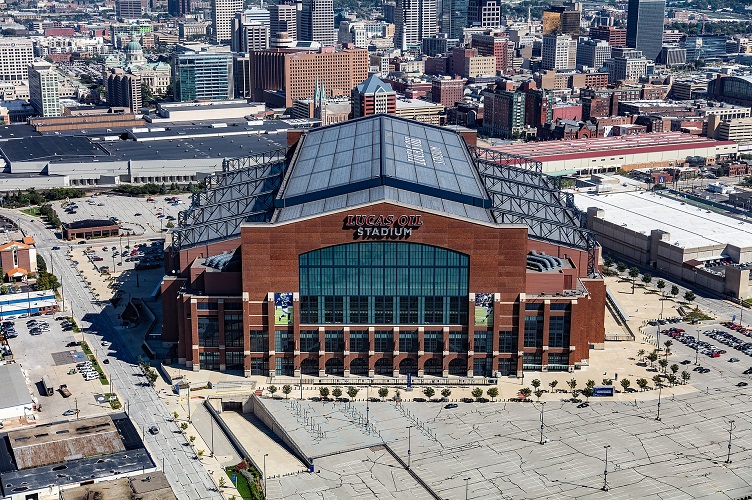
While most of the world is still under lockdown and having to conform to social distancing mandates due to the outbreak of the COVID-19 pandemic, the emergence of vaccines has hope that soon life will return to somewhat normality. With it, people will soon be returning to theaters, concerts and sporting events. However, when they return, new technologies will be in place to offer a better viewing experience.
One of these new technologies is 5G, which has been added to several smart venues to bring new views of the action, statistics, augmented reality and more.
New smartphone experience
5G phones are getting more common and more available to the general public. Already, 5G has been installed in stadiums worldwide and more are coming, allowing participants to enjoy new experiences while inside the venue.
Concerts or sports games feature several cameras inside the venue and attendees can choose these for streaming to their mobile devices concurrently, and they are all synchronized. Fixed cameras, mobile cameras or even drones will be filming the event simultaneously. Car racing, bike racing and horse events are all suitable to use 5G connected cameras for 4K video streaming when the total weight of the devices are under 150 grams or less, like compact 5G phones so that it will not affect the racing speed.
These features are a supplementary experience that will provide a new atmosphere to be inside the venue. Multiple angle videos can be available anywhere but the best place to consume them, concurrently with the real thing, is right inside the venue. It enhances the enjoyment even further when you are sitting far away from the stage because it is the live audio from the venue with the multiple angle videos on your hand.
Augmented reality (AR) information can be displayed on a phone for statistics or historical information of the player. These features need to be in the precise location of the viewer, which can be easily achieved with many existing technologies, but it also needs the speed of 5G to upload the video for analyzing the perspective of the viewer and return the AR information for overlaying in 20-30 milliseconds.
Head-mounted phones
Taking another step further, it is not uncommon to use our mobile phone as the head-mounted viewer of AR and virtual reality (VR) content and some low-cost mounts like Google Cardboard will be suitable and can be included in the ticket price, distributing at the stadium. Consumers can put in their own phones to enjoy the virtual visual effects with synchronizing live audio. Stationed 360 degrees cameras can also be set in the stadium, therefore attendees can choose which angle to view from, and can turn their heads around for an immersive experience.
Emerging events
New types of events that may not have been thought of before may emerge. For example, eSports streaming, which is not those PC gaming events but racing with remote control cars or even drones. 180 or 360 degrees of cameras attached to the vehicles for real-time video streaming, and each audience can select which vehicle to watch inside the venue.
Technologies behind the scenes
The responsiveness and large bandwidth of the 5G connections in these scenarios will become essential, going beyond other typical 5G use cases. In order to reach such a high requirement, mobile edge computing (MEC) must be used. Due to the nature of the consumption model that all these responsive visual effects will not be consuming anywhere else but just at the stadium during the event, it is meaningless to have the real-time visual content stored and processed elsewhere but also inside the stadium with MEC. All the traffic will not be going through the mobile backhaul, but flow like inside a wireless local network, thus the response time will get even better, bandwidth can be better controlled and guaranteed, and it will not impact the public consumption of the 5G network.
However, coverage inside the venue will be a huge challenge. Increasing the density of the traditional distributed antenna system (DAS) will induce interference because the coverage from each antenna will be overlapping, and it degrades the experience. VIP seats are usually having bad signals as well because they are too far away from the top of the stadium. We can have a smart venue specific solution, that is installing 5G small cells antennas under the seats. The radio frequency (RF) coverage from each of these cells will be coordinated and shaped to ensure its coverage area will not be interfering with those from other seating sectors. These small cells will be operating in low-power mode so that they will not interfere with each other and they are also safe to be so close to the human body. Not only this solution can help to enhance coverage but also providing better location information of the end device that will be very useful in AR consumption.
These small cells will be a supplementary solution to coexist with the legacy DAS. They will be helping in the RF coverage of 5G mid-band and low band. 5G high-band with millimeter-wave (mmWave) can also be added as another supplementary capacity layer that provides a line of sight coverage for the supreme speed and experience.
