
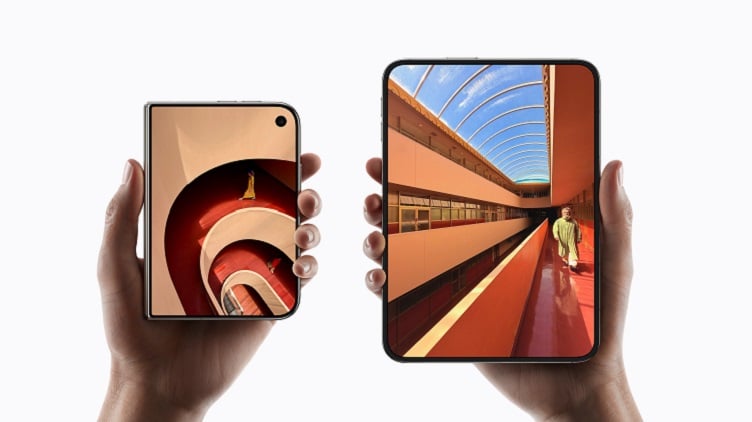
Apple upset the foldable smartphone sector this month when it introduced its first foldable iPhone that can fold down to a passport-size phone and that features a 7.6-inch inner display.
The rollout of the iPhone Duo is likely to expand the popularity of the foldable phone sector significantly, shifting competition toward differentiated structural designs that may have rivals reassessing foldable strategies, according to market research firms.
“Apple appears to have hit it out of the park with the iPhone Duo,” said Nabila Popal, senior director with the Data & Analytics team at International Data Corporation (IDC). “While a passport-size form factor is not new, the execution here looks quite good. The user experience is intuitive and fluid.”
Popal added the Duo could stand out among a crowd of foldable devices and ultimately could be a blockbuster product for Apple. IDC forecasts Apple will account for 81% of net foldable value added and 71% of net unit growth in the foldable smartphone sector between 2026 and 2030.
Changing materials
As a result of the iPhone Duo introduction, market research firm TrendForce expects a shift to begin the foldable sector to focus on thinner, lighter designs, an emphasis on reducing creasing between displays and increasing long-term reliability.
Creasing between displays no longer solely depends on hinge design or any single materials, instead, TrendForce expects vendors to move to co-design of ultra-thin glass (UTG), optically clear adhesive (OCA), OLED modules and support structures.
The firm said suppliers will be able to better control stress distribution across the folding area by optimizing:
- Material modulus
- Thickness distribution
- Layer positioning
Additionally, iPhone Duo’s inner display module features a 10-layer stack of thin materials combined with nano-texture surface treatments to reduce reflections and make the crease less visually noticeable. This may influence how other foldable vendors create future iterations of foldable smartphones, TrendForce said.
Tradeoffs
Another dynamic that could impact the foldable sector is the tradeoff in technology to benefit other areas of a smartphone. This could be anything from focusing on device thickness, camera capabilities, biometric components and battery space.
For example, the Duo omitted a dedicated periscope telephoto camera to conserve internal space. It suggests that Apple is not just pursuing a phone with a larger foldable display but is looking toward long-term reliability with the crease reduction technology and integration of the display module with the overall device, the firm said.
These changes in the foldable environment will likely follow a series of structural realignments for the foldable sector as the iPhone Duo begins to take market share away from the other foldable phone vendors, TrendForce said.
TrendForce forecasts that iPhone Duo shipments will reach about 5 million units this year alone, giving Apple a 24.8% share of the sector. It would make Apple the second largest brand behind Samsung.
The iPhone Duo
The Duo when closed is a 5.4-inch outer display and a 7.6-inch inner display. The phone is powered by the A20 Pro processor and features a thermal management system with a custom-designed vapor chamber and dual-battery architecture.
The display is billed as Apple’s largest ever display, about 50% larger than the iPhone 18 Pro Max. The displays features ProMotion, Always On and 3,000 nits of peak outdoor brightness.
Other features include:
- Apple Pencil support with USB-C
- Reimagined iOS 27
- Apple Intelligence
- Siri AI
