
New Yorker Electronics has announced the release of a new ultra-thin polymer electrolytic capacitor that represents a totally new capacitor form factor. The PPC Series from Cornell Dubilier Electronics (CDE), designed specifically for applications requiring high ripple current and the thinnest profile possibilities, opens up entirely new product design options.
Rated for 125° C, the PPC series combines the advantages of aluminum electrolytic and aluminum polymer 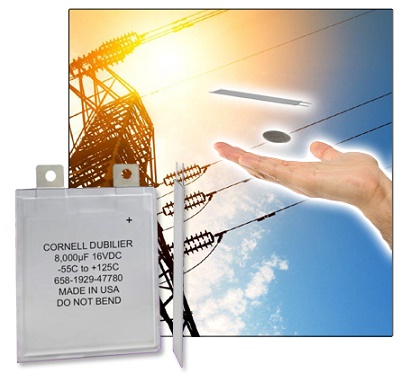 Source: New Yorker Electronicstechnology. These capacitors have the ultralow equivalent series resistance characteristics of conductive aluminum polymer capacitors in a 1 mm thin package. With high capacitance and high ripple current per volume, applications for 125° C polymer capacitors include DC/DC converters, tablets, telecommunications, thin displays and industrial power conversion.
A single PPC capacitor can handle ripple currents equivalent to dozens of surface mount capacitors or a bulky cylindrical device. CDE has stated that a single PPC capacitor is equivalent to a parallel bank of 50 or more polymer tantalum capacitors – at one fourth the height. Using a single unit means PPC capacitor solutions are lighter in weight and can improve overall circuit reliability.
Custom values are available within a capacitance range of 8,000 µF to 20,000 microfarads, with working voltages ranging from 6.3 to 24 W V DC. Cornell Dubilier plans to extend the series to higher operating voltages later in the year, which will also be available through franchise distributor New Yorker Electronics. Operating life is 2,000 hours at 125° C.
The PPC is rated for 10 g peak for vibration and withstands shocks up to 100 g (MIL-STD-202, Method 213, Condition I). With flat tin-plated copper terminations, it is possible to mount the device off-board or directly to a PCB. Mounting is by means of 3M double-sided VHB tape to ensure that the entire capacitor surface is kept rigid.
