
Researchers from Florida created a computer model that can track sea turtle babies after they hatch in Florida and enter what is known as the "lost years." The model was built to predict the movements of loggerheads, Kemp’s ridley and green turtles.
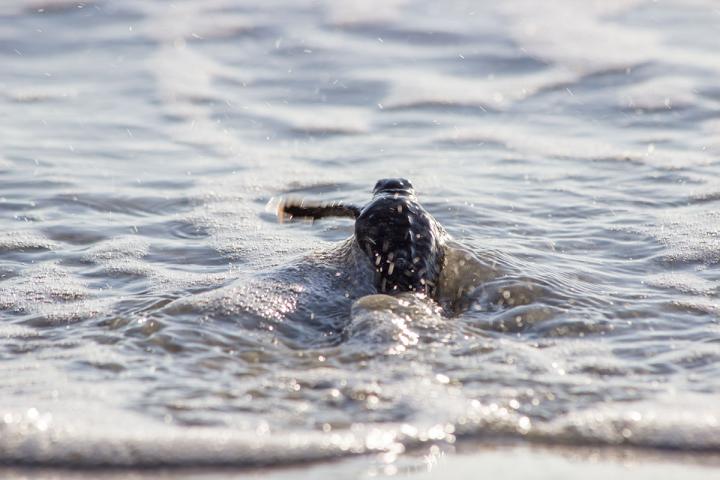 Sea turtle hatchling heads to the ocean, where it will be for several years. Those years are often referred to as the "lost years." (Source: G. Stahelin)
The team used ocean circulation data gathered over 30 years. This data is used routinely by the National Oceanic and Atmospheric Administration (NOAA). The team also used sea turtle nesting and stranding data from the Caribbean, Gulf of Mexico and Florida coasts. To check if the model was accurate, the team used stranding data. The model accounts for hurricanes and their impact on the ocean, but it doesn’t account for man-made threats.
The model predicts where turtles go during the “lost years," which is the period when turtles hatch from eggs, run down the shoreline and into the ocean. The following few years of the turtle’s life are spent living amongst the ocean sargassum. There has been little to no data gathered about these years because it is difficult to track and gather data on a baby turtle. Most turtle data is gathered when juvenile turtles return to the coastline to forage. Understanding the lost years is critical to animal research. Gathering data on those years could help researchers find what threats young turtles encounter and predict population trends.
The team found that the turtles studied typically spend a lot of their lives in other places. They migrate offshore and inshore, through the ocean waters from juvenile age until adults when they return to foraging and resting grounds. The model can be used as a helpful tool to inform conservation efforts, help animal scientists study behavior and guide policymakers.
A paper on this research was published in Ecography.
