
GL Communications Inc. has announced its latest Protocol Analyzer for Digital Data Service (DDS).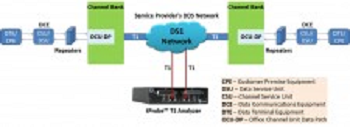 Source: GL Communications Inc.
Specialized channel cards called OCU-DP (Office Channel Unit Data Port) are connected to standard CSU/DSUs with datacomm interfaces. Both synchronous and asynchronous data is formatted and fit cleanly into a 64 kbps time slot (by repeating the data bits or bytes). The bit repetition had the added advantage of providing error correction and thus better performance. The channel data is then inserted into time slots of a standard T1. In this manner, many data circuits can be packed into a private line T1.
Explains company CEO Vijay Kulkarni, “The DDS data is formatted into frames separated by one or more bytes. The data channel may utilize multiple, all or a fractional time slot of the T1 line. Also, there may be multiple data channels within the T1 line. The captured data analyzed using GL's DDS Protocol Analyzer.”
Non-intrusive TAPs are used to passively duplicate the signal between two end points on a network link without disturbing the actual network activity. GL’s T1 Analyzer hardware can be used with RJ48 Y Bridge — splits one RJ48 into two complete — to non-intrusively tap and capture the DDS frames on a T1 line.
Important Features
- Displays summary, detail and Hex-dump views
- Streams can be captured on the selected time slots (contiguous or non-contiguous), sub-channels or full bandwidth.
- Frames can be captured in either 64 kbps, 56 kbps, n x 64 kbps or n x 56 kbps data channels (hyper-channels)
- Exports summary view information to a comma delimited file for subsequent import into a database or spreadsheet
- Capability to export detailed decode information to an ASCII file
- Status bar displaying information regarding running percent utilization, number of frames captured and frame errors, etc.
- Multiple trace files can be loaded simultaneously with different GUI instances for offline analysis
