
Quantum scientists around the world are trying to improve quantum computers to make them more reliable and powerful. The German start-up eleQtron sells groundbreaking quantum computers using microwave radiation instead of lasers to control the individual trapped ion qubits, which leads to a simpler design and much less cooling and power consumption.
This big step is possible with arbitrary waveform generators (AWGs) from Spectrum Instrumentation using advanced Direct Digital Synthesis (DDS) technology with up to 20 sine wave carriers per output to perform the quantum operations. 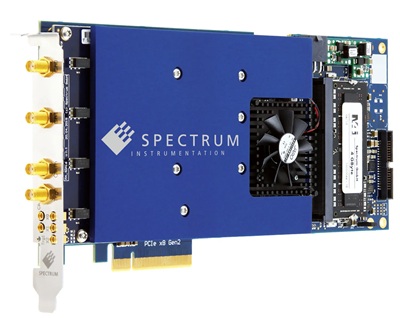 The M4i.6631 AWG, generating practically any waveform. In DDS mode, the card generates up to 20 independent sine wave carriers per channel for fast and easy experiment control. Source: Spectrum Instrumentation
The company eleQtron, a spin-off from the University of Siegen, recently delivered a quantum computer that implements their patented MAGIC (MAgnetic Gradient Induced Coupling) quantum processors. MAGIC differentiates from other quantum processor designs by using microwave radiation, instead of lasers, to control and manipulate the qubits.
Laser ablation is used initially in a high vacuum to create a string of ytterbium (171Yb+) ions. This process can build a string of up to 30 ions in a single register, each one functioning as a qubit. Key to implementing quantum algorithms is the use of a magnetic field and an oscillating electric field to generate a Paul trap (quadrupole ion trap). Many designs use a laser at this stage to control and manipulate the qubits, preparing them to execute quantum gates. Such lasers, however, must be exceptionally accurate in targeting each ion individually and have high power requirements.
By comparison, microwaves are technically simpler and require around one-fifth of the power. A high-frequency oscillator source and the output of Spectrum’s DDS card are combined using a single sideband (SSB) mixer, generating a signal around 12.64 GHz. Thanks to the Zeeman effect resulting from the magnetic field, each ion can be “addressed” by modulating the signal in deltas of 3 to 5 MHz, which offers low crosstalk and integrates nicely to chip based ion traps. The DDS card generates the multi-tone signal that is needed to implement individual control and manipulation of the qubits.
The eleQtron scientists reached out to Spectrum Instrumentation when they hit the limits of their existing AWG hardware. The signals generated have to be modified in amplitude, phase offset, pulse length and frequency in order to correctly control each qubit. This helps achieve the desired Rabi frequency that determines the speed of quantum operations. But such requirements place significant demands on the AWG.
The eleQtron team was recommended the M4i.66xx-series of 16 bit AWGs, a well-known instrument line in the community of quantum researchers worldwide. These PCIe cards can offer one, two or four synchronous channels with up to 1.25 GS/s output rate, and a large onboard memory that can be segmented to replay different waveforms. With Spectrum’s optimized drivers, data transfer rates of 2.8 GB/s are attainable, and up to eight cards can be synchronized if needed. With the additional DDS firmware, the outputs allow up to 20 sine wave cores on one channel. Each DDS core can be programmed for frequency, amplitude, phase, frequency slope and amplitude slope with just a few commands, which leads to ultrafast changes on the sine wave cores with a resolution of 6.4 ns. This helps to address more qubits and enables the flexibility in quantum processor design, which is needed to implement more complex quantum circuits. For the eleQtron team, the DDS solution was the key for their concept. They also reported about the outstanding support they got from Spectrum, from the quality of the documentation to the rapid response by the design engineers themselves.
