
Two robotic systems that promise to expedite the construction process, improve productivity and reduce waste are the focus of new research projects at the University of Stuttgart in Germany.
The projects are focused on two different approaches to robotic construction. SCALAR (multi-scalar robotic construction for autonomous on-site assembly of modular timber structures) will explore how autonomous machines can assemble prefabricated timber modules, while COBRAS (circular on-site building with robotic assembly swarms) examines how swarms of smaller robots might be used to build reusable lightweight structures.
 Source: University of Stuttgart
Specifically, the SCALAR project seeks to improve modular timber construction, wherein building components are produced off-site and then assembled at the construction site. This approach, according to the team, promises to reduce on-site construction times and timber also presents a renewable alternative to some conventional building materials.
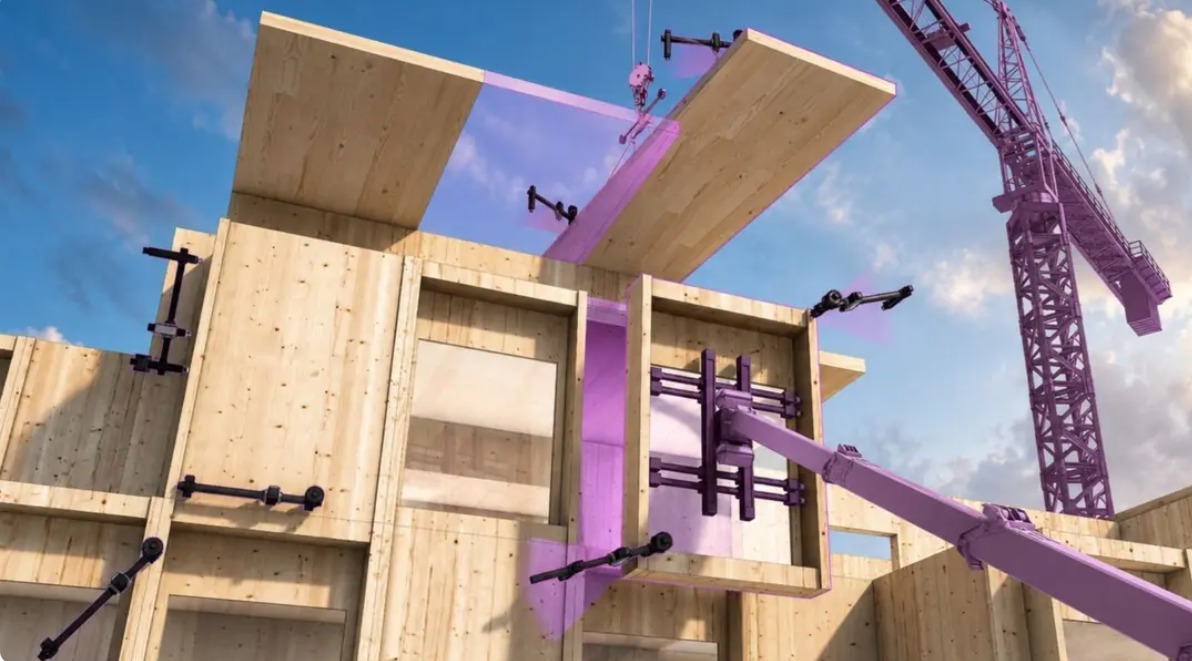
The SCALAR project combines heavy-lifting equipment with mobile robots to automate timber construction. Retrofitted cranes will move timber modules into position, while smaller robots handle precise assembly tasks. Universal connections and digital design will support the process, with virtual simulations used to rehearse each build before construction begins. On-site, a real-time control system will coordinate the machines and monitor safety, using sensors designed to operate in dusty, low-light environments. The system could support building renovations as well as new construction.
Space-frame structures can span large distances while using relatively little material, and their components can be dismantled and reused. However, the large number of individual parts makes manual assembly slow and labor-intensive. The COBRAS project aims to automate the process using swarms of identical mobile robots that coordinate without a central controller. Teams could scale to meet project demands and continue operating when individual robots are removed for maintenance. The researchers also plan to design structures specifically for robotic assembly and disassembly, allowing components to be reused or reconfigured for different sites and applications.
According to the researchers, the two three-year projects are expected to launch in November 2026. Both have won European Innovation Council (EIC) Pathfinder grants.
