
A team of researchers from Massachusetts Institute of Technology (MIT) has developed a robotic enteroscope capable of moving through the more than 20 ft long, 1 in thick small intestine — a traditionally difficult organ to navigate — for the purpose of delivering drugs, removing small polyps, taking tissue samples or performing imaging.
Inspired by snakes' ability to navigate slippery surfaces using their scales for traction, the MIT team developed a soft, tubelike robot with a textured exterior that grips the intestinal mucosal lining as it moves through the narrow organ. The robot also carries specialized tools for detecting and treating abnormalities, including polyps.
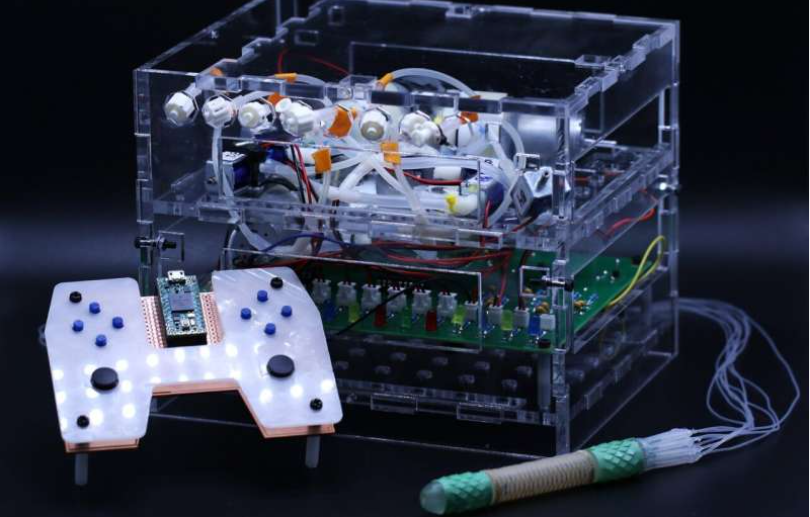 Source: MIT
The design addresses limitations of the current diagnostic approach, known as double-balloon enteroscopy. This procedure allows doctors to investigate conditions such as intestinal bleeding, lesions and blockages by advancing an enteroscope through the small intestine. A healthcare worker alternately inflates and deflates two balloons to guide the instrument through the intestinal tract. However, the process is slow and labor-intensive, requiring considerable manual maneuvering.
The researchers aimed to develop a more easily controlled system that could navigate the small intestine’s entire 20-25 ft length with less manual effort. To achieve this, they drew inspiration from snake locomotion, in which a snake steers by contracting the muscles on one side of its body and then the other.
The robot replicates this motion using four-chamber pneumatic actuators that inflate in different combinations to extend the tube or bend it in any direction. Additional inflatable balloons at the head and tail alternately expand and contract to anchor the robot against the intestinal wall and propel it forward. Both ends also feature patterned sleeves inspired by kirigami, the Japanese art of cutting and folding paper, which help the robot maintain traction as it travels through the intestine.
As the anchoring balloons inflate, they stretch the surrounding kirigami-inspired sleeves, causing tiny three-dimensional needles to emerge from the surface. These projections, which function like snake scales, increase friction against the intestinal lining and provide traction for movement without excessively stretching or damaging delicate tissue.
According to the MIT announcement, the robot also features an electronic navigation system that allows an operator to guide it through narrow passages and around tight turns using an external controller. Connected to the controller by a cable, the device is designed to enter the body through either the mouth or rectum.
For diagnostic and therapeutic applications, the robot carries a camera for imaging, a sprayer for targeted drug delivery and clips for collecting tissue biopsies or removing polyps.
Animal trials showed that the system could travel approximately 6.5 ft through the small intestine while demonstrating the capabilities of its onboard camera, drug delivery sprayer and tissue clips. Researchers are now improving its navigation capabilities and investigating additional applications, with the ultimate goal of automating more aspects of small intestine examinations.
The technology is detailed in the article “Bioinspired soft enteroscopic robot for locomotion, steering, and intervention in porcine intestine studies,” which appears in the journal Science Robotics.
