
Key takeaways
- UCLA and UC Davis researchers developed a 185-milligram, insect-inspired flying robot that withstands extreme impacts and quickly recovers flight.
- Flexible polymer wings and artificial muscles enable the microdrone to absorb collisions, generate lift and potentially navigate hazardous, confined environments.
Researchers from the University of California, Los Angeles (UCLA) and the University of California, Davis (UC Davis) have developed a tiny, insect-inspired flying robot designed to withstand collisions and quickly regain stability. Mimicking the recovery abilities of flies, moths and other flying insects, the drone could explore confined or hazardous environments that are difficult for humans and conventional robots to access.
The design also addresses a key limitation of existing insect-inspired flying robots: their fragile components, which have restricted their ability to operate outside controlled laboratory environments.
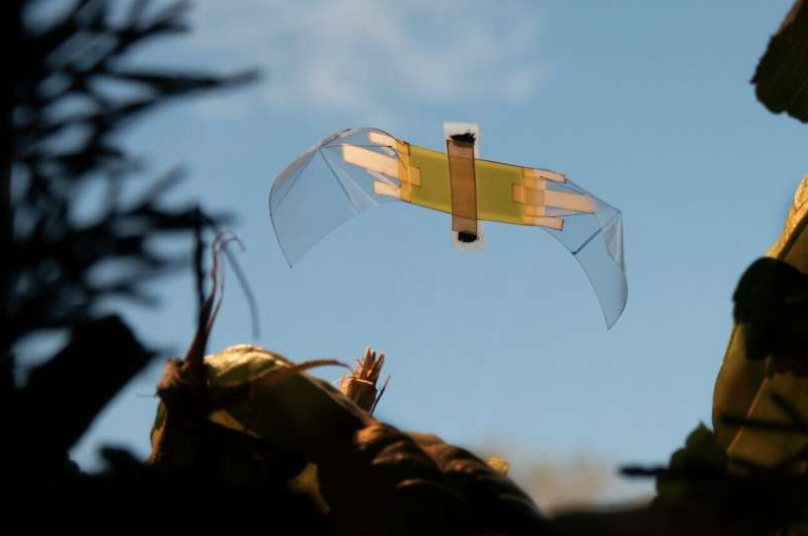 Source: Wenzhong Yan/UC Davis
To overcome this limitation, the researchers incorporated electrically responsive polymer materials into the drone's design, creating a more durable structure that could withstand collisions while generating sufficient lift for takeoff.
The robot is made entirely of polymers and weighs just 185 milligrams. The design combines an electrically driven, soft "muscle" with flexible, cone-shaped wings.
The drone uses a thin, flexible polymer film as an artificial wing muscle. When exposed to an electric field, the material expands and contracts rapidly, directly driving the wings without requiring a separate mechanical transmission. The wings' aerodynamic design and partial deformation generate lift, while their flexibility and crease-resistant materials allow them to absorb impacts and withstand collisions.
The prototype of the insect-inspired robot, which receives electrical power from external wires, was tested in the lab, where it generated enough lift — equal to three times its own weight — to take off without assistance. It also ascended at an average of 16 inches per second and resumed flight after it was hit with a flyswatter and flattened under loads approximately 11,000 times its own weight.
Once outfitted with its own onboard power source, flight control components and sensors, the drone could be used for monitoring natural environments, searching for survivors of disasters in confined spaces and inspecting hazardous areas.
The design demonstrates mechanical intelligence by using the wing materials and structure to adapt automatically to changing conditions, generate lift, absorb impacts and recover. This built-in adaptability could help small flying robots handle unpredictable real-world environments.
An article detailing the work, “Takeoff of an all-polymer micro aerial flying robot,” appears in the journal Science Robotics.
