
A team of scientists from the University of California, San Diego, has created an approach that uses blue and red light as a remote control to assemble and disperse swarms of biohybrid microrobots that could one day be used to treat injuries.
According to its developers, the microrobots come in two parts. The first part is comprised of a living green microalga dubbed Chlamydomonas reinhardtii (CR), which uses two tail-like structures (flagella) to swim through aquatic environments and respond to light.
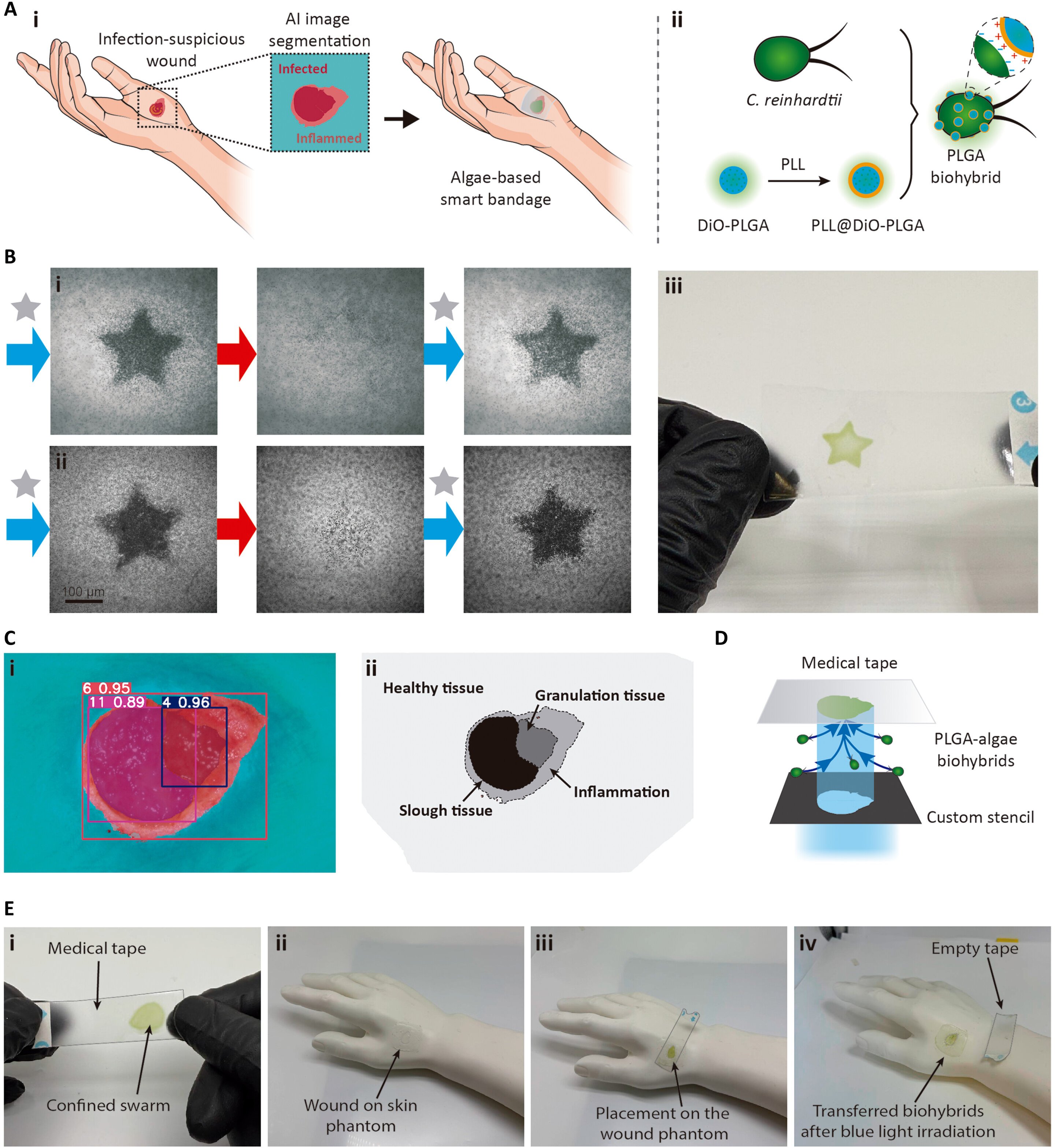 Source: Science Advances (2026). DOI: 10.1126/sciadv.aed0994
The second part is comprised of nanoparticles derived from a biodegradable plastic called PLGA that functions like tiny backpacks that can be filled with medicine and that are given a positive charge so they can attach to the negatively charged algae.
The CR algae are highly sensitive to light and rely on their flagella to swim toward or away from it to survive. The behavior of the CR algae will change according to the color of the light they encounter.
Based on this characteristic, the team built a system that uses light to guide millions of cells to split apart, merge together and change shape on command, thereby creating a variety of patterns like a gear and a star.
"Such reversible swarming behavior is realized by combining the wavelength-dependent assembly ability of CR and its inherent phototactic properties with light exposures through a series of different mask openings that define the desired swarm geometry," explained the study authors.
To determine how the approach could work in a medical setting, it was trialed on a simulated wound on an artificial skin model.
The team used an AI program to automatically scan the shape of the injury and then project the exact patterns of light necessary for guiding the microrobots. These tiny medical robots successfully carried and then released drug-loaded particles to the target area.
Beyond the potential medical applications for these robots, the team also suggests that they could be used for environmental cleanup operations.
"The biohybrid microrobot swarms can dynamically change their morphology, size, and position. The reversible nature of the generated swarms and their remarkable versatility and reconfigurability hold considerable promise for a myriad of possible microrobotic applications," noted the researchers.
An article detailing the team’s work, “Light-switchable swarming of biohybrid microrobots,” appears in the journal Science Advances.
