
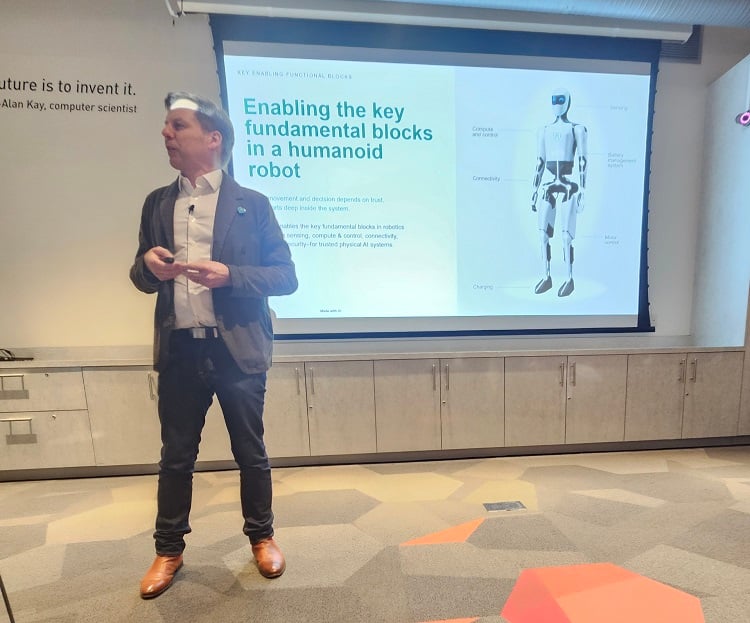
Getting a humanoid robot to move smoothly is the easier problem, Infineon Technologies told attendees at its 10th annual OktoberTech last week. The hard part is making physical AI trustworthy, and Q-Day, the impending arrival of quantum computing, makes it harder to secure every chip in the machine.
Here’s what we learned from Infineon OktoberTech 2026.
1) Trustworthy physical AI
One of the major themes during OktoberTech 2026 was the need to secure trust in AI as we enter the next stage in the AI era — physical AI.
“The speed of change we see thanks to AI is incredible,” said Stephan Zizala, president of edge systems at Infineon Technologies. “However, I think we’re just seeing the tip of the iceberg. We’ve started a huge wave of innovation in generative AI, but the big step will be physical AI, because it will penetrate every part of our life.”
According to Zizala, not everything can be done at the data center, especially inside a factory. That’s where physical AI will come into play.
The low latency of having AI on-device will allow decisions to happen in real time rather than wait for a data center to respond. Data protection is equally important, as companies won’t want to have their critical data moving back and forth from a data center.
The need for trustworthy physical AI has become critical in the AI era. If the humanoid is not trustworthy, Zizala said, there will be no breakthrough.
Infineon forecasts robot shipments will triple from 2025 to 2030 as more drones, cobots, industrial robots, mobile robots, domestic robots and humanoid robots come online and are integrated with physical AI.
A robot has dozens of microcontrollers and connectivity devices, including several in every finger. Attackers will pick the simplest one to hack, Zizala said. Infineon — which makes sensor, compute and control, connectivity, power and security semiconductors — said it is building security into low-end parts, not just central compute.
 Maher Matta, president of Infineon Americas, and Andreas Urschitz, CMO of Infineon Technologies, discuss 10 years of OktoberTech and what’s ahead. Source: GlobalSpec
2) Q-Day looms
Securing every chip in a robot is getting harder as the industry inches closer to Q-Day, which Zizala and the U.S. government put at sometime around 2030. Because robots stay in the field for maybe 10 to 15 years, Zizala said, Q-Day is a design decision today as these robots shipping today will be in the field when hackers get quantum-computing level capabilities.
Infineon said it has planned for and offers security solutions for physical AI builds of the future. “If a customer embarks on security in [physical AI], they are aware of Q-Day,” Zizala told Electronics360. “And if there’s an affordable solution out there [they want it].”
Governments see the need for more cryptography as they have established regulations for secure physical AI before Q-Day.
In Europe, the Cyber Resilience Act (CRA) requires connected products to ship with security built-in and kept up to date. This includes a path for Q-Day. In the U.S., a similar regulation is being established for cryptographically relevant quantum computer (CRQC).
The U.S. government has warned that quantum computers could eventually break the public-key cryptography that protects much of today’s sensitive data. Federal guidance directs agencies to prepare by identifying vulnerable systems and moving them to quantum-resistant algorithms.
Zizala said that many vendors are working with Infineon on both the CRA and U.S. requirements in parallel to support the looming Q-Day need for more cryptography.
Quantum computing is also an opportunity
During Infineon OktoberTech 2026, guest keynote speaker Michio Kaku, professor of theoretical physics and science advocate at City University of New York Graduate Center, gave reasons to view quantum computing as something that will unlock vast new opportunities that were simply not possible with digital computing.
Kaku said quantum computing means a new world of possibilities and thinking because, as he described it, you have multiple pathways toward a solution.
Kaku described it as a new form of computation, one that means abandoning the digital world for the quantum world.
