
Key takeaways
- FlexiQuad’s flexible, impact-absorbing frame allows the drone to withstand collisions and recover flight stability without sacrificing speed or maneuverability.
- Designed for hazardous and confined environments, FlexiQuad could support search-and-rescue missions, inspections and environmental monitoring where conventional drones face challenges.
A team of researchers from ETH Zurich has developed a soft, resilient quadcopter that promises to survive collisions.
Unlike conventional quadcopters, which feature a rigid central body connected to four propeller-equipped arms, FlexiQuad uses a flexible, ring-shaped frame where its rotors, batteries and control module are distributed. Eliminating the traditional body leaves a hollow central area and allows the frame to deform upon impact, absorbing collision energy.
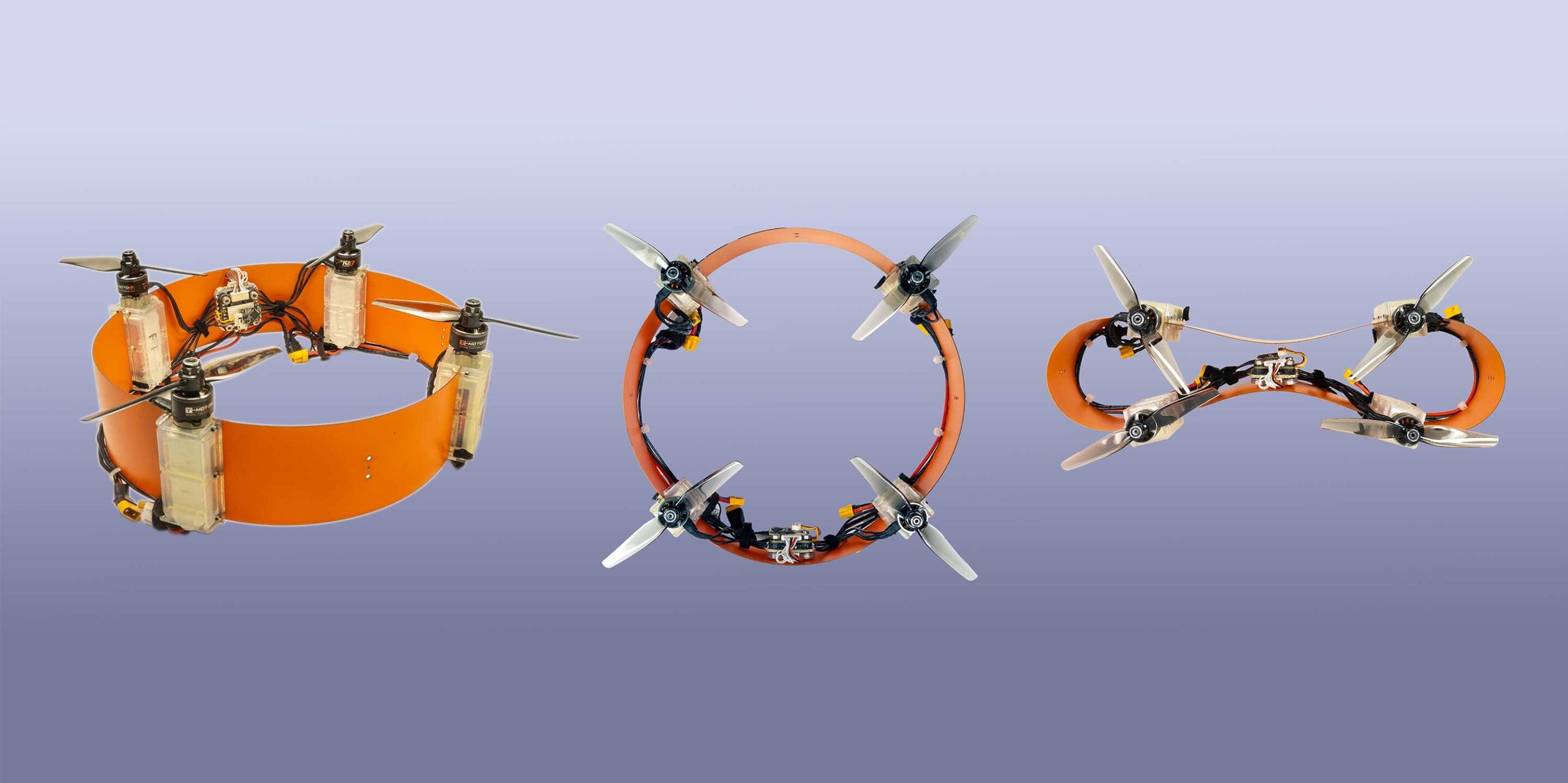 Source: Luca Girardi/ETH Zurich
According to Luca Girardi, a researcher at ETH Zurich’s Mobile Robotics Lab, the frame’s selective flexibility draws inspiration from the wing structures of birds and insects, which vary in stiffness and bend in different directions. Researchers designed FlexiQuad to flex laterally while maintaining vertical rigidity. This configuration lets the frame give way sideways in a collision while remaining stiff enough to transmit the rotors’ thrust.
Despite its flexible construction, FlexiQuad can reach speeds of up to 50 mph and achieve linear and angular acceleration comparable to that of traditional quadcopters. The findings demonstrate that a flexible frame does not necessarily compromise flight performance, Girardi said.
During collision tests, FlexiQuad was flown into obstacles at speeds of up to approximately 16 mph. The drone kept flying after these impacts. Its frame flexed briefly on contact, cushioning the blow enough for FlexiQuad to steady itself. In separate tests, the deformable frame also let FlexiQuad pick up and carry objects, including a soft first-aid kit, and lift a load that outweighed the drone itself.
Researchers have also used reinforcement learning to help FlexiQuad recover its stability after collisions and resume autonomous flight. The ETH Zurich researchers are investigating how changes in frame deformation and vibration patterns could provide additional feedback to improve flight control.
The researchers’ patent application envisions using FlexiQuad in environments that are difficult or hazardous for conventional robots and humans, from inspecting ship ballast tanks and surveying dense forests to locating people in collapsed buildings.
