
A miniature robot capable of preparing teeth for crowns has been developed by a team of researchers at the University of Basel.
With the potential for reducing the number of appointments necessary for dental treatments associated with crowns, the small dental robot is roughly the size of a wine cork — measuring just 43 millimeters by 26 millimeters by 28 millimeters.
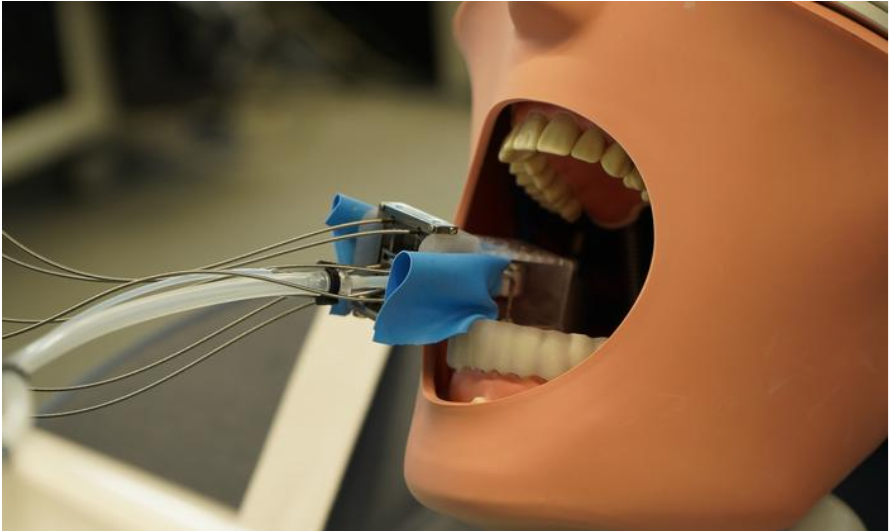 Source: University of Basel
According to its developers, the Miniature Intraoral Robot’s (MIR’s) motors and control system are located on the outside of the robot and connected to it by flexible drive shafts, cables and tubes.
“It is designed to be small enough to fit comfortably into an open mouth,” the researchers explained.
The robot is designed to prepare teeth according to a digital plan. Specifically, following a scan at the patient’s first appointment, dentists could potentially plan how the robot will remove the tooth material and then order the crown immediately, instead of waiting for the second appointment, which is the current process.
The team explained that the scan not only plans the crown, but it also creates a custom-fitted dental splint, which is what the mini dental robot attaches to. Patients are even able to turn their head and the MIR will move with them.
The dental robot was trialed on tooth models composed of synthetic resin and on a ceramic material with a hardness much like that of tooth enamel. The MIR preps the tooth first using a wide drill to reduce the tooth surface by removing material from above. Then a longer, thinner drill is used to work on the sides of the tooth.
MIR already works precisely despite not having any sensors to measure or to correct its position directly. During the trials, the positional error was less than 0.2 millimeters, which will be reduced further once sensors are incorporated into the system.
The team is evaluating not only the drilling precision of the MIR dental robot, but also the forces it generates, which remained below 5 newtons during testing — roughly equal to the gravitational force of a half-liter bottle of water. They are also assessing the system’s noise levels to determine its appropriateness for clinical use. Future development will focus on integrating sensors and a camera to enable real-time position tracking and treatment monitoring, allowing the robot to resume work accurately even after interruptions such as power outages, without increasing its size.
An article detailing the robot, “Miniature Intraoral Robot (MIR) for Minimally Invasive Tooth Preparation,” appears in the journal IEEE Transactions on Medical Robotics and Bionics.
