
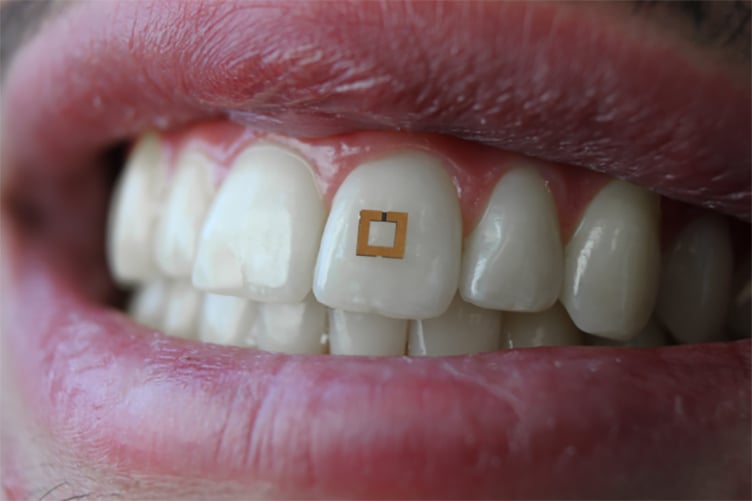
Wearable sensors to track health information represent a major segment of emergent medical technology: devices worn around the wrist to track fitness, patches placed under the arm to gauge body temperature, portable monitors to measure vital signs and so on. A new miniature sensor developed by researchers at Tufts University School of Engineering takes the technology to another location in the body: patients' teeth.
When the device is mounted directly on a tooth, it can monitor and wirelessly transmit information on intake of glucose, salt and alcohol. The researchers say that the future adaptations could enable detection and recording of a wide range of nutrients, chemicals and even psychological states.
Previous incarnations of dietary intake devices were limited by various factors, such as requiring the use of a mouth guard to be worn, or rapidly degrading and needing frequent replacement. The Tufts team developed a tiny 2- by 2-millimeter footprint for their device, with the flexibility to conform and bond to the irregular surface of a tooth.
The sensor is comprised of three layers — a central bioresponsive layer that absorbs chemicals to be detected, sandwiched in between two layers of gold. Together, they act as an antenna, reflecting back radiofrequency (RF) signals that represent actionable information. For example, if the central layer takes on salt, its electrical properties will shift; this causes the sensor to absorb and transmit a different spectrum of RF waves, with varying intensity. The nutrient can then be detected and measured.
"In theory we can modify the bioresponsive layer in these sensors to target other chemicals — we are really limited only by our creativity," explains Fiorenzo Omenetto, Ph.D., a corresponding author of the research and professor of engineering at Tufts. "We have extended common RFID technology to a sensor package that can dynamically read and transmit information on its environment, whether it is affixed to a tooth, to skin or any other surface."
The research appears in the journal Advanced Materials.
