
For more than half a century, industrial robots have helped automate dull and dangerous processes, increasing efficiency while increasing operator safety. Because of their brute strength, quick movements and significant mass, robots are typically constrained to safety cages, while programming requires the intervention of engineers or highly trained technicians. As we enter the second quarter of the twenty-first century, cobots, short for collaborative robots, are changing the rules of robot-human separation.
What is a cobot?
Cobots are industrial robots designed to work alongside humans in a shared space. They typically take the form of a single robot arm, though some feature a more human-like dual-arm setup. Cobots can sense when they hit something and react by stopping or even retracting slightly, a safety feature that makes them capable of working outside of a cage in many applications. A simplified programing interface means that operators, not just engineers and highly trained technicians, can quickly adjust their automated collaborators’ motions.
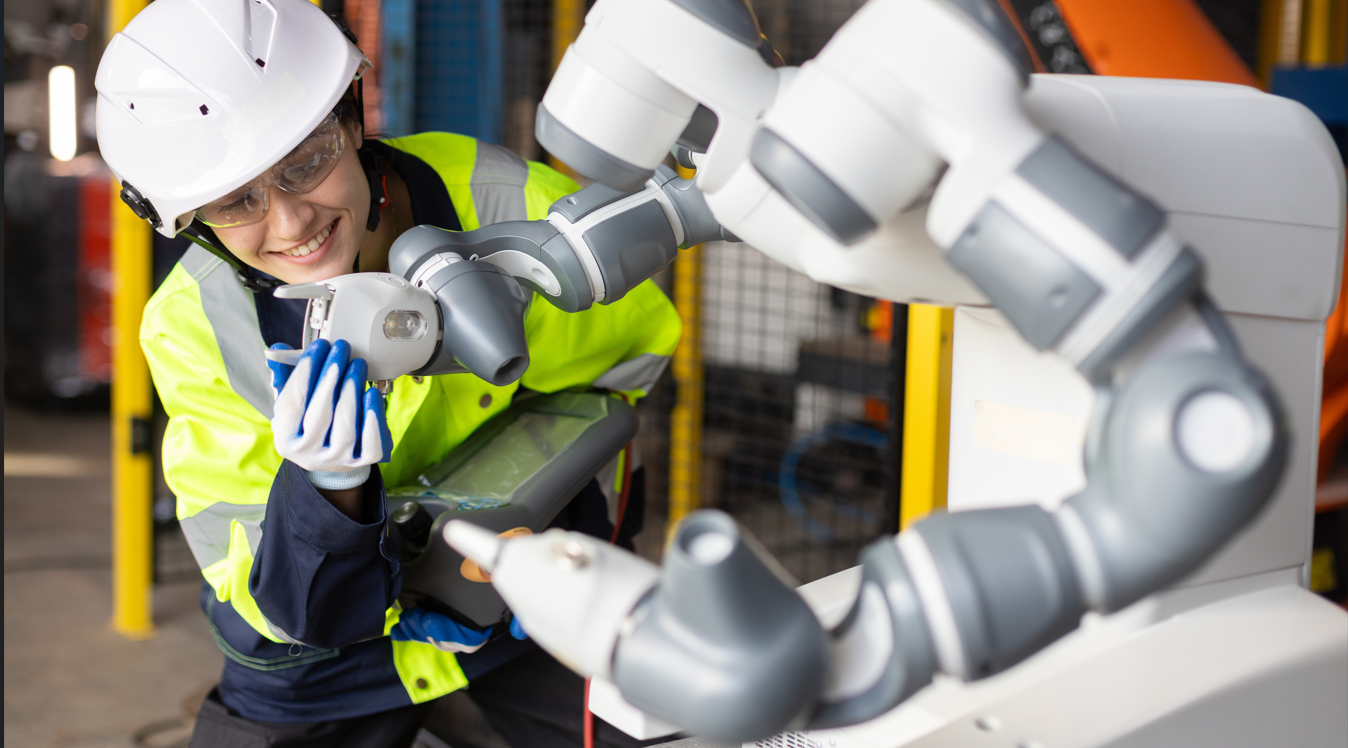 Source: eakgrungenerd/Adobe Stock
Cobot versatility appropriate for new implementations
This new class of robot can quickly adapt to new situations, while working in the midst of human operators. These capabilities make cobots appropriate for tasks that wouldn’t be practical to automate with traditional cage-bound arms, typically implemented to perform the same tasks over and over for long periods of time — years in some cases.
For example, cobots can be used in relatively low-volume welding operations that were traditionally performed by hand. Here, cobot welders work alongside humans, who rapidly set up their robotic counterparts for different jobs, producing repeatable, quality welds. Not only does this save significant labor costs, the actual welding speed can be massively increased, slashing the production time required to complete finished goods.
Taking the previously-done-by-hand robotics paradigm several steps further, cobots mounted on a sturdy mobile base are being explored for construction automation. Here, semi-repetitive tasks like painting and sanding can be automated by cobots, mounted to a mobile base that allows them to move to different positions on a job. Because construction sites are dynamic environments, interspersed with humans, their ability to sense and safely react to unintended impacts is essential. Cobots are also more than capable of working in more traditional factory settings, like electronics manufacturers or automotive plants, performing tasks like screwdriving, pin insertion, machine testing, packaging and more.
Even with their ability to work among humans, and their easy programming setup, cobots tend to be less expensive than their traditional robotic counterparts. This affordability, along with the ability to automate previously labor-intensive tasks, means that cobot installation can produce an incredible ROI — often measured in months, not years. Whether in a large factory, or in a smaller operation, cobots open up human-robot collaboration possibilities that would have previously been impractical or unsafe — after they help put up the facility’s drywall!
Collaborative robot or collaborative application?
While collaborative robots have safety features that potentially allow them to be used among humans, that doesn’t make the tasks they are performing safe in all situations. Consider, for example, collaborative robots working in a low-volume welding environment as outlined above. The robot may stop if it hits an unexpected obstruction (human or otherwise), but this still doesn’t completely eliminate the danger posed by molten metal and an extremely hot welding gun.
In other applications, end-of-arm tooling can present internal pinch points that, with no overall safety cage present, must itself be guarded against the possibility of contact with humans. Or if a vacuum gripper is used to lift a heavy object, personnel or equipment underneath could be subject to impact if the part accidentally detaches. While such scenarios may seem far-fetched, remote possibilities must be considered when a process is repeated thousands, or even millions, of times. Engineers should also consider how, when and even if operators can modify a process, potentially introducing new risks.
To bring these concerns to the forefront, recent changes to ISO and ANSI standards have moved away from the term “cobot,” and the implication of inherent safety, to “collaborative application,” wherein the overall automation process must be considered. While thinking about an application in its entirety is the proper approach, the net safety benefits of using (robots formerly known as) cobots for dangerous or repetitive work, which often leads to repetitive stress injuries (RSIs), can be extremely beneficial.
Case study: OK Go music video
While industrial automation is perhaps the de facto standard usage for cobots, others have found creative uses for these devices. Rock band OK Go used 25 collaborative robot arms for their fantastic “Love” music video. Here, cobots positioned mirrors for precisely-timed kaleidoscopic effects that couldn’t have been done without robotics. However, since the mirrors and robots were in close proximity to band members, this would have been extremely dangerous without cobot safety features.
According to video co-director Miguel Espada, cobots “are perfect for creativity, because you take the robot, you put it somewhere, and we teach the robot how to move.” Or as singer (and also video co-director) Damian Kulash put it, “If we can’t just get something and start playing with it, we can’t have the ideas.”
Cobots: Significant opportunities and growth potential
Globally, collaborative robot sales are currently in the billions of dollars, with well over 100,000 units shipped in 2025. As this technology advances, it seems likely that engineers and factory automation specialists will find more and more applications where this technology can be applied. Perhaps now is the right time to take a fresh look at your factory and consider what can be automated with cobot technology. Or maybe it’s finally time to make that wild music video that you dreamed up a decade ago!
