
Smart glasses have long held promise as being a viable wearable since Google Glass debuted in 2012. But performance, battery life, comfort and reliability have always gotten in the way of success.
InnoPhase IoT believes the underlying connectivity hardware may be one step toward shifting that trajectory toward mass consumer adoption. If smart glasses are finally going to make a splash on the consumer market, connectivity hardware needs to be small enough, power-efficient enough and cheap enough to disappear into everyday eyewear.
At Sensors Converge 2026, InnoPhase IoT highlighted its latest family of system-on-chips (SoC) dubbed the Talaria 6. which is built on a digital CMOS RF architecture designed for ultra-low-power Wi-Fi 6 connectivity aimed at wearables and other constrained devices. This extends battery to allow wearables, including smart glasses, to operate longer without any performance degradation.
“Half the planet wears prescription glasses and about 80% have sunglasses. Glasses are something many people are familiar with,” said Greg McCuistion, director of sales at InnoPhase IoT during an interview at Sensors Converge 2026. “The challenge for many wearables [vendors] is they’ve got traditional big heavy-lifting Wi-Fi parts … quite frankly it’s an overkill part.”
McCuistion said these bulky, power-hungry wireless architectures were originally designed for heavier computing workloads. But many wearable devices, particularly smart glasses, don’t necessarily need massive on-board AI compute.
“Really, what you need is good connectivity to your phone,” McCuistion said. “You need some bandwidth, but you need low power. But what you do not really need is AI capability here. Instead, AI is run on a smartphone or other device nearby connected via Wi-Fi.”
Price is still king
McCuistion noted price and functionality are the other parts of the smart glasses equation. Price has always been an issue with smart glasses, and a real price point will be equal to those prescription glasses or sunglasses you find in an optometrist's office — somewhere in the $200 to $300 range.
Price is also something that is potentially tied to the silicon substrates in smart glasses. This would reduce the overall cost of producing chips and key to lowering the overall price. The digital CMOS RF chips, like InnoPhase Iot’s Talaria 6 platform, also play a role in having these chips disappear into the glasses so they appear like regular prescription glasses or sunglasses.
But real-world applications will also be a big part of the equation with the ability to connect to a smart phone for emails, texts and more, where checking a smartphone or watch is unnecessary. Or something as beneficial as glasses that make night driving easier, McCuistion said.
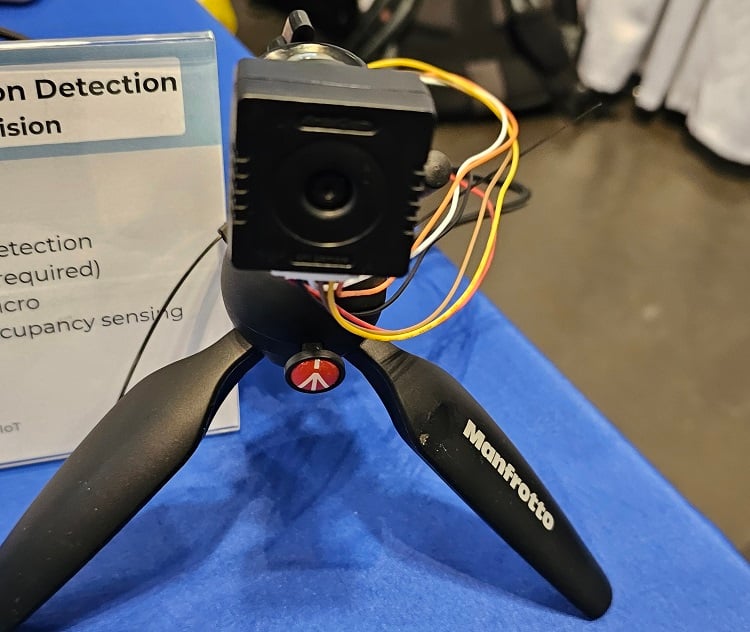 At Sensors Converge 2026, InnoPhase IoT demonstrated a person detection and occupancy sensing module running the Talaria 6 with no cloud required instead using the edge AI inference directly on the SoC. Source: GlobalSpec
Talaria beyond smart glasses
Because the Talaria 6 SoC integrated Bluetooth Low Energy, Classic, Thread and Zigbee within a single chip, the multi-protocol flexibility enables integration into major consumer ecosystems like:
- Apple Home
- Amazon Alexa
- Google Home
Additionally, it is also Matter compliant, which enables it to be applicable across a wide range of consumer smart home devices.
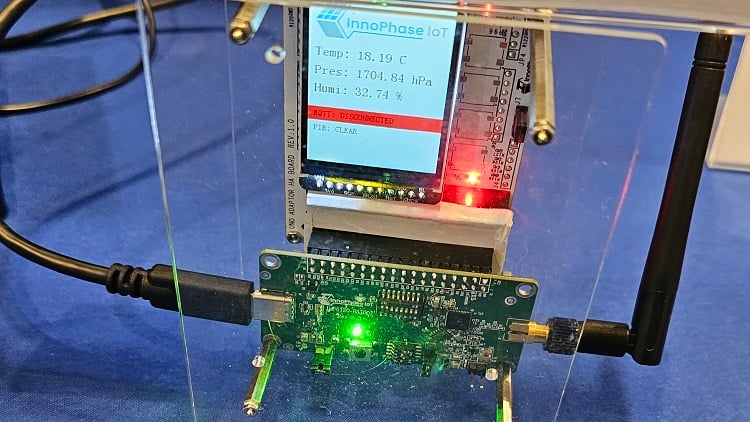
At Sensors Converge 2026, InnoPhase IoT demonstrated a person detection and occupancy sensing module running the Talaria 6 with no cloud required, instead using the edge AI inference directly on the SoC. It also displayed an environmental sensor that could be installed into a smart home device, an industrial monitoring system or even a smart thermostat.
