
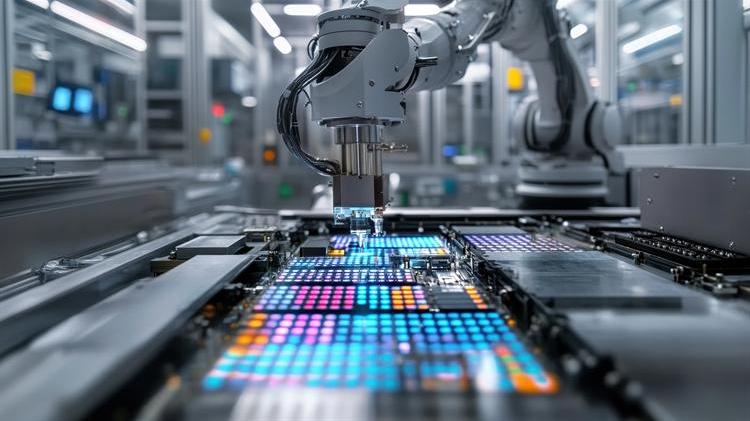
Artificial intelligence (AI) gets a lot of attention these days, and in the electronics industry, it gets most of its attention in electronic design automation (EDA) tools. To be fair, as a productivity tool, it’s not surprising AI is targeted as one way to reduce design time, improve quality and/or prevent redesigns of new products.
But the area where it has huge potential as a productivity tool is in advanced manufacturing. This is not just as the synthetic brain for robotic systems, but as a tool for gathering insights from mountains of production data that is continuously created on the factory floor.
Today, AI is covering the whole stack of data analysis-based applications, starting at the wafer level and culminating in PCB assembly. Once a design is in assembly, AI primarily makes way into production through inspection of the assembly and the components themselves
Although implementation of AI-based solutions has been slow and steady, we can offer some perspective on the approaches used in electronics manufacturing. First, we’ll look at what’s happening in the fabs and move upwards to the assembly level to see how AI is making inroads in manufacturing.
Dynamically-tuned parametric test optimization
On the fabrication line, semiconductors are subjected to multiple tests to verify quality and functionality. On-the-line testing is critical for identifying defects early and optimizing for yield. However, given the amount of test data that is generated, it is difficult to determine how to optimize the testing regime for any product.
AI enables dynamic test flow adjustments that target cost reductions while maintaining quality. These applications work by identifying redundant coverage and adjusting test sequences based on real-time data captured from the fabrication line. Test data often contains redundant information, i.e., multiple tests detecting the same failure modes. Machine learning can be used to identify these correlations and determine which tests may be unnecessary:
- Correlation across all parametric measurements can be determined
- Any test pairs with high correlation coefficients likely reflect overlapping failure modes
- Process engineers then need to verify whether redundant tests are identifying the same failure mode
- Monitor escape rates at downstream test stages to validate that omitted tests don't compromise quality
Static test limits often include excessive guard band or margin to account for worst-case variations in test data. To reduce test time and cost, AI models can be used to tune testing parameter limits based on rolling window data (typically 1000-5000 units) for each parametric test. In a dynamically-tuned approach, test data is analyzed statistically to determine whether scan limits in each test are appropriate against the actual measured performance. This allows test limits to be adjusted to maintain fixed sigma coverage (e.g., mean ±3σ) rather than using static values.
Preventative maintenance and tool drift detection
Production test equipment drifts gradually as components age and calibration degrades. To catch this drift early, process engineers need to establish correlation models across multiple tools. This means parametric data is required from all test setups running on the same product, and a known-good statistical baseline is needed for comparison. An AI model can then learn what the known-good electrical test data looks like, and this can be used for comparison against data captured on the fabrication line.
Equipment where this process applies includes test sockets and probe cards, both of which degrade with insertion cycles and with non-uniform wear. AI can be used to identify electrical signatures that indicate progressive degradation by comparing against the baseline dataset. Some of the practical monitoring methods include:
- Adding voltage sensing to power delivery networks to measure contact resistance
- Tracking probe/socket voltage drop during device power-up; steadily increasing values indicate wear before failures occur
- Run known-good reference devices at regular intervals to detect probe tip degradation
- Plot parametric readings over time and fit degradation curves that extrapolate to quality limits
Once an AI model can positively identify tool drift from the test data and the required maintenance steps are determined, this information needs to be entered into a central repository. As the tool drift problems are linked to successful maintenance steps in the dataset, AI can later use that information to recommend maintenance steps for solving future tool drift events.
Software is already being used to implement this approach in multiple industries. Tim Burke, CTO and co-founder of Arch Systems, describes their approach to tracking this information.
“Instead of wasting your time trying to categorize downtime, you just tell what you saw, take a picture, and say what you did to fix the problem,” Burke said. “An AI agent can take that information, which could be a voice note recorded in your natural language. Just tell us what you did, capture that tacit knowledge, and then we put it into an AI agent, which then labels the downtime.”
This area is a great example of the application of multimodal LLMs, which need to process numerical data, categorical data, and natural language in a single system.
Quality control in assemblies
In PCBA manufacturing, component obsolescence, recalls, counterfeits, and package defects all accumulate cost to EMS providers. Areas like predictive maintenance and data modeling still apply in PCBA manufacturing, but they do not address these challenges with the components. AI is now able to step in and crunch component inspection data so that rework and recalls can be prevented.
This approach involves vision systems which capture visual and X-ray images of each part coming into SMT assembly and verifying them against known-good parts. An AI model can then analyze the inspected parts as part of pre-assembly quality control. These pre-assembly inspections help identify components which may have been destined for scrap, were incorrectly labeled, have package defects, have undergone a silicon revision, or which do not match the BOM line item before they are put into an assembly.
Dr. Eyal Weiss, CTO and co-founder of Cybord, explains how AI makes these pre-assembly inspections possible.
“Every component is unique, and we are trying to look for evidence of a fingerprint that the machine that packaged it imprinted on it during the component manufacturing process… without AI this would not be possible,” Weiss said.
These inspections are delineated by lot number or batch number provided directly from the vendors, which allows an AI model to link a given component back to a specific factory or even a specific machine. This approach also helps identify parts that have been misrepresented, e.g., recycled parts, old parts, or scrapped parts.
Counterfeiting of outright faked components remains a challenge as it is a constant game of cat and mouse. As inspection methods become more elaborate, fraudsters also create more elaborate counterfeits. It has reached the point that the AI tools have yet to keep up with the inspection methods required to identify outright fakes.
It is likely that AI will see greater application in this area as it remains a constant problem for reliability and quality control. It also requires greater collaboration with the semiconductor vendors as they will need to provide information on construction of their components so that AI datasets can be built for counterfeit identification.
