

New York Governor Kathy Hochul has signed an executive order to create what is claimed to be the nation’s first statewide moratorium on new hyperscale data centers.
Hochul said the executive order establishes the strongest standards for data center development in America and creates a blueprint to support localities. The pause is for up to one year to build a regulatory framework that protects ratepayers, the environment, the energy grid and communities in New York. The order applies to data centers consuming 50 MW or more of power.
“New York has always been at the forefront of innovation and change but we’ve also always guaranteed that New Yorkers benefit,” Hochul said. “As data center development threatens to hike up utility bills, deplete our natural resources, and create uncertainty for New Yorkers, it’s my responsibility to take action and lead.”
The move comes as traditional and hyperscale data center zoning is coming under scrutiny among certain areas of the U.S. due to the issues regarding water consumption, energy consumption and noise and environmental pollution. The complaints come from data centers being a burden to communities by raising energy rates, depleting water tables and infiltrating neighborhoods with unwanted sounds.
New York is experiencing growth in demand for data center development driven by AI and other compute technologies. That demand is leading to proposals for new data centers statewide, Hochul said.
New guidelines
Additionally, Governor Hochul directed the Empire State Development (ESD) to issue a community investment framework (CIF) within 60 days to provide guidance to local entities to help negotiate community benefits as part of any large-scale data center deal. These include:
- Infrastructure improvements
- Childcare investment
- Direct financial support to the community
The CIF will establish frameworks that provide organized labor a place in data centers and prioritize wage standards and project labor agreements for data center construction, local hiring, apprenticeships and workforce development to maximize economic benefits.
Hochul also directed the state to draft a New York Grid Acceleration Fund that would require data centers to invest in the state’s aging grid infrastructure and energy needs. This would include the procurement of clean energy supply and establishment of an insurance pool to require data centers to fund new clean electric generation dedicated to their operations.
Finally, Hochul said the state will seek legislation to repeal sales tax exemptions for massive data centers across New York.
Legislative activity increasing
According to a report from the Information Technology and Innovation Foundation (ITIF), in 2025, there were more than 200 data center bills introduced across all 50 states with more than 40 enacted into law. This has continued into 2026 as bans and moratoriums for data centers are under discussion in more than 20 states. This amounts to more than $130 billion in projects being delayed or abandoned in the first quarter of 2026.
However, Daniel Castro, president of the ITIF, which is a Washington, D.C., think tank that counts Amazon, Google, Meta and Microsoft among its funders, called the New York moratorium “the wrong approach” in a statement.
“Communities deserve thoughtful consideration of issues such as energy demand, water use and noise, and policymakers should establish clear, predictable standards to address them,” Castro said. “But pausing data center development is not the answer. AI is moving quickly, and the infrastructure that powers it will be built somewhere. If the United States fails to build the data centers needed to support the AI economy, it will fall behind in developing and adopting one of the most important technologies of the 21st century.”
The Data Center Coalition — a trade association whose membership and partner companies include major data center owners and cloud providers such as Amazon Web Services, Google, Microsoft, Equinix and Meta — pushed back on the moratorium.
Dan Diorio, the group's executive vice president of state policy and government affairs, said in a statement that the pause would push hundreds of billions in planned data center investment, jobs and economic activity to other states, warning it overlooks the role of data centers in attracting supply chain investment and jobs and risks sending a message that New York is closed for business.
Companies act
Some companies are working to tackle these issues including signing an agreement with the Trump administration to build, procure and fund new generation capacity sufficient to cover electricity demands of their data centers. This includes Google, Amazon, Meta, Microsoft, OpenAI, Oracle and xAI, which would pay for all grid infrastructure upgrades required to connect their data centers without passing the costs onto the residential or commercial ratepayers.
Microsoft has created the Datacenter Community Pledge that commits it to protecting local watersheds and investing in projects to strengthen regional water resilience. It is part of a company-wide push to become water positive by 2030 — meaning replenishing more water than it withdraws.
According to a report from Reuters in April 2026, company investors are pushing Amazon, Microsoft and Google to move from high-level metrics to site-level transparency due to data centers consuming about 1 trillion liters of water in 2025 alone.
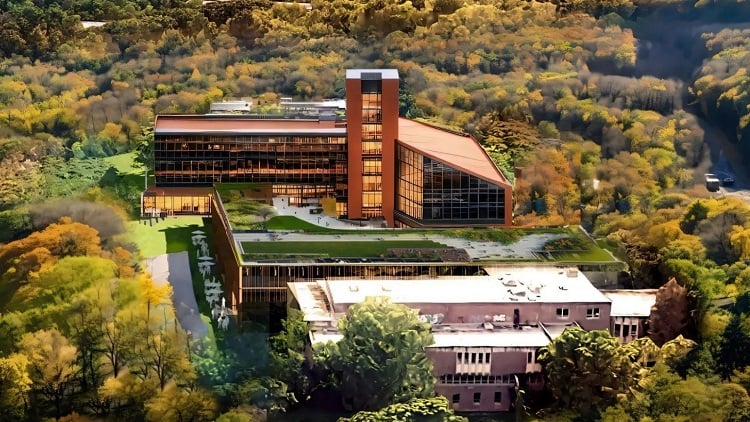 An artist rendering of the Kenwood Commons, a proposed data center and tech campus in Albany, New York. Source: Rendering by Kohn Pedersen Fox/EKG Group
Albany’s divide
The divide between community concerns and tech growth is playing out at a data center project at Kenwood Commons in Albany, New York. Developer Guild Ventures has spent months negotiating with community groups over concerns about water use, air quality and utility costs.
According to a report from Spectrum News, Eva Bass, of the Albany South End Community Collaborative, welcomed the pause, saying it creates more room for community engagement. Arlene Way, of the Reimagine Albany Coalition, agreed and called it a step in the right direction for transparency and needed guardrails.
But the sentiment is not universal. Justin Wilcox, executive director of the business advocacy group Upstate United, argued the moratorium undercuts the state's AI ambitions and could push data center investment and jobs to states more welcoming to the industry.
Guild Ventures said in a statement that it supports proper regulation of the industry and designed Kenwood with limited water use and no air impacts, calling it a model other developers could follow.
Second life sustainability
There is also a new recycling economy that has emerged from hyperscale data centers to reduce waste and promote sustainability. Companies like Re-Teck are using data center GPUs and other electronic components and giving them a second life.
The tremendous growth of the data center market is refreshing GPUs and CPUs at a much faster rate than traditional IT hardware cycles. Whereas these parts were previously refreshed within three to four years, in some hyperscale data centers that cycle is happening even faster.
That means GPUs, CPUs and memory as well as materials like copper are being recycled and reused for other second-life uses.
