
Modern choices of conveying information range from smartphones to computers to texts and emails. These data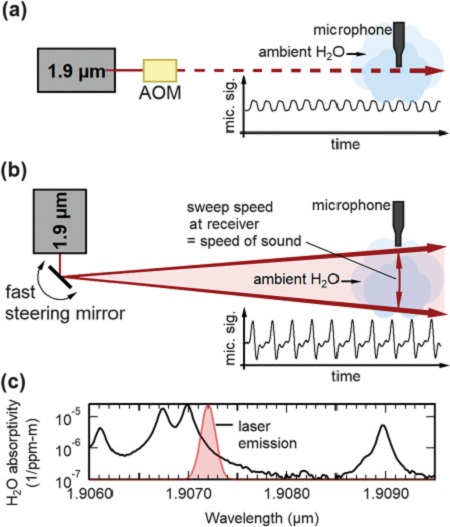 Delivery of audible messages via photoacoustics. (a) Traditional photoacoustic configuration: 1907.2 nm laser light is absorbed by ambient water vapor. (b) Dynamic photoacoustic communication amplifies the audible signal. (c) Water absorptivity near 1.9 μm, with an overlay of the laser emission from the thulium fiber laser. Source: MIT transmission modalities require both the sender and the recipient to be similarly equipped, but what if the intended receiver lacks the appropriate electronic devices?
Photoacoustics might be able to support communications needs in this case. MIT researchers have demonstrated two laser-based techniques that can transmit an audible message to a person without any type of receiver equipment.
Experiments demonstrated the use of a 1.9 μm thulium laser to produce photoacoustic signals from ambient atmospheric water vapor at 50% relative humidity with sound pressure levels well into the audible realm. The method generates continuous wave audible signals near the receiver via the absorption of light by water vapor.
A fast-steering mirror was also used to sweep the laser beam, spurring the laser spot at the speed of sound over some arch adjacent to the receiver. The process amplifies the acoustic signal and produces pulsed acoustic emission without the need for a resonant chamber. Commercially available equipment applied to this technique can transmit sound to a person more than 2.5 m away at 60 decibels.
These methods for sending highly targeted audio signals over the air could be used to communicate across noisy rooms or warn individuals of dangerous or emergency situations. The researchers next plan to demonstrate the technology outdoors at longer ranges.
The study results are published in Optics Letters.
