
Smart textiles, or clothing with sensors and other technology integrated into the cloth, are used to measure different body functions or perform actions that help with comfort or performance.
But this clothing is typically hard to wash, uncomfortable and tight to wear on the body. Researchers at ETH Zurich are looking to improve these characteristics in smart clothing using acoustic waves that are passed through glass fibers.
The researchers said this makes measurements more precise in addition to making the textiles light, breathable and easier to wash.
“They are also inexpensive because we use readily available materials, and the power consumption is very low,” said Daniel Ahmed, professor of acoustic robotics for Life Sciences and Healthcare at ETH Zurich.
Transforming textiles
Called SonoTextiles, normal fabrics were transformed into smart sensors that react to touch, pressure and movement.
“While research has already been conducted into smart textiles based on acoustics, we are the first to explore the use of glass fiber in combination with signals that use different frequencies,” said Yingqiang Wang, author of the study from ETH Zurich.
At one end of each glass fiber is a small transmitter that emits sound waves. The other end of each of the glass fibers is connected to a receiver that measures whether the waves have changed.
Each transmitter then works at a different frequency, meaning it requires little computing power to determine which fiber the sound waves have changed on.
“In the future, the data could be sent directly to a computer or smartphone in real time,” Ahmed said.
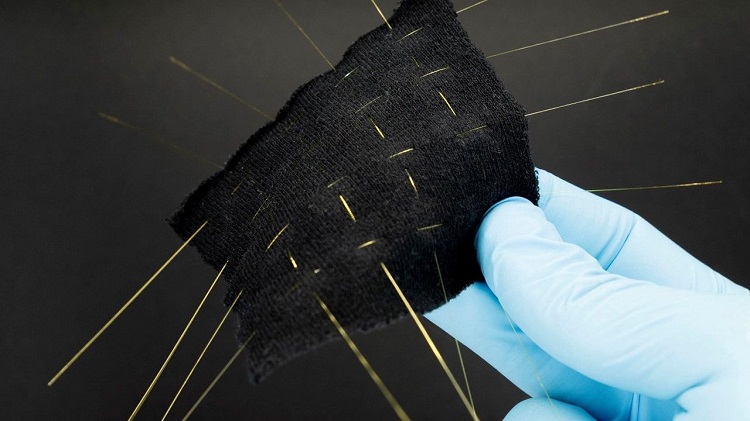 A smart textile developed by ETH Zurich that sends acoustic waves through glass fibers to monitor a variety of athletic performance measurements or bodily functions. Source: ETH Zurich
Use cases
There is a range of potential applications for this technology.
ETH Zurich gave an example of a T-shirt with SonoTextiles that monitor the breathing of asthma patients and triggers an alarm in an emergency.
Another potential use case would be in sports training and performance monitoring, where athletes receive real-time analysis of movements to help prevent injuries and optimize performance.
A third example of an application is in sign language where gloves simultaneously translate hand movements into text or speech. This type of glove could also be used in mixed reality environments.
“SonoTextiles could even measure a person’s posture and improve their quality of life as an assistive technology,” said Chaochao Sun, who worked on the study at ETH Zurich.
The next steps include making smart textiles more robust for everyday use, potentially replacing the glass fibers with metal. ETH Zurich is also looking at new ways to expand SonoTextiles into other applications as well as more textiles.
The full research can be found in the journal Nature Electronics.
