Birds and other animals use magnetoreception to detect the Earth’s magnetic field and perceive direction or altitude. An electronic skin (e-skin) engineered at Helmholtz-Zentrum Dresden-Rossendorf (HZDR), Germany, 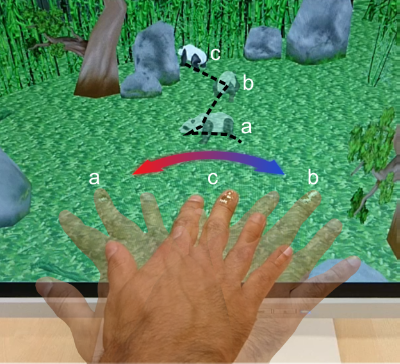 An ultra-thin foil on the middle finger was used to control a virtual panda with the help of the Earth’s magnetic field. When the hand swipes left, towards the magnetic north, the animal also moves in that direction. Source: HZDR / G.S. Cañón Bermúdezcan extend this same capability to humans.
The thin, malleable polymer foil incorporates magnetic field sensors to detect geomagnetic fields, even ones as weak as 40 to 60 microtesla. Ultrathin strips of the magnetic material permalloy enable the wearer to gauge orientation in terms of Earth’s magnetic field. The electric current can only flow at a 45° angle, which changes the response of the sensor to render it most sensitive around very small fields. The voltage is strongest when the sensors point north and weakest when they point south.
During outdoor trials of a sensor attached to a user’s index finger, voltage rose and fell as direction changed, and the cardinal directions that were displayed matched those on a traditional compass used as a reference.
These sensors also transfer and digitize the data to control the movements of an avatar within a virtual world. Researchers demonstrated the technology by using the magnetic sensors to control a digital panda in the computer game engine, Panda3D. The sensors were observed to maintain functionality during extreme bending and twisting.
The technology could benefit those with vision or orientation issues, and could be used to study the effects of magnetoreception in humans.