
People who suffer from hypertension and other disorders may one day be better equipped to safeguard their health by monitoring sodium intake with a soft, intraoral electronic sensor. The stretchable sensing system was designed by Georgia Institute of Technology researchers to be worn in the mouth and wirelessly transmit sodium consumption data via Bluetooth to a smartphone or tablet.
The device consists of a thin, breathable elastomeric membrane and miniaturized flexible electronic components. By monitoring and recording sodium intake in real-time, the system could advise users planning 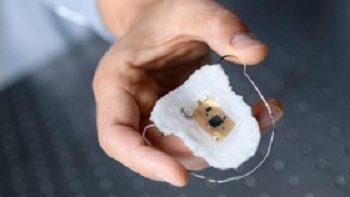 The intraoral electronics with a sodium sensor is based on a breathable elastomeric membrane that resembles a dental retainer. The ultrathin device is flexible and stretchable, and can wirelessly transmit data up to 10 meters. Source: Rob Felt, Georgia Institute of Technologymeals how much of their daily salt allocation they had already consumed.
The flexible design began with computer modeling to optimize the mechanical properties of the device for use in the curved and soft oral cavity. Model results were used to design the actual nanomembrane circuitry and choose components. The intraoral sensor was further developed by replacing traditional plastic and metal-based electronics with biocompatible and ultrathin components connected using mesh circuitry. A flexible micro-membrane sodium sensor was tailored for integration with the miniaturized hybrid circuitry.
The device has been tested in three adult study participants who wore the sensor system for up to a week while eating both solid and liquid foods including vegetable juice, chicken soup and potato chips. The researchers plan to further miniaturize the device to the size of a tooth, and test it with users who have hypertension, obesity or diabetes. Since the battery must be recharged daily, another design goal is to replace the battery and complex circuitry with a scheme to power the sensor inductively.
