
Researchers at Julius-Maximilians-Universität Würzburg (JMU) are working to develop tiny robots — roughly 50 times smaller than a strand of a human hair — that will one day enable the manipulation of objects far too small for human hands, specifically allowing for the direct interaction with the microscopic world.
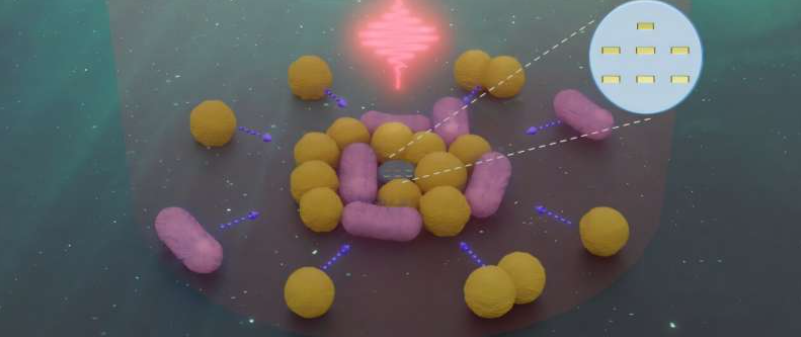
Looking specifically at handling biological objects in aqueous environments, such as single cells or bacteria, the team demonstrated how these so-called nanorobots can function as microscopic cleaners capable of controlled manipulation, including collection and relocation of bacteria.
 Source: Jin Qin/Uni Würzburg
To power and steer such extremely small machines, the researchers used the recoil of individual photons to move micrometer-sized devices — otherwise called microdrones.
According to their developers, these microdrones use plasmonic nanoantennas to absorb and redirect specific light, producing recoil forces that propel them. Because of their tiny mass, this light-driven recoil creates significant acceleration and high speeds. In the lab, the team has managed to further miniaturize these light-driven robots to sizes below 1 µm.
The team simplified steering by using light polarization to control the nanorobot’s orientation, while photon recoil continued to power movement. This enabled agile, light-powered robots that are capable of making sharp turns, scanning areas efficiently and selectively capturing, transporting and releasing bacteria — functioning much like microscopic cleaning devices.
As such, the robots can effectively "clean" microscopic environments under controlled lab conditions by gathering bacteria and depositing them at defined locations.
"This is a striking example of how light can be used not only to observe the microscopic world, but also to actively shape it," the team noted. "The idea of tiny robotic cleaners may sound futuristic, but we are already demonstrating the physical principles that make it possible."
The team suggests that some potential future applications for the micro-drones include microbiology, biomedical research and targeted manipulation at the microscale.
An article detailing the work, “A nanoscale robotic cleaner,” appears in the journal Nature Communications.
