
Technology and medicine go hand in hand. There are new medical devices being developed every day. The latest medical device is worn by patients like a visor. This visor detects large-vessel occlusion in patients who are suspected to have a stroke. The device is 92 percent accurate according to clinical researchers from the Medical University of South Carolina (MUSC), Mount Sinai, the University of Tennessee Health Sciences Center.
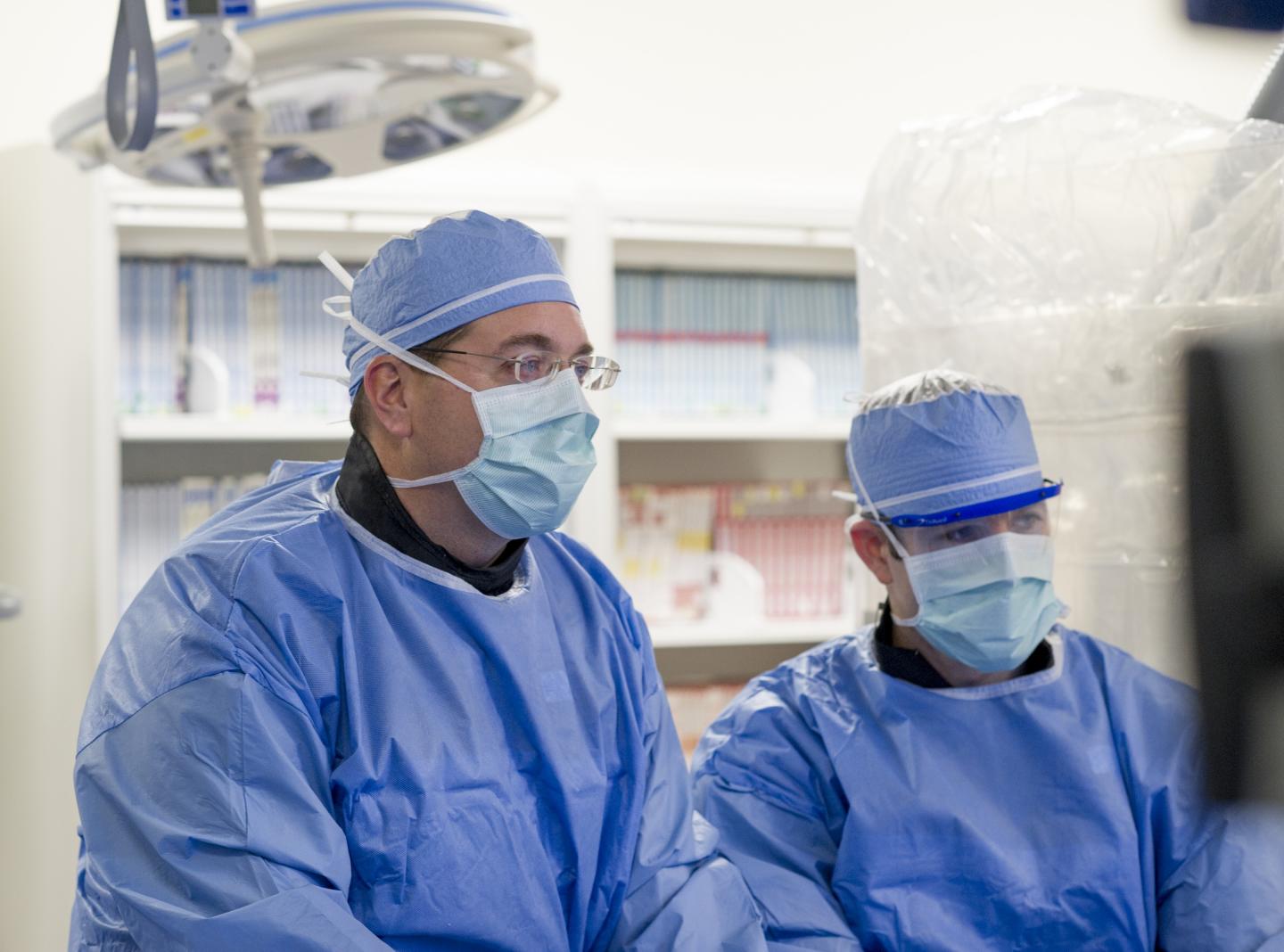 MUSC Health neurosurgeon Dr. Raymond D. Turner (left) is the principal investigator for the Medical University of South Carolina in the VITAL study. Source: Medical University of South Carolina
Patients who have large-vessel occlusions can use this visor to detect when they need to be sent to a comprehensive stroke center for endovascular therapy. This device’s accuracy beats the accuracy of a physical exam, which is only 40-89 percent accurate.
The volumetric impedance phase shift spectroscopy (VIPS) device, named the Cerebrotech Visor TM. It sends low-energy radio waves through the wearer’s brain that can change frequency when passing through liquids. This wave is reflected through the brain and detected by the device. If a patient is having a severe stroke, the fluids in the brain will change and produce asymmetry in the radio waves that VIPS is detecting.
It is standard for a stroke patient to received endovascular therapy within 24 hours of a large stroke. But the chance of a success decreases by 20 percent for every hour a patient goes without treatment.
The researchers believe that this device could be the key to higher survival rates from extreme stroke cases when deployed with emergency medical personnel. The accuracy of the device simplifies the decisions that emergency personnel have to make when assessing a patient.
"Transfer between hospitals takes a lot of time," said Raymond D. Turner, M.D. professor of neurosurgery and chief of the Neuroscience Integrated Center of Clinical Excellence at MUSC. "If we can give the information to emergency personnel out in the field that this is a large-vessel occlusion that should change their thought process in triage as to which hospital they go to."
The VIPS was deployed with emergency medical personnel in regions near one of the five comprehensive stroke centers that have endovascular capabilities. The goal was to use the device to identify severe strokes and compare the results to other physical examination methods currently used by emergency personnel.
Emergency personnel evaluated participants who were healthy and patients who had suspected strokes using the VIPS device. Within 30 seconds, the machine took three readings and averaged them.
The device has a 92 percent accuracy rate compared to neurologists’ diagnoses. The VIPS device is more accurate than the standard procedures used.
Cerebrotech Medical Systems created the VIPS device. The company paid consultants to analyze neuroimaging data independently. The data was used to teach the VIPS device to detect which radio waves indicate a stroke. Currently, it is not clear if the device would work for patients with cranial implants because the metal could interfere with the device’s operating radio waves.
The device requires very little training for emergency personnel in order to be used in the field. This could reduce the possibility of human error during the emergency diagnosis project.
The next step for researchers is to study whether the VIPS device can use complex machine learning algorithms so the system can teach itself to discriminate between a minor and a major stroke. If this is successful, a VIPS device could change the way emergency personnel operates.
"This could potentially be something like a defibrillator," said Turner. "You can find out if a patient is having a stroke, just like you can put a defibrillator on a patient to see if they're having a heart attack."
The paper on the VIPS device was published in the Journal of Neurointerventional Surgery.
