The L Prize in the 60W replacement lamp category was awarded to Philips in August 2011. By then, samples had already survived more than 8,000 hours of accelerated long-term testing. 31 of the lamps passed the 40,000-hour point of continuous operation in July 2015 with an average lumen maintenance after 40,890 hours of 95.6%, with no failures.
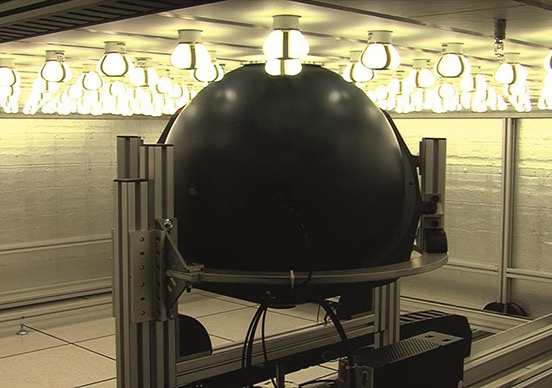 The L Prize-winning lamp from Philips Lighting North America continues to show very stable light output, even after 40,000 hours of continuous testing.Using the same rate, it will take an average of 194,765 hours of operation for the lamps to reach 70% lumen maintenance. The average chromaticity changes after 40,890 hours of operation was 0.00093—a minor difference indicating that there was no detectable color shift, and that the light emitted today is indistinguishable from the light emitted four years ago.
The lumen maintenance test apparatus (LMTA), in which lamps are operated continuously in a 45°C environment, measures the relative lumen and chromaticity maintenance of up to 200 screw-based lamps. Two hundred samples of a 60W LED replacement product submitted by Philips Lighting were initially measured over a time period of 7,000 hours to determine whether the lamps met the minimum requirements of the L Prize competition. Measurements continue for the purpose of long-term data collection. Spectroradiometric measurements performed by a mobile integrating sphere took place every 100 hours for the first 5,000 hours of operation and weekly (every 168 hours) thereafter.
These results indicate that well-designed LED integral lamps can operate reliably over long periods of time, with excellent lumen and chromaticity maintenance.
Related Links:
Visit http://www.lightingprize.org/pdfs/lprize_60W-lumen-maint-testing_2015.pdf for an updated report on lumen maintenance testing.
