
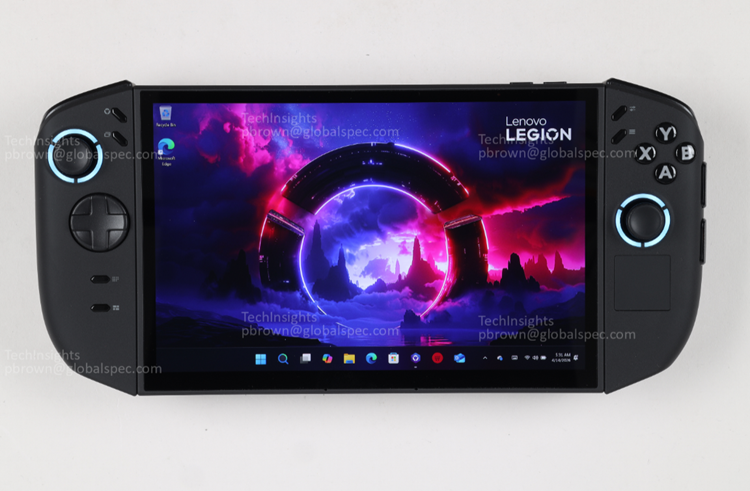
Editor’s note: Information from this teardown is supplied courtesy of TechInsights. Click here to request full access. To view a complimentary report of Summary — Lenovo Legion Go 2, Click here.
Handheld games have always been a consumer darling as far back as the 1970s when the first handheld war erupted between Mattel and Coleco over the best portable American football game.
As technology improved, the industry got the GameBoy, Sega GameGear, PlayStation Portable and the Nintendo DS. With graphics now able to replicate those inside many PCs, handheld games are now as sophisticated as some of the larger console brothers and sisters.
Enter Lenovo’s Legion Go 2, an effort to capture some of the market share that has been gobbled up by Nintendo’s Switch. The Legion Go 2 features an application processor from AMD and main DRAM from Samsung.
Lenovo is about to release its Legion Go 2 Generation 2 portable gaming console so it will be interesting to see what the company improves on performance from one generation to the next.
The following is a partial deep dive into the Legion Go 2 conducted by TechInsights.
Summary
8.8-inch OLED w/touchscreen
32 GB LPDDR5X SDRAM
Target market: Consumer
Price: $1,999
Availability: Worldwide
Released: October 2025
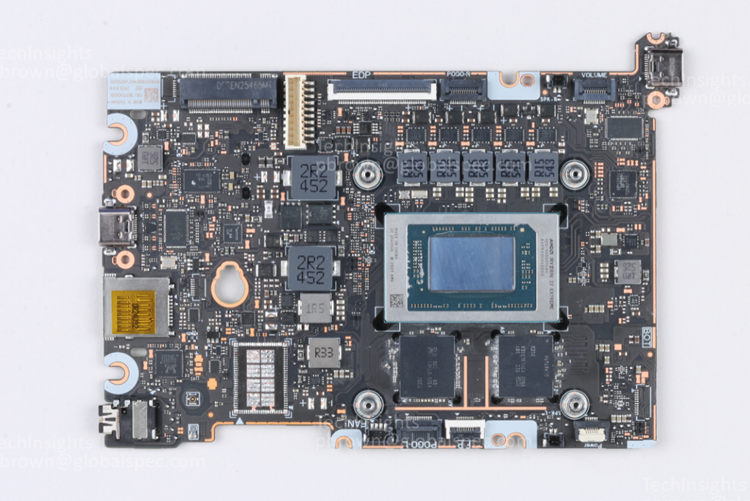 The electronic components found on the main board of the Lenovo Legion Go 2. Source: TechInsights
Main board
The main board of the Lenovo Legion Go 2 includes the main application processor from AMD as well as the 16 GB mobile LPDDR5X SDRAM from Samsung. Other electronic components include:
- Texas Instruments’ two-input positive AND gate, power distribution switch, USB Type-C PD controller
- Realtek’s audio CODEC, dual synchronous step-down controller w/LDO
- Global Mixed-mode Technology’s load switch
- Parade Technologies’ USB4/DisplayPort 2.1 and Thunderbolt 4.0 IC
- Will Semiconductor’s power distribution switch
- Monolithic Power Systems’ synchronous buck converter
- Lenovo’s embedded controller with memory
- Zilltek’s MEMS microphone
- Silicon Mitus’ AMOLED display power supply
- ANPEC Electronics’ 3-amp LDO regulator
- Genesys Logic’s card reader controller
- Onsemi’s four-line ESD protection diode array
(Learn more about logic ICs on GlobalSpec.com)
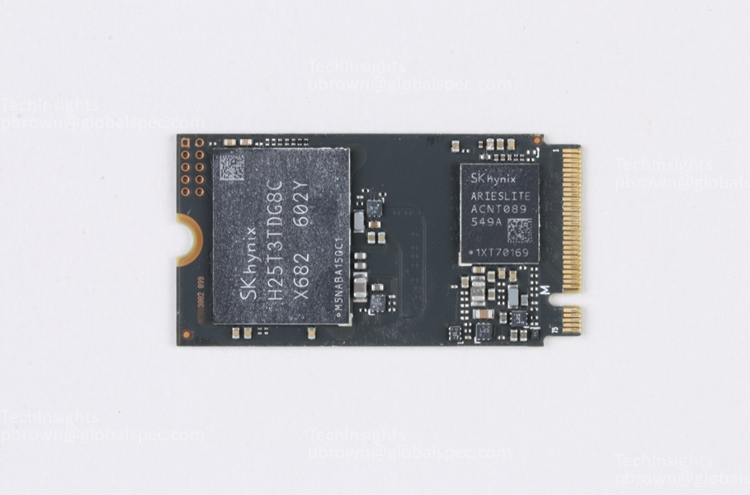 The electronic components found on the SSD board of the Lenovo Legion Go 2. Source: TechInsights
SSD board
On the SSD board inside the Lenovo Legion Go 2 includes a 1TB 3D TLC NAND flash chip from SK Hynix and a PCI Gen 4.0 x 4 SSD controller also from SK Hynix.
(Learn more about flash memory on GlobalSpec.com)
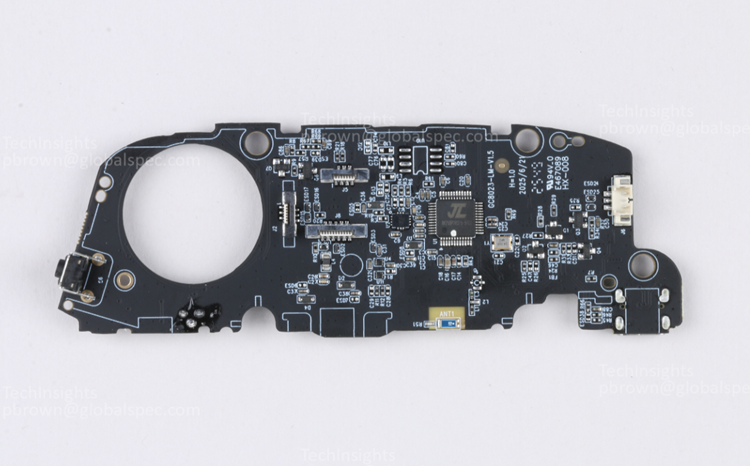
Left controller board
The left controller board (and the right controller board) on the Lenovo Legion Go 2 includes the following electronic components:
- STMicroelectronics’ six-axis MEMS accelerometer and gyroscope
- ZhuHai Jieti Technology’s Bluetooth 5.4/Audio w/memory
- PriSemi’s overvoltage protection IC
- Nanjing Qinheng Microelectronics’ battery charger
- Nexperia’s level translating buffer/line driver
- Fremont Micro Devices’ serial EEPROM memory
(Learn more about MEMS devices on GlobalSpec.com)
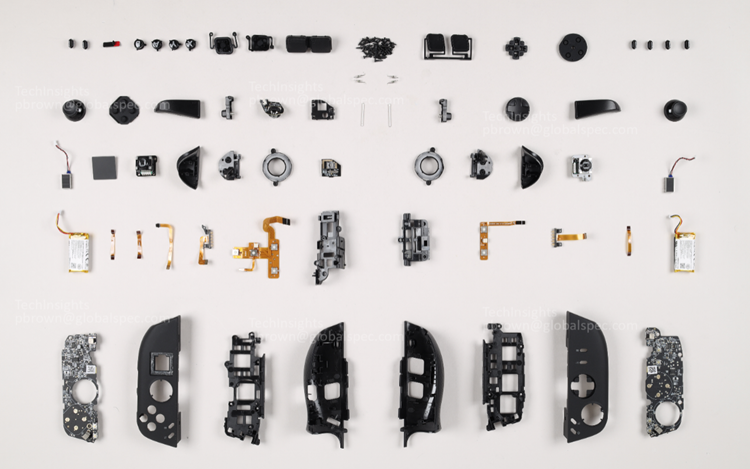 Some of the electronic components found on the Lenovo Legion Go 2. Source: TechInsights
Major components
- $424.24 — 5.0 GHz octa-core application processor — AMD (Qty: 1)
- $140.46 — Multichip memory — 16 GB Mobile LPDDR5X SDRAM — Samsung (Qty: 2)
- $135.27 — M.2 SSD subsystem — SK Hynix (Qty: 1)
- $45.37 — 144 Hz display/touchscreen subsystem — Samsung (Qty: 1)
- $15.73 — Main battery subsystem — Navitasys Technology (Qty: 1)
- $10.30 — 10 Layer buildup FR4/HF — HANNSTAR BOARD CORP (Qty: 1)
- $8.30 — Wi-Fi/BT subsystem — MediaTek (Qty: 1)
- $6.10 — Heatsink (Qty: 1)
- $5.09 — Fingerprint sensor subsystem (Qty: 1)
- $3.30 —Fan: Large (Qty: 1)
