
A delicate 3D-printed robotic gripper capable of cradling a raw egg without cracking the shell as well as gripping a full 1 kg water bottle has been developed by a team from the Korea Advanced Institute of Science and Technology (KAIST) KAIST's Extreme Materials Research Center and Seoul National University of Science and Technology
To develop a material capable of such tasks, the KAIST team used artificial intelligence (AI) to create a recipe for making 3D-printed products as stretchable as rubber without clogging printers. The result was a 3D-printable material that can stretch sixfold its original length without tearing.
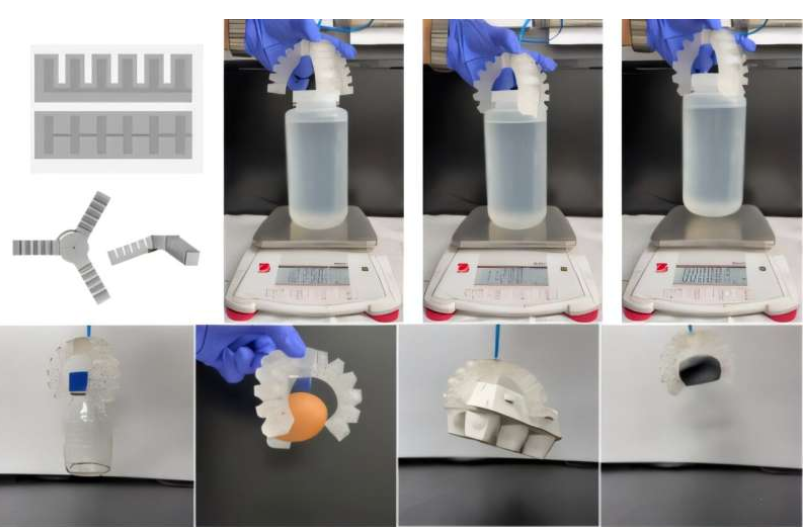 Source: The Korea Advanced Institute of Science and Technology (KAIST)
To create the robotic gripper, the team used Digital Light Processing (DLP), which is a type of 3D printing that cures a liquid material into a complex shape by exposing it to light.
Previously, DLP printing has struggled to produce stretchable, durable objects because the polymers needed for elasticity make resins too thick to print smoothly. Although diluting the resin improves printability, it weakens the polymer network, resulting in brittle, tear-prone materials.
As such, the researchers used machine learning trained on a dataset of chemical formulations to identify an ideal 3D-printing material.
AI optimized the resin’s chemistry to balance smooth printing with durability, and created a material that could significantly stretch without tearing. The team used it to print pneumatic actuators that curl like human fingers. They then built a soft robotic hand capable of gently adapting its grip to objects ranging from computer mice and glass bottles to fragile eggs.
The team suggested that the AI framework expedited material development by rapidly identifying optimal formulations, enabling faster creation of custom medical implants, durable wearable sensors and safer soft robotic tools.
An article detailing the work, “Machine learning guided formulation design of digital light processing printable elastomers beyond viscosity stretchability tradeoff,” which appears in the journal Nature Communications.


