
Researchers at Delft University of Technology in the Netherlands have developed a soft robotic arm powered by microalgae that bends in response to light, enabling it to grasp and lift small objects.
According to lead researcher Marie-Eve Aubin-Tam, the proof-of-concept actuator is a soft, green strip composed of two hydrogel layers, with microalgae growing on its surface. Measuring just 2 cm long and 1 mm thick, the strip responds to changes in light by producing large, reversible bending movements.
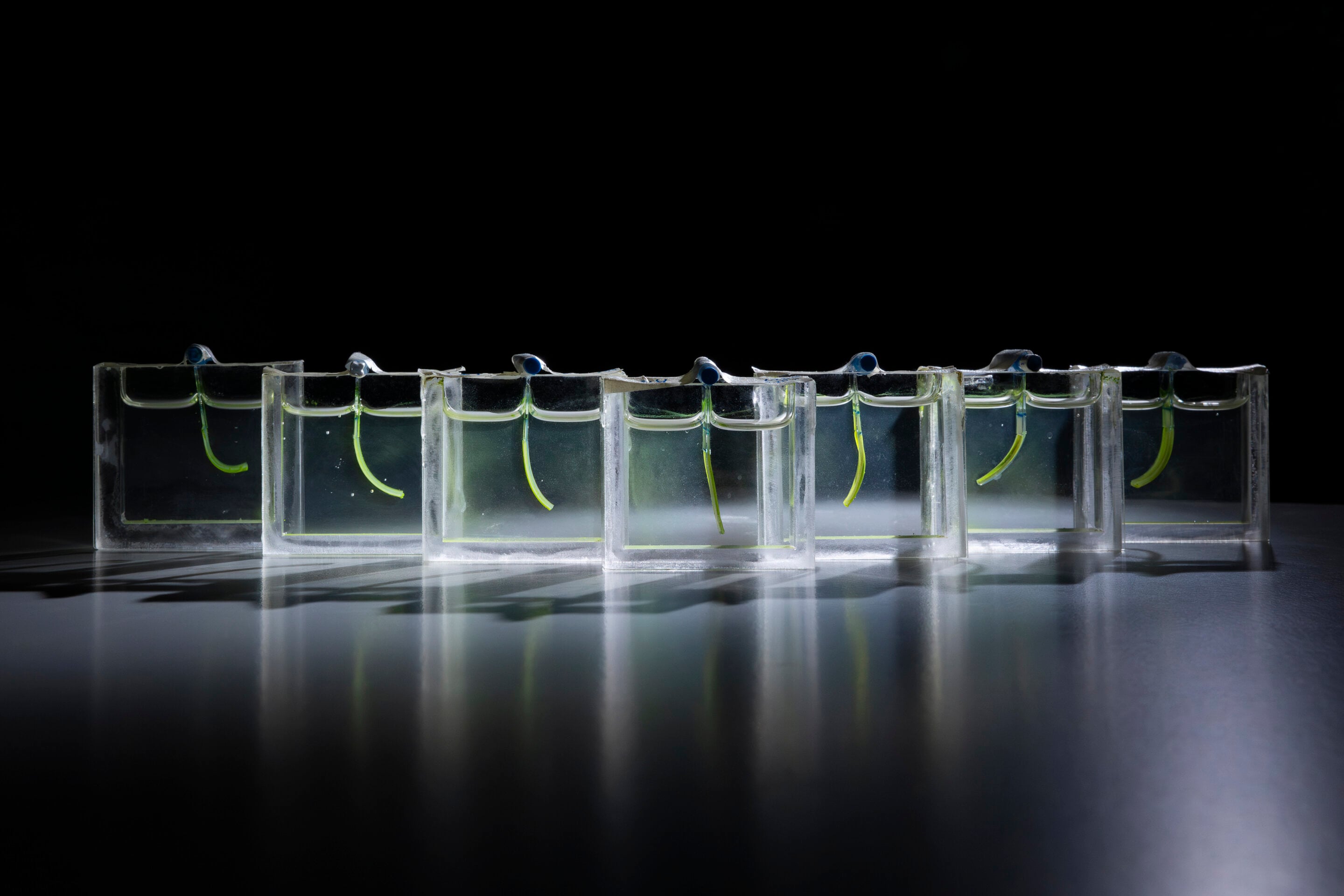 Source: Delft University of Technology/Studio Oostrum
The team tested the actuator’s grasping ability by having it hook and lift a rubber ring and grip a small metal ball. By changing the actuator’s shape, researchers can also tailor its movements for different tasks. Its soft, gentle grip could be especially useful for handling objects underwater, according to the researchers.
According to the research team, the actuator’s movement is driven by photosynthesis. When exposed to light, the microalgae use light energy and carbon dioxide (CO₂) to produce sugars while also taking up nitrogen. Together, these processes raise the hydrogel’s pH. This change creates a difference in swelling between the hydrogel layers, causing the strip to bend.
When the light is switched off, the algae consume the sugars and release CO₂, lowering the pH so that the strip begins bending back in the opposite direction within 10 seconds. Because microalgae are largely self-sustaining and use light as their energy source, the technology could eventually enable soft robots that are more autonomous and responsive to environmental changes, said Aubin-Tam.
Beyond robotics, the researchers suggested the light-responsive actuator could inspire other shape-changing devices, including agricultural systems and adaptive blinds that adjust their form in response to changing light conditions.
The algae robotic arm is detailed in the article “Light-powered photosynthetic living actuator,” which appears in the journal Nature Communications.
