
A soft robotic gripper capable of inspecting fruit for ripeness and harvesting it without incurring damage, thus reducing food waste and improving harvesting efficiency, has been developed by a team from West Virginia University (WVU).
According to its developers, the gripper is made up of soft silicone and polyurethane fingers featuring multiple sensors that measure a fruit’s size, shape, color and firmness to determine if it is ready to be picked. The team tested the robotic gripper on strawberries and it proved capable of removing the fruit by twisting the stem instead of cutting it.
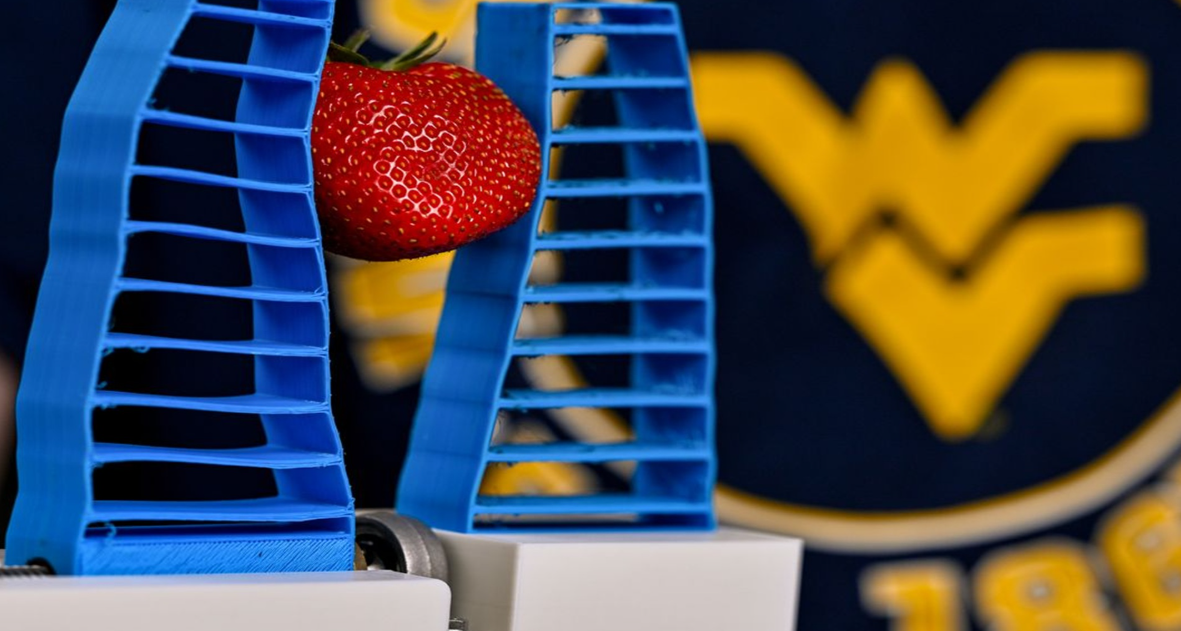 Source: Jennifer Shephard/WVU
“Our gripper’s quick, accurate inspections and harvesting can reduce spoilage of fruits and lower supply chain costs,” the team said. “Fruit inspections are critical for harvesting decisions that have traditionally been made by human workers. However, using human workers for harvesting involves challenges such as labor shortages, health concerns and inaccuracies in picking.”
To enable the gripping and handling of delicate fruit without incurring damage, the new gripper design combines tactile and visual sensing in a soft robotic structure. Meanwhile, stretchable optical fibers are embedded within each finger and function as tactile and curvature sensors, while a mini camera and distance sensor are located in the palm of the robotic gripper.
As such, the five-fingered gripper is capable of identifying a fruit’s shape, stiffness and ripeness while also being able to detect slippage during handling. The team explained that the gripper can open and close in less than two seconds, lift payloads that weigh up to 1 kg and achieve roughly 100% accuracy in shape prediction.
The team believes that the gripper could be appropriate for applications beyond fruit handling, including in space exploration, health care, food handling and underwater manipulation.
An article detailing the gripper, “Sensor fusion of touch & vision in soft manipulators for fruit picking” appears in the journal Nature Communications.
