
A team of researchers from MIT has developed a swarm of small square robotic boats capable of assembling themselves into structures that can subsequently break apart and re-assemble into larger structures on the water.
This new system, dubbed "FloatForm," features a swarm of small square robotic boats, each of which is roughly 8.3 inches square. According to their developers, these boats are self-contained vessels featuring their own thrusters, sensors and magnetic latches. When working together, the boats can serve as a temporary platform following an emergency, a market on a canal or a stage that appears for a festival and dissolves at the festival’s conclusion.
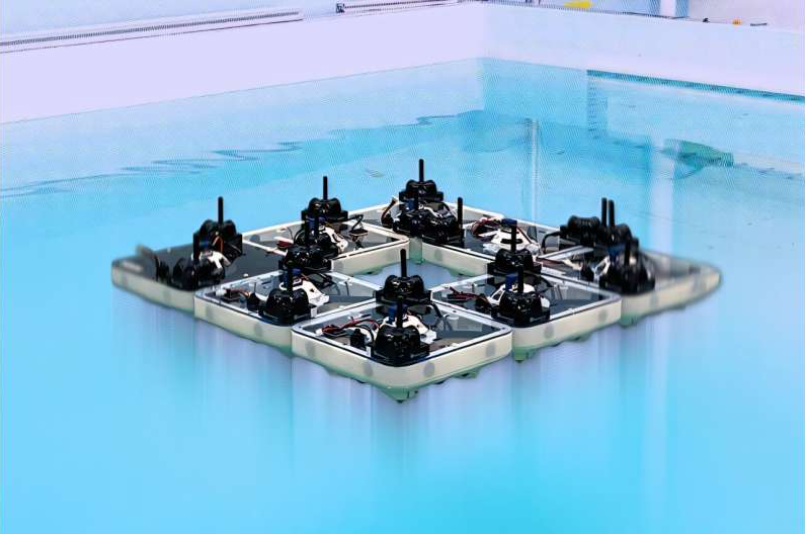 Source: Alex Shipps/MIT CSAIL
"Our FloatForm project envisions a future where the waterfront becomes a programmable extension of the city, where autonomous boats can self-organize into bridges, platforms, and other useful structures on demand. This kind of distributed robotics opens new possibilities for mobility, emergency response, public space, and infrastructure on water,” the team explained. "With FloatForm, we are essentially turning static water surfaces into dynamic, programmable spaces. Imagine an urban environment where public space isn't fixed, but can autonomously expand, contract, or reconfigure on demand."
Taking inspiration from fire ants, which tend to survive floods by linking their bodies to form so-called living rafts wherein each ant is an independent agent with its own capabilities, FloatForm features a lightweight central planner that only steps in sparingly to assign each robot a final position to perfect the network. Like the ants, the individual boats independently navigate toward the target shape, avoid collisions and adapt to disturbances. The robots coordinate by exchanging positions with their closest neighbors while the whole swarm moves together all at once.
During trials, a fleet of eight robots repeatedly gathered from random positions to create a target shape, latch into a rigid structure, break apart on command, re-assemble into a new configuration and then drove across the pool as one unified vessel, with each run taking four to eight minutes.
In collective transport mode, the robots autonomously coordinated to move as a single structure using energy-efficient magnetic latches. An origami-inspired mechanism allows the robots to connect and disconnect across short distances while consuming power only during latching and unlatching, conserving battery life for movement and onboard computation.
In the lab, the system accomplished its missions without human intervention 90% of the time using four robots and 70% of the time using eight robots.
The developers envision the system being used for temporary offshore platforms, adaptive environmental monitoring networks, reconfigurable emergency-response docking stations and other remote operations such as scientific expeditions and infrastructure maintenance.
An article detailing the technology, “Self-reconfiguring modular robotic boats,” appears in the journal Nature Communications.
