
Taking inspiration from nature, a team of scientists from Princeton University and Northwestern University is building a swarm of interconnected mini-robots that could one day lead to buildings with dynamic facades that respond to sunlight and the people inside.
While buildings are essentially unmoving static boxes, some structures in nature — such as ants that link their bodies to create a bridge that changes shape with the surrounding terrain, for instance — are constantly changing.
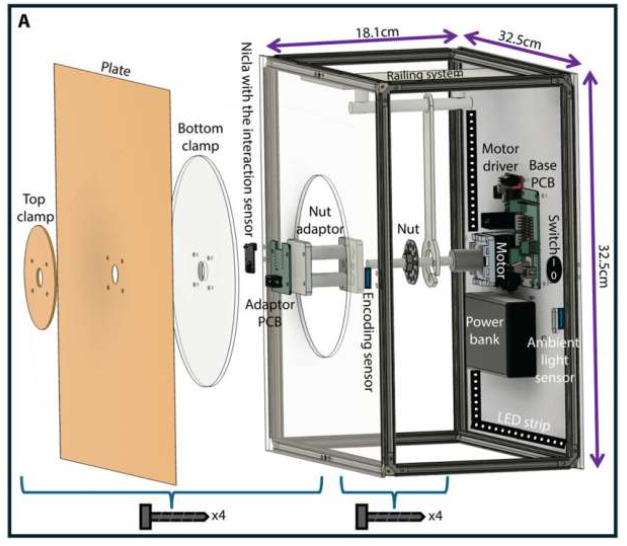 The SGbot design. (A) The components and dimensions of the SGbot robot. Credit: Science Robotics (2026). DOI: 10.1126/scirobotics.ady7233
As such, the team used swarm intelligence, which is otherwise known as the collective behavior of self-organized systems like schools of fish moving as one, to form a "living" skin for buildings.
To accomplish this, the team constructed a system of individual units dubbed SGbots, which are tiny modular robots featuring sensors and a wireless radio for communicating with their neighbors. In lieu of gears and hinges, each robot features a soft actuator that pulls a flexible plastic sheet through a ring that causes it to "bloom," much like a flower in response to environmental stimuli.
To demonstrate how the SGbots might work in a real building, the researchers attached 16 of the bots to a sunny office window for several days. The team discovered that when the sun was strong, the SGbots extended their sheets together — or "bloomed" — to block sunlight. When the sun weakened, the SGbots reportedly retracted their sheets to let more light in.
When the team simulated sensor failures and communication breakdowns, the so-called “Swarm Garden” system was able to adapt with the robots talking to each other so that an SGbot with a broken sensor could still follow the lead of its fellow SGbots.
In another trial, the team set up an array of 36 robots in a public gallery to demonstrate how they would respond to human movement with a dancer wearing a device that enabled the swarm to mimic the dancer’s movements.
"The system created a 'partnership defined by negotiation,' making the swarm feel 'alive' and inspiring new forms of creative expression," the researchers explained.
An article detailing the work, “Architectural swarms for responsive façades and creative expression,” appears in the journal Science Robotics.
