
Zinc-based batteries offer a lower-cost, fire-proof alternative to widely used lithium-ion batteries. However, this energy storage technology suffers from a shorter operational lifespan due to the formation of dendrites — major culprits in the short-circuiting of batteries. Fortunately, a dendrite-defying solution has been developed by researchers from Concordia University (Canada), McMaster University (Canada) and A-PRO Materials Co., Ltd (South Korea).
A path of gold is followed to extend the service life of zinc batteries — specifically, application of gold nanoparticles on a battery's inner surface. This treatment was demonstrated to reduce dendrite growth by up to 50 times compared to regular zinc batteries, and to support battery operation for more than 6,000 hours in the laboratory. As described in the Journal of Materials Chemistry A, the nanoparticles function as uniformly distributed nucleation sites that homogenize local charge fields, enhance ion transport and suppress dendrite formation while preserving the active zinc surface.
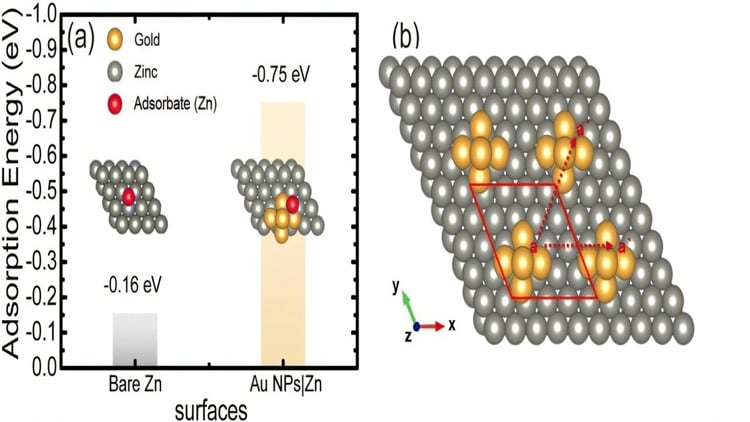 (a) The adsorption energy of zinc adsorbate on the surface of bare zinc and gold nanoparticle-Zn. (b) Schematic of zinc atom diffusion along the x-axis and diagonal pathway on the gold nanoparticle/zinc slab. Source: Journal of Materials Chemistry A (2026). DOI: 10.1039/d5ta08137h
While it may be initially assumed that use of this precious metal would bump up battery cost, the gold particles are only distributed on less than 10% of the battery surface.
"Because of the way that we make it, which doesn't require any special lab conditions and only small amounts of gold, it just becomes dead cheap to put gold particles on the surface, it's 1/100th of the price of regular gold coatings," explained the researchers.
The utility of this particle-coating technology for enhancing copper electrode performance for next-generation anode-free batteries is now under investigation.
