
The increasing energy demands of data centers, driven by the rapid adoption of artificial intelligence (AI), are placing new pressures on power infrastructure. FIAMM Energy Technology introduces the Pure Guard battery range, leveraging Thin Plate Pure Lead (TPPL) technology to meet these evolving requirements with high performance and reliability.
Data centers are becoming power-hungry
AI workloads — such as training and inference for large language models and generative AI — require massive amounts of energy. A single modern AI-focused data center can consume between 100 and 300 MW, equivalent to the power needs of a small city. Global data center power consumption is expected to double between 2022 and 2030, underscoring the urgency for scalable and efficient power solutions.
Batteries: A critical component of UPS systems
As power requirements grow, so does the space needed for infrastructure capable of delivering high-quality, uninterrupted power. Batteries are a fundamental part of any uninterruptible power supply (UPS) system, providing energy storage proportional to the power and backup time required. Backup duration cannot be reduced below a few minutes without compromising system integrity, which in turn increases the space occupied by batteries.
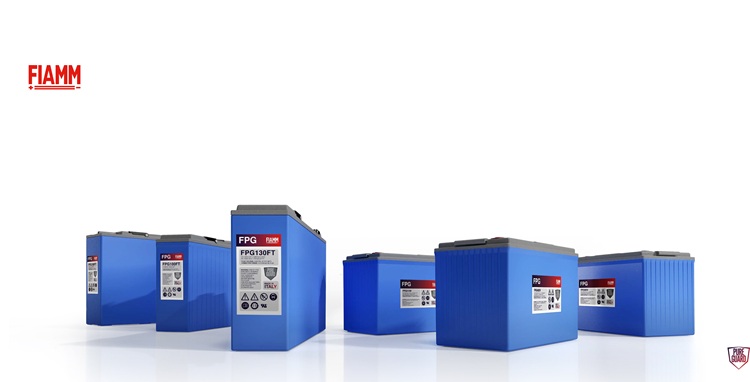 Source: FIAMM
To address this, FIAMM developed the Pure Guard range to optimize performance for short backup durations, enabling a volume reduction of 20% or more. Built on proven TPPL technology with decades of field experience, these batteries are highly tolerant to high-current discharges and short-duration peak loads, making them ideal for bridging grid outages until generators come online.
Fast recharge and long cycle life
Pure Guard batteries recharge significantly faster than traditional VRLA batteries — up to 90% capacity within 2 to 3 hours — which is crucial for facilities experiencing frequent short power interruptions. They also offer a long cycle life, especially under repeated micro-cycles involving partial discharges followed by opportunity charging.
Extended service life and environmental Tolerance
The pure lead positive grids are more resistant to chemical corrosion than conventional VRLA designs, resulting in a longer float life — up to 15 years in standby mode when installed in temperature-controlled environments and properly maintained. Their stable float characteristics lead to lower trickle currents, reducing power dissipation and cooling requirements.
Low trickle current also minimizes water decomposition into hydrogen and oxygen, which can otherwise lead to battery dry-out or internal chemical reactions. Additionally, the low self-discharge rate allows for up to 24 months of shelf life, offering greater flexibility in site planning and implementation. Pure lead technology also performs better than lithium-ion in cold environments, accepting charge currents even below 0° C.
Safe and sustainable battery design
Pure Guard batteries are built with flame-retardant ABS plastics and can be safely installed within data center premises — either in the UPS room or in adjacent dedicated rooms — without special restrictions. Their proximity to critical loads enhances system reliability and reduces risks and costs associated with long distribution cables.
Unlike lithium-ion batteries, Pure Guard does not require additional fire suppression, containment or segregation systems, which are often necessary to mitigate fire propagation risks. The batteries also contain a high percentage of recycled lead, and spent units retain residual value, as they can be efficiently recycled into new batteries or other products.
Intelligent monitoring capabilities
To ensure optimal performance and safety, the installation of a battery monitoring system (BMS) is strongly recommended. These systems monitor the health of Pure Guard batteries and raise alarms in case of anomalies — without interfering with battery operation or availability. BMS data collection and analysis are essential for predicting battery life and preventing failures.
FIAMM Energy Technology has developed dedicated algorithms for processing large volumes of BMS data, providing end users with clear, actionable reports to support maintenance and operational decisions.
